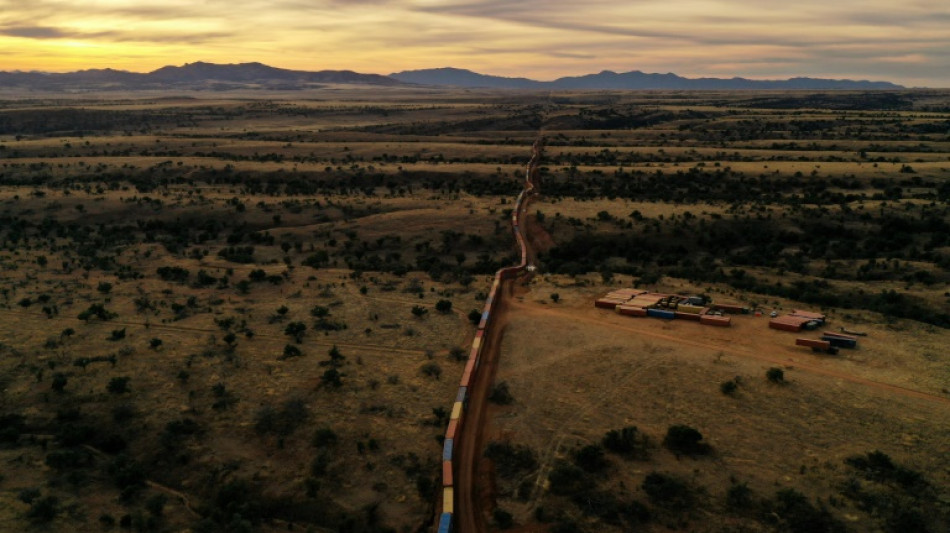
Arizona to remove shipping container wall on US-Mexico border / Photo: © AFP

 How young is too young as child prodigies win big at Asian Games

 UK Labour party meets buoyed by Burnham but eager for concrete plans

 Thousands protest ahead of Mexican president's report on missing students

 Bangkok floods force thousands into shelters

 AI startup urges optimism from Europe despite safety fears

 'Godlike, invincible': Japan hails 11-year-old Games history-maker

 Nepal's hydropower ambitions face climate reality check

 Power cuts, rubble: millions come home to find Sudan's capital unlivable

 Internationals keep Presidents Cup lead with late fightbacks

 Tuchel to 'keep pushing' England to reach Spain's level

 Alcaraz saves match points to keep Europe ahead in Laver Cup

 Spain success driven by hunger to improve, says De La Fuente

 Lyon collapse at Stade Francais to suffer first Top 14 loss
 Oyarzabal and Spain sink England again as Modric shines for Croatia

 Housing protesters camp in central Madrid after mass demonstration

 Louise Trotter expands her palette at Bottega Veneta

 Pope prays at Lourdes after huge Paris mass

 USA trims International lead after Presidents Cup four-balls

 Russia accuses Europe of blocking Ukraine talks, as strikes drag on

 'He said hello': Families pray with pope on Paris avenue

 Pope celebrates giant Paris mass, flies to Lourdes

 Thousands march in Madrid over eviction of 87-year-old woman

 England women back to winning ways with last-gasp defeat of New Zealand

 Trump rejects Iran proposal for deal to reopen Hormuz

 England's Cox says injured Buttler leaves 'big shoes to fill'

Arizona agreed Wednesday to dismantle a wall of shipping containers at the Mexican border that critics said was an expensive, ecologically damaging political stunt that did nothing to keep migrants out of the United States.
The state's Republican Governor Doug Ducey spent $90 million of taxpayers' money lining up rusting boxes in what he said was a bid to stem the flow of people crossing into the country.
The corrugated containers, which snake for four miles (seven kilometers) through federal lands like a huge stationary cargo train, divide an important conservation area that is home to vulnerable species, but which is so difficult to traverse that people traffickers routinely avoid it.
Now Ducey, who leaves office early next year, will have to get rid of the 915 containers from the Coronado National Forest.
In an agreement reached Wednesday with the federal government, Ducey's administration said it will "remove all previously installed shipping containers and associated equipment, materials, vehicles, and other objects from the United States' properties on National Forest System lands within the Coronado National Forest."
- Biodiversity -
From close up, the double-stacked container wall looks like the clumsy handiwork of a giant playing with building blocks.
Its presence is so jarring that, in addition to the federal court case, it was also the subject of two lawsuits by the Center for Biological Diversity, an environmental organization that has been active in the area for three decades.
"The biodiversity of this region is off the charts," Russ McSpadden, a member of the organization, told AFP.
"It's one of the most important conservation areas in the entire United States."
Arizona shares around 370 miles (600 kilometers) of border with Mexico, including environmental preservation areas, national parks, military zones, and indigenous reservations.
Until the 2017 arrival in the White House of Donald Trump -- who was propelled to power on his pledge to "Build That Wall" -- there was very little in the way of a physical barrier separating it from Mexico.
Now vast stretches of the border have a fence that towers up to nine meters high.
Before the containers arrived in the Coronado National Forest -- an area that can only be reached by dirt roads -- the border here was demarcated by a wire fence.
That meager barrier was more than equal to the task of keeping people at bay, says McSpadden, whose cameras have picked up jaguars, and who has worked with teams collecting data on ocelots.
"I've never captured migrant traffic on any of the remote cameras," he said.
"It's an incredibly wild valley. There's no real urban population anywhere nearby. It's a very difficult part of the border for migrants to cross."
And even if this were a heavily trafficked route, a casual observer can see that the shipping containers would not be very effective.
In several places that AFP visited, the boxes do not line up because of the uneven terrain, leaving gaps easily large enough for a person to walk through.
Others have holes rusted in them, and in some spots, it appears to have been impossible for workers to find a place stable enough to put a container.
A viral video shows a determined climber scaling the six-meter-high barrier in a matter of seconds, gaining easy purchase on the textured box walls.
But what the shipping containers do block is a waterway and the migration routes of the animals McSpadden studies.
"Jaguars know no borders," he says.
"Southern Arizona, northern Mexico, it's the same for them."
With males known to range hundreds of miles, it's easy for animals that came north to hunt to get trapped away from breeding populations south of the border.
"Jaguars want to move back and forth freely," he says.
"This is their range, and the border wall bisects the jaguars' home."
O.Krause--BTB


