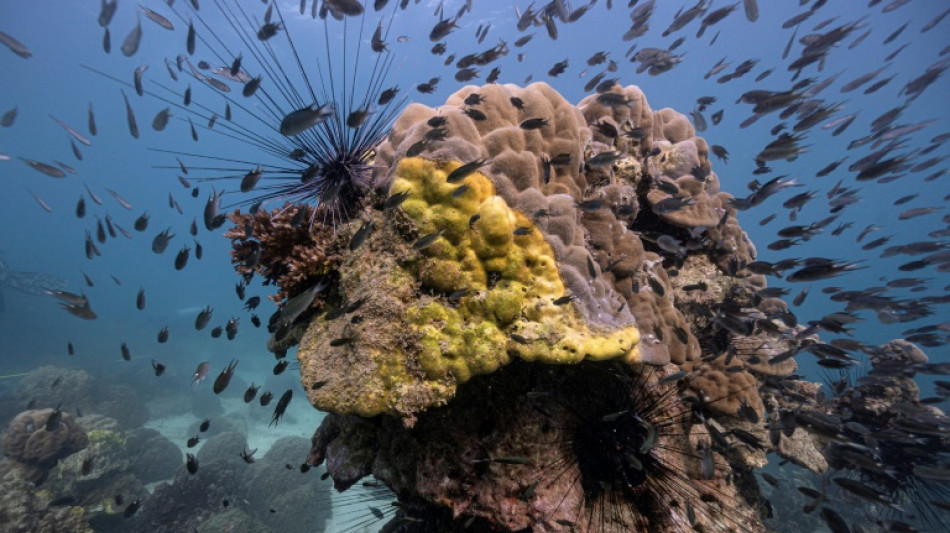
'It just dies': Yellow-band disease ravages Thailand's coral reefs / Photo: © AFP

 How young is too young as child prodigies win big at Asian Games

 UK Labour party meets buoyed by Burnham but eager for concrete plans

 Thousands protest ahead of Mexican president's report on missing students

 Bangkok floods force thousands into shelters

 AI startup urges optimism from Europe despite safety fears

 'Godlike, invincible': Japan hails 11-year-old Games history-maker

 Nepal's hydropower ambitions face climate reality check

 Power cuts, rubble: millions come home to find Sudan's capital unlivable

 Internationals keep Presidents Cup lead with late fightbacks

 Tuchel to 'keep pushing' England to reach Spain's level

 Alcaraz saves match points to keep Europe ahead in Laver Cup

 Spain success driven by hunger to improve, says De La Fuente

 Lyon collapse at Stade Francais to suffer first Top 14 loss
 Oyarzabal and Spain sink England again as Modric shines for Croatia
 Housing protesters camp in central Madrid after mass demonstration

 Louise Trotter expands her palette at Bottega Veneta

 Pope prays at Lourdes after huge Paris mass

 USA trims International lead after Presidents Cup four-balls

 Russia accuses Europe of blocking Ukraine talks, as strikes drag on

 'He said hello': Families pray with pope on Paris avenue

 Pope celebrates giant Paris mass, flies to Lourdes

 Thousands march in Madrid over eviction of 87-year-old woman

 England women back to winning ways with last-gasp defeat of New Zealand

 Trump rejects Iran proposal for deal to reopen Hormuz

 England's Cox says injured Buttler leaves 'big shoes to fill'
Underneath the calm turquoise waters off eastern Thailand, a rapidly spreading disease is killing corals over vast stretches of the sea floor, and scientists fear it may be getting worse because of climate change.
Yellow-band disease -- named for the colour it turns corals before destroying them -- was first spotted decades ago and has caused widespread damage to reefs in the Caribbean. There is no known cure.
But it was detected for the first time off Thailand's eastern coast just last year, near the popular tourist city of Pattaya, and has already spread over roughly 600 acres (240 hectares) of the sea.
"I haven't seen anything like this before," said marine scientist Lalita Putchim, of Thailand's Department of Marine and Coastal Resources.
"Everywhere we went we saw it, and we expect to see more of it as we go."
Scientists believe overfishing, pollution and rising water temperatures because of climate change may be making the reefs more vulnerable to yellow-band disease.
The disease's impact cannot be reversed, unlike the effects of coral bleaching.
"When the coral is infected with this disease, it just dies," Lalita said.
The loss of corals could have a devastating impact on the ecosystem -- the reef is "like a forest", sustaining massive amounts of life, and its death could eventually impact humans too, she added.
Thai scientists are hoping their investigation into this outbreak will help find a way to stop or cure yellow-band disease.
On one research trip near Samaesan island in Chonburi district, Lalita and her team donned diving gear on a boat before heading underwater.
They photographed infected corals, taking measurements and photographs while harvesting samples to study later.
Thai marine authorities are using social media to track reports of infected reefs, and have also asked the public to report any sightings of affected corals.
Thai researchers have also been aided by local volunteers, as well as business owner Thanapon Chaivanichakul, who collected underwater photographic evidence.
"I was shocked when I first saw it," Thanapon told AFP, using a series of expletives to describe the disease.
The disease is also a threat to the livelihoods of many in the area.
Choopan Sudjai, the owner of a sightseeing boat, relies on the income from tourists who come to see the area's natural beauty -- especially the coral reefs.
"Now that the coral has been infected and will be destroyed, what will we do in five years?" said the 55-year-old.
"It feels as if our own home has been destroyed."
A.Gasser--BTB


