
China's population shrinks for first time in over 60 years / Photo: © AFP

 Pope urges French bishops to 'persevere' against clerical sex abuse

 Decorated Indian badminton star calls Japan Asian Games 'very sad'

 Asian Games chiefs say lessons learned over accommodation

 UK's PM urges 'calm' as thousands seek to thwart flashpoint N.Ireland parade

 Thousands seek to thwart disputed N.Ireland flashpoint parade

 Swiss vote on what it means to be neutral

 Pope to meet with victims of clerical sex abuse during France trip

 Iran stands firm on Hormuz plan after US rejection

 Madrid protest camp grows after eviction outrage

 Italy winemakers hail bumper harvest but cut output

 Kyiv shoppers feel the pinch from Russian strikes

 Japanese anime actor fights TikTok over AI voice cloning
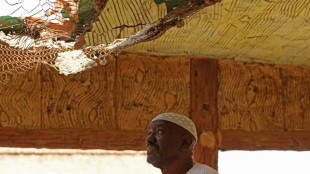
 Curtain falls on the romance of India's single-screen cinemas

 Smells like teen spirit as US thrash Peru 4-1

 Cavy chaos: Hundreds attend New Zealand's biggest guinea pig show

 Venezuela releases more political prisoners after opposition talks

 England's best 'for a long time' despite Spain defeat, says Kane

 Powerful storm pummels northeast US with rain, high winds

 Filmmaker Mike Leigh wins top prize at Spain festival with 'last film'

 Spain beat England in Nations League to extend unbeaten run

 Ireland squad vote to play Israel tie despite Gaza unease

 Gutsy Vollering wins cycling road race world title

 Vollering wins cycling road race world title

 Man City's meteoric rise clouded by dark shadow

 Mbappe out for two weeks or more with knee injury say Real

China's population shrank last year for the first time in more than six decades, official data showed Tuesday, as the world's most populous country faces a looming demographic crisis.
The nation of 1.4 billion has seen birth rates plunge to record lows as its workforce ages, in a rapid decline that analysts warn could stymie economic growth and pile pressure on strained public coffers.
The mainland Chinese population stood at around 1,411,750,000 at the end of 2022, Beijing's National Bureau of Statistics (NBS) reported, a decrease of 850,000 from the end of the previous year.
The number of births was 9.56 million, the NBS said, while the number of deaths stood at 10.41 million.
The last time China's population declined was in the early 1960s, as the country battled the worst famine in its modern history, a result of the disastrous Mao Zedong agricultural policy known as the Great Leap Forward.
China ended its strict one-child policy -- imposed in the 1980s owing to fears of overpopulation -- in 2016 and began allowing couples to have three children in 2021.
But that has failed to reverse the demographic decline for a country that has long relied on its vast workforce as a driver of economic growth.
"The population will likely trend down from here in coming years," Zhiwei Zhang of Pinpoint Asset Management said.
"China cannot rely on the demographic dividend as a structural driver for economic growth," he added.
"Economic growth will have to depend more on productivity growth, which is driven by government policies."
- 'I will not be a mother' -
News of the population decline quickly trended on China's heavily censored internet, with some expressing fears for the country's future.
"Without children, the state and the nation have no future," one comment on the Twitter-like Weibo service read.
"Having children is also a social responsibility," another comment from a well-known "patriotic" influencer read.
But others pointed to the soaring cost of living and the difficulties of raising children in modern China.
"I love my mother, I will not be a mother," said one.
"No one reflects on why we do not want to have (children) and do not want to get married," another said.
Many local authorities have already launched measures to encourage couples to have children.
The southern megacity of Shenzhen, for example, now offers a birth bonus and pays allowances until the child is three years old.
A couple who has their first baby automatically receives 3,000 yuan ($444), an amount that rises to 10,000 yuan for their third.
In the country's east, the city of Jinan has since January 1 paid a monthly stipend of 600 yuan for couples that have a second child.
Chinese people are "getting used to the small family because of the decades-long one-child policy", Xiujian Peng, a researcher at Australia's University of Victoria, told AFP.
"The Chinese government has to find effective policies to encourage birth, otherwise, fertility will slip even lower," she added.
- 'A real concern' -
And analysts argue much more needs to be done.
"A comprehensive policy package that covers childbirth, parenting, and education is needed to reduce the cost of childraising," researcher Peng told AFP.
"Women's job insecurity after giving birth should be addressed particularly."
Independent demographer He Yafu also pointed to "the decline in the number of women of childbearing age, which fell by five million per year between 2016 and 2021" -- a consequence of the ageing of the population.
The Chinese population could decline each year by 1.1 percent on average, according to a study by the Shanghai Academy of Social Sciences updated last year and shared with AFP.
China could have only 587 million inhabitants in 2100, less than half of today, according to the most pessimistic projections of that team of demographers.
And India is set to dethrone China this year as the most populous country in the world, according to the United Nations.
"A declining and ageing population will be a real concern for China," Peng said.
"It will have a profound impact on China's economy from the present through to 2100."
L.Dubois--BTB


