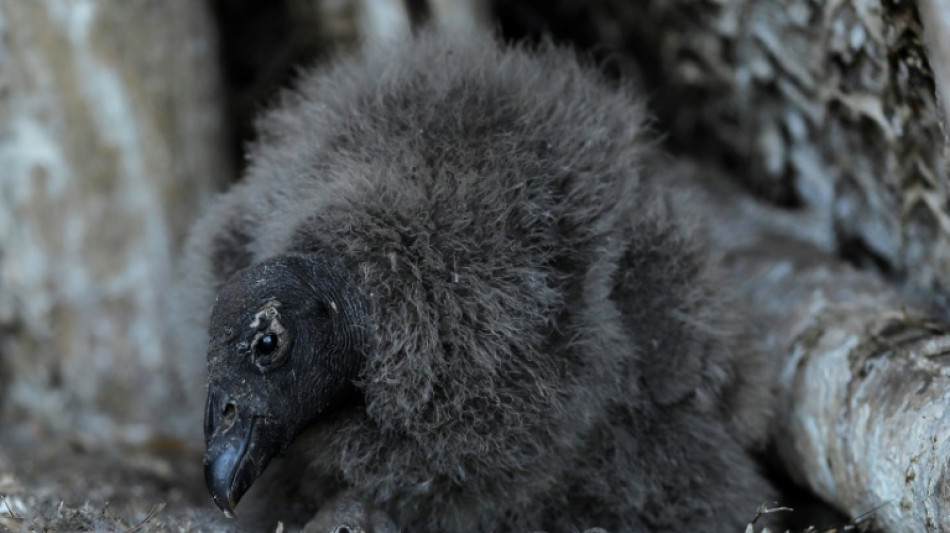
Chile preparing threatened condor chicks for release into wild / Photo: © AFP

 Pope urges French bishops to 'persevere' against clerical sex abuse

 Decorated Indian badminton star calls Japan Asian Games 'very sad'

 Asian Games chiefs say lessons learned over accommodation

 UK's PM urges 'calm' as thousands seek to thwart flashpoint N.Ireland parade

 Thousands seek to thwart disputed N.Ireland flashpoint parade

 Swiss vote on what it means to be neutral

 Pope to meet with victims of clerical sex abuse during France trip

 Iran stands firm on Hormuz plan after US rejection

 Madrid protest camp grows after eviction outrage

 Italy winemakers hail bumper harvest but cut output

 Kyiv shoppers feel the pinch from Russian strikes

 Japanese anime actor fights TikTok over AI voice cloning
 Curtain falls on the romance of India's single-screen cinemas

 Smells like teen spirit as US thrash Peru 4-1

 Cavy chaos: Hundreds attend New Zealand's biggest guinea pig show

 Venezuela releases more political prisoners after opposition talks

 England's best 'for a long time' despite Spain defeat, says Kane

 Powerful storm pummels northeast US with rain, high winds

 Filmmaker Mike Leigh wins top prize at Spain festival with 'last film'

 Spain beat England in Nations League to extend unbeaten run

 Ireland squad vote to play Israel tie despite Gaza unease

 Gutsy Vollering wins cycling road race world title

 Vollering wins cycling road race world title

 Man City's meteoric rise clouded by dark shadow

 Mbappe out for two weeks or more with knee injury say Real

Alhue and Mailen were born in captivity but conservationists hope to free the chicks soon as part of a project to boost Chile's ailing population of Andean condors.
The Andean condor, a type of vulture, is the largest flying bird in the world but its population is considered "vulnerable" by the International Union for the Conservation of Nature's Red List of Endangered Species.
There are just an estimated 6,700 Andean condors living in the wild.
At Chile's Rehabilitation Center for Birds of Prey (CRAR), conservationists are trying to boost those numbers.
"The aim is to introduce condors to nature born from condors that cannot be freed, who are here for life," said Eduardo Pavez, the CRAR founder.
The CRAR center in Talagante, 40 kilometers from Santiago, looks after birds that cannot be released into the wild, either because they cannot fly or have become too accustomed to human contact.
The parents of both Alhue, a male, and female Mailen, have lived in the center for years and cannot be released.
- Venerated but threatened -
The condor has long been venerated by indigenous peoples in the Americas.
In Andean religious mythology, the condor was a symbol of power and ruled the upper world, acting as an intermediary with the world of spirits and the sun god, Inti.
It features on the coat of arms of several countries, such as Colombia, Ecuador, Bolivia and Chile.
It is virtually extinct in Venezuela in the north of the continent, while the largest concentrations are found in the south of Chile and Argentina.
The greatest threat to the condor is human occupation of the Andean mountain range, and a lack of food.
CRAR, founded in 1990, takes in all sorts of birds of prey including owls and falcons that are injured, have been in an accident or were kept in captivity.
Its aim is to rehabilitate them and release them back into the wild, but in many cases that is impossible.
Alhue's mother, for example, was injured by a power line and can no longer fly.
Mailen's mother, who was brought to the center at the age of about one, has become too accustomed to humans to be able to survive in the wild.
Over the years, CRAR has already freed 13 out of 25 condor chicks born in captivity, with another four due to be soon released.
- Teaching by pecks -
Within the next six to nine months, once they are fully grown, Alhue and Mailen will be separated from their parents.
The parents will then be able to begin reproducing again while their offspring will start socializing with and learning from other adult condors at the center.
They will be taken to a large cage where adults that cannot be released mix with juveniles preparing for the outside world.
There they can fly around and communicate with other members of their species.
"Here they establish a hierarchy where the adult males dominate. They have to learn that hierarchy, sometimes by force of pecks, so they find their place in condor society," said Pavez.
That is a vital apprenticeship for Mailen and Alhue ahead of their likely release in the southern hemisphere in spring of 2024 so that they are able to build relationships with other wild condors, get to know their territory and find food.
E.Schubert--BTB


