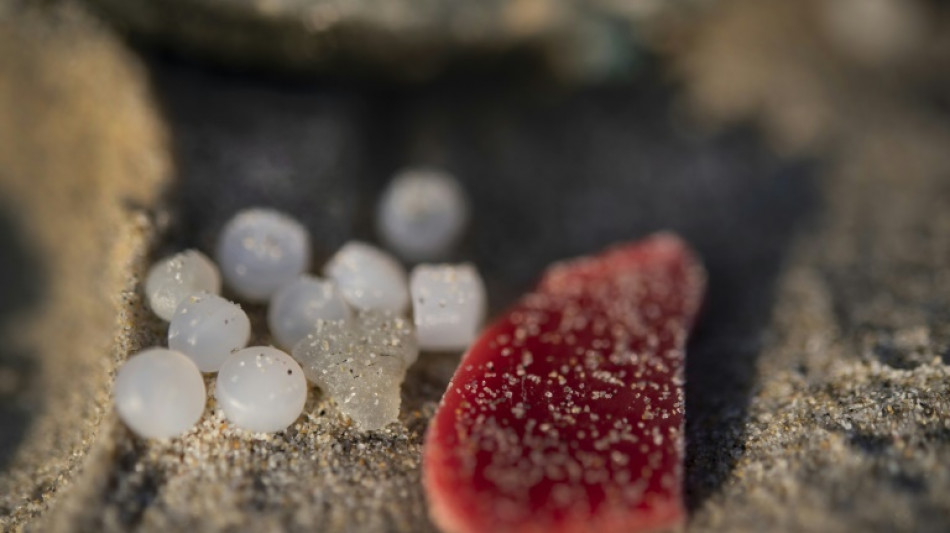
France to probe microplastic pellet pollution on Atlantic beaches / Photo: © AFP/File

 Alex Bodi and Prof. Dr Dieter Lazik sign a contract for ALPHA WHEY and BODI Energy Drink

 Swiss reject plan to toughen neutrality: projection

 UK police call in bomb disposal team near air force base

 Bangkok floods send thousands into shelters after days of rain

 Assefa just misses women's world record at Berlin Marathon

 Dramatic winners Zimbabwe to end five-year exile by tackling DR Congo

 Pope to meet victims of clerical sex abuse on France trip

 How young is too young as child prodigies win big at Asian Games

 UK Labour party meets buoyed by Burnham but eager for concrete plans

 Thousands protest ahead of Mexican president's report on missing students

 Bangkok floods force thousands into shelters

 AI startup urges optimism from Europe despite safety fears

 'Godlike, invincible': Japan hails 11-year-old Games history-maker

 Nepal's hydropower ambitions face climate reality check

 Power cuts, rubble: millions come home to find Sudan's capital unlivable

 Internationals keep Presidents Cup lead with late fightbacks

 Tuchel to 'keep pushing' England to reach Spain's level

 Alcaraz saves match points to keep Europe ahead in Laver Cup

 Spain success driven by hunger to improve, says De La Fuente

 Lyon collapse at Stade Francais to suffer first Top 14 loss
 Oyarzabal and Spain sink England again as Modric shines for Croatia

 Housing protesters camp in central Madrid after mass demonstration

 Louise Trotter expands her palette at Bottega Veneta

 Pope prays at Lourdes after huge Paris mass

 USA trims International lead after Presidents Cup four-balls

French prosecutors said on Friday they would investigate the appearance of vast quantities of tiny toxic plastic pellets along the Atlantic coast that endanger marine life and the human food chain.
The criminal probe will follow several legal complaints about the pellet invasion lodged by local authorities and the central government in Paris, Camille Miansoni, chief prosecutor in the western city of Brest, told AFP.
The microscopic pellets, called nurdles, are the building blocks for most of the world's plastic production, from car bumpers to salad bowls.
They are usually packed in bags of 25 kilogrammes (55 pounds) for transport, each containing around a million nurdles, which are sometimes called "Mermaids' Tears".
But they can easily spill into the ocean when a cargo ship sinks or loses a container. Environmentalists also suspect that factories sometimes dump them into the sea.
Fish and birds often mistake them for food and, once ingested, the tiny granules can make their way into the diet of humans.
Experts told AFP the nurdles found along the coast of Brittany may have come from a plastic industry container that fell into the sea.
"We can't rule out a single source for the industrial pellets," said Nicolas Tamic at the CEDRE pollution research body in Brest.
On Tuesday, the French government filed a legal complaint against persons unknown and called for a international search for any containers that may have been lost at sea.
Local authorities have followed suit, and the environmental crime branch of the Brest prosecutor's office will lead the investigation.
Last weekend, around 100 people took part in a clean-up campaign on a microplastic-infested beach in Pornic in Brittany to collect pellets and draw attention to the problem.
"We think they've come from a container that may have been out there for a while and opened up because of recent storms," said Lionel Cheylus, spokesman for the NGO Surfrider Foundation.
"Our action is symbolic. It's not like we're going to pick up an entire container load," said Annick, a pensioner, as she filled her yoghurt pot with nurdles.
French politicians have taken note. Joel Guerriau, a senator from the region, has called for a "clear international designation" of the pellets as being harmful.
Ecological Transition Minister Christophe Bechu labelled the nurdles "an environmental nightmare", telling AFP the government would support associations fighting pellet pollution.
Ingesting plastic is harmful for human health but nurdles, in addition, attract chemical contaminants found in the sea to their surface, making them even more toxic.
Measuring less than five millimetres (0.2 inches) in size, they are not always readily visible except when they wash up in unusually huge quantities, as has been the case since late November along the northwestern French coast.
burs/jh/sjw
M.Furrer--BTB


