
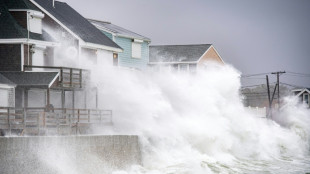
Business and consumers hamper climate fight: report / Photo: © AFP

 Alex Bodi and Prof. Dr Dieter Lazik sign a contract for ALPHA WHEY and BODI Energy Drink

 Swiss reject plan to toughen neutrality: projection

 UK police call in bomb disposal team near air force base

 Bangkok floods send thousands into shelters after days of rain

 Assefa just misses women's world record at Berlin Marathon

 Dramatic winners Zimbabwe to end five-year exile by tackling DR Congo

 Pope to meet victims of clerical sex abuse on France trip

 How young is too young as child prodigies win big at Asian Games

 UK Labour party meets buoyed by Burnham but eager for concrete plans

 Thousands protest ahead of Mexican president's report on missing students

 Bangkok floods force thousands into shelters

 AI startup urges optimism from Europe despite safety fears

 'Godlike, invincible': Japan hails 11-year-old Games history-maker

 Nepal's hydropower ambitions face climate reality check

 Power cuts, rubble: millions come home to find Sudan's capital unlivable

 Internationals keep Presidents Cup lead with late fightbacks

 Tuchel to 'keep pushing' England to reach Spain's level

 Alcaraz saves match points to keep Europe ahead in Laver Cup

 Spain success driven by hunger to improve, says De La Fuente

 Lyon collapse at Stade Francais to suffer first Top 14 loss
 Oyarzabal and Spain sink England again as Modric shines for Croatia

 Housing protesters camp in central Madrid after mass demonstration

 Louise Trotter expands her palette at Bottega Veneta

 Pope prays at Lourdes after huge Paris mass

 USA trims International lead after Presidents Cup four-balls

Corporations and consumers are the main obstacle to the emissions cuts needed to keep global warming to the 1.5-degree Celsius limit, researchers said Wednesday, adding that "positive signs" in other areas are not yet enough to meet climate goals.
The report by a multidisciplinary team of researchers warned that staying within the 1.5C goal was "not plausible", but that this could change if societies stepped up their efforts to cut emissions.
"We see all kinds of positive signs, for example, the political protests, divestment decisions, climate litigation cases, transnational initiatives, this is all on the rise," said one of the study authors Anita Engels. "So you could think that we are really on a good track."
But she added: "We need to do so much more".
The report, the Hamburg Climate Futures Outlook, assessed the plausibility of achieving the emissions reductions necessary to limit temperatures in line with the Paris Agreement.
That 2015 deal saw nations agree to limit global warming to well below two degrees Celsius since pre-industrial times, preferably 1.5C.
Researchers looked at 10 societal factors that they considered to be the most important drivers of decarbonisation and found that currently none are yet at a level that would lead to the dramatic emissions reductions needed by 2050.
- Media 'ambivalent' -
Using global databases and computer modelling, the authors found that seven social trends were moving tentatively in the right direction -- including United Nations climate governance, regulation, litigation, and divestment from fossil fuels.
One -- the media -- was seen as "ambivalent".
But the two heading in the wrong direction were corporate responses and consumption patterns, which the researchers said "continue to undermine the pathways to decarbonisation".
The two are closely interlinked, said Engels.
"It would be so much easier if the way the products are produced is regulated in a way that (consumers) are not forced to buy climate destructive products," she told AFP.
The report said it was still too early to assess the potential impact of recent events such as Russia's invasion on Ukraine.
Researchers also looked at six physical processes around the planet, from the melting of ice sheets to fears that a deforested Amazon rainforest will transform into savannah.
Jochem Marotzke from the Max Planck Institute for Meteorology said that these and other physical processes were important, but that "we're not on a slippery slope".
It was human agency that would prove most decisive, he said.
P.Anderson--BTB


