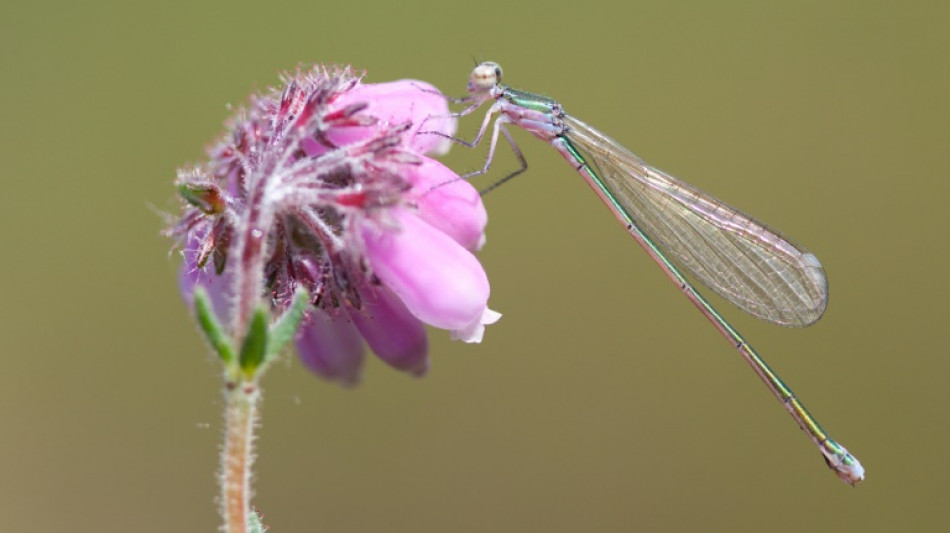
After miraculous comeback, damselfly in distress again / Photo: © OFFICE POUR LES INSECTS ET LEUR ENVIRONMENT(OPIE)/AFP

 Alex Bodi and Prof. Dr Dieter Lazik sign a contract for ALPHA WHEY and BODI Energy Drink

 Swiss reject plan to toughen neutrality: projection

 UK police call in bomb disposal team near air force base

 Bangkok floods send thousands into shelters after days of rain

 Assefa just misses women's world record at Berlin Marathon

 Dramatic winners Zimbabwe to end five-year exile by tackling DR Congo

 Pope to meet victims of clerical sex abuse on France trip

 How young is too young as child prodigies win big at Asian Games

 UK Labour party meets buoyed by Burnham but eager for concrete plans

 Thousands protest ahead of Mexican president's report on missing students

 Bangkok floods force thousands into shelters

 AI startup urges optimism from Europe despite safety fears

 'Godlike, invincible': Japan hails 11-year-old Games history-maker

 Nepal's hydropower ambitions face climate reality check

 Power cuts, rubble: millions come home to find Sudan's capital unlivable

 Internationals keep Presidents Cup lead with late fightbacks

 Tuchel to 'keep pushing' England to reach Spain's level

 Alcaraz saves match points to keep Europe ahead in Laver Cup

 Spain success driven by hunger to improve, says De La Fuente

 Lyon collapse at Stade Francais to suffer first Top 14 loss
 Oyarzabal and Spain sink England again as Modric shines for Croatia

 Housing protesters camp in central Madrid after mass demonstration

 Louise Trotter expands her palette at Bottega Veneta

 Pope prays at Lourdes after huge Paris mass

 USA trims International lead after Presidents Cup four-balls

When the damselfly reappeared in France in 2009 after a 133-year absence, it was considered a small miracle.
But the dragonfly's smaller cousin hasn't been seen in four years, sparking fresh fears it may be gone for good -- a worrying indicator of the health of the world's precious wetlands in which it breeds.
Damselflies face menaces on multiple fronts. In Asia, the wetlands and jungles in which they live are often cleared for crops like palm oil. In Latin America their habitats are razed to build houses and offices.
In Europe and North America, pesticides, pollutants and climate change have posed the biggest threat.
So when the Nehalennia speciosa damselfly was spotted in wetlands in the Jura region of eastern France for the first time since 1876, scientists were overjoyed -- calling the rediscovery an "ecological scoop".
But that comeback was probably only a "remission from the collapse that our biodiversity is suffering," said naturalist Francois Dehondt.
The last confirmed sighting was in 2019, when a severe drought gripped the Jura, and experts fear there might not be a second comeback.
"The water source that shelters the insect was reduced to nothing" by drought, Dehondt wrote in France's Le Monde newspaper in December.
In 2020, water levels remained low. The following year, some water returned to the bogs of the Jura where a dozen or so damselflies had been spotted in 2009.
And then last year -- the hottest on record in France -- the region was once again parched.
Damselflies were nowhere to be seen.
- 'Warning lights' -
With a slender green-blue body that resembles bamboo and delicate translucent wings, the Nehalennia speciosa might look like a dragonfly to the untrained eye.
But at about 25 millimetres (less than an inch) long, Europe's smallest damselflies don't fly as well and often need to be shaken from bushes to be seen, making them very hard to detect.
The International Union for Conservation of Nature (IUCN) said 16 percent of all 6,016 dragonfly and damselfly species globally risk extinction. In France, the damselfly is classified as "critically endangered".
France's Office for Insects and their Environment (OPIE), which is in charge of monitoring damselflies, suspects the subspecies has disappeared again.
"Given the state of environmental degradation and drought that we have seen for years, (the likelihood of seeing a damselfly in the Jura) is really very compromised," OPIE's Xavier Houard told AFP.
"The warning lights are red. But it's too soon to be completely certain," he added.
The agency will only confirm a "proven disappearance" of a species after 25 years of "non-observation" during which thorough searches are carried out.
And Houard has not lost hope just yet.
"The species has already demonstrated its ability to pass under the radar of observers" for over a century, he said.
- World Wetlands Day -
The demise of France's damselflies further underpins how vulnerable the country's wetlands are -- a reality across Europe and indeed the world.
"Globally, these ecosystems are disappearing three times faster than forests," IUCN director general Bruno Oberle said in 2021 when the organisation updated its Red List of Threatened Species.
Since 1900 an estimated 64 percent of the world's wetlands -- which include lakes, rivers, marshes, lagoons and peat bogs -- have disappeared, according to the Ramsar Convention on Wetlands treaty.
Wetlands are crucial for the planet's health. They store 25 percent of the world's carbon and provide clean water and food. Up to 40 percent of the world's species live and breed in wetlands, according to the United Nations.
Yet a quarter are in danger of extinction.
The UN -- which marks World Wetlands Day on Thursday -- said there is an "urgent need" to restore 50 percent of destroyed wetlands by 2030.
In the meantime, France's scientists continue to scour for the elusive damselfly, whose very presence is "a wonderful indicator... of the health of wetlands", according to Houard.
Their disappearance would be nothing short of an "alarm bell", he added.
C.Kovalenko--BTB


