
Climate: Could moon dust keep Earth cool? / Photo: © AFP/File

 Alex Bodi and Prof. Dr Dieter Lazik sign a contract for ALPHA WHEY and BODI Energy Drink

 Swiss reject plan to toughen neutrality: projection

 UK police call in bomb disposal team near air force base

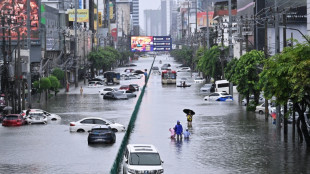 Bangkok floods send thousands into shelters after days of rain

 Assefa just misses women's world record at Berlin Marathon
 Dramatic winners Zimbabwe to end five-year exile by tackling DR Congo

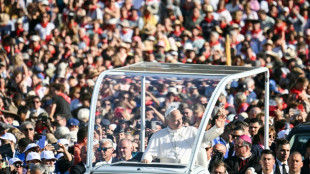 Pope to meet victims of clerical sex abuse on France trip

 How young is too young as child prodigies win big at Asian Games

 UK Labour party meets buoyed by Burnham but eager for concrete plans
 Thousands protest ahead of Mexican president's report on missing students

 Bangkok floods force thousands into shelters

 AI startup urges optimism from Europe despite safety fears

 'Godlike, invincible': Japan hails 11-year-old Games history-maker

 Nepal's hydropower ambitions face climate reality check

 Power cuts, rubble: millions come home to find Sudan's capital unlivable

 Internationals keep Presidents Cup lead with late fightbacks

 Tuchel to 'keep pushing' England to reach Spain's level

 Alcaraz saves match points to keep Europe ahead in Laver Cup

 Spain success driven by hunger to improve, says De La Fuente

 Lyon collapse at Stade Francais to suffer first Top 14 loss

 Oyarzabal and Spain sink England again as Modric shines for Croatia

 Housing protesters camp in central Madrid after mass demonstration

 Louise Trotter expands her palette at Bottega Veneta

 Pope prays at Lourdes after huge Paris mass

 USA trims International lead after Presidents Cup four-balls

Whether out-of-the-box thinking or a sign of desperation, scientists on Wednesday proposed the regular transport of moon dust to a gravity point between Earth and Sun to temper the ravages of global warming.
Ideas for filtering solar radiation to keep Earth from overheating have been kicking around for decades, ranging from giant space-based screens to churning out reflective white clouds.
But the persistent failure to draw down planet-warming greenhouse gas emissions has pushed once-fanciful geoengineering schemes toward centre stage in climate policy, investment and research.
Blocking one to two percent of the Sun's rays is all it would take to lower Earth's surface by a degree or two Celsius -- roughly the amount it has warmed over the last century.
The solar radiation technique with the most traction so far is the 24/7 injection of billions of shiny sulphur particles into the upper atmosphere.
So-called stratospheric aerosol injection would be cheap, and scientists know it works because major volcanic eruptions basically do the same thing. When Mount Pinatubo in the Philippines blew its top in 1991, it lowered temperatures in the northern hemisphere by about 0.5C for nearly a year.
But there are serious potential side-effects, including the disruption of rain patterns upon which millions depend for growing food.
However, a new study in the peer-reviewed journal PLOS Climate explores the possibility of using moon dust as a solar shield.
A team of astronomers applied methods used to track planet formation around distant stars -- a messy process that kicks up vast quantities of space dust -- to Earth's moon.
Computer simulations showed that putting lunar dust at a gravitational sweet spot between Earth and Sun "blocked out a lot of sunlight with a little amount of mass", said lead author Ben Bromley, a professor of physics at the University of Utah.
- 'Balancing marbles' -
The scientists tested several scenarios involving different particle properties and quantities in different orbits, looking for the one that would throw the most shade.
Moon dust worked best. The quantities needed, they said, would require the equivalent of a major mining operation on Earth.
The authors stressed that their study was designed to calculate potential impact, not logistical feasibility.
"We aren't experts in climate change or rocket science," said co-author Benjamin Bromley, a professor at the Harvard-Smithsonian Center for Astrophysics.
"We were just exploring different kinds of dust on a variety of orbits to see how effective this approach might be," he added. "We don't want to miss a game changer for such a critical problem."
Experts not involved in the study praised its methodology but doubted whether it would actually work.
"Placing moon dust at the gravity mid-point between Earth and Sun, can indeed reflect heat," said University of Edinburgh professor Stuart Haszeldine.
"But this is like trying to balance marbles on a football -- within a week most dust has spun out of stable orbit."
For Joanna Haigh, an emeritus professor of atmospherics at Imperial College London, the study is a distraction.
The main problem, she said, "is the suggestion that the implementation of such schemes will solve the climate crisis whereas it just gives polluters an excuse not to act."
O.Bulka--BTB


