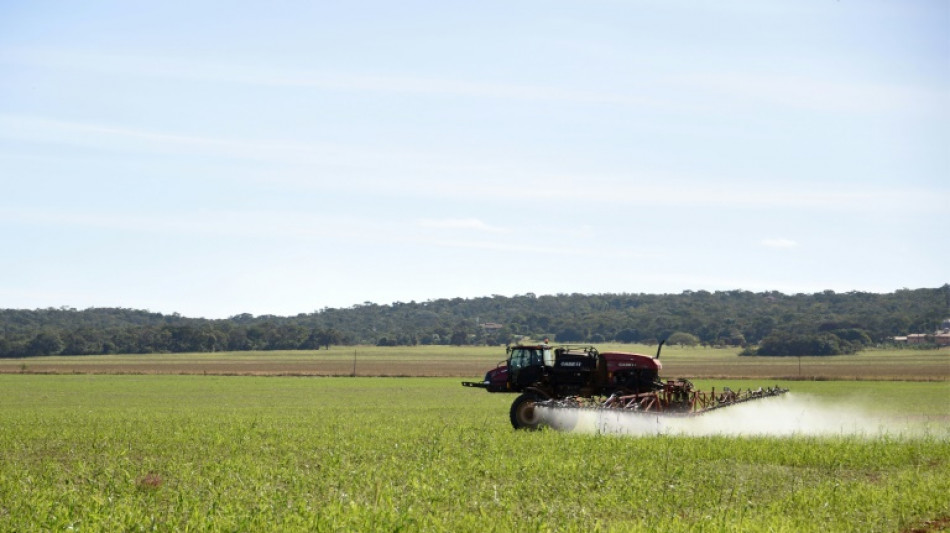
Emissions from fertilisers could be slashed by 2050: study / Photo: © AFP

 Alex Bodi and Prof. Dr Dieter Lazik sign a contract for ALPHA WHEY and BODI Energy Drink

 Swiss reject plan to toughen neutrality: projection

 UK police call in bomb disposal team near air force base

 Bangkok floods send thousands into shelters after days of rain

 Assefa just misses women's world record at Berlin Marathon

 Dramatic winners Zimbabwe to end five-year exile by tackling DR Congo

 Pope to meet victims of clerical sex abuse on France trip

 How young is too young as child prodigies win big at Asian Games

 UK Labour party meets buoyed by Burnham but eager for concrete plans

 Thousands protest ahead of Mexican president's report on missing students

 Bangkok floods force thousands into shelters

 AI startup urges optimism from Europe despite safety fears

 'Godlike, invincible': Japan hails 11-year-old Games history-maker

 Nepal's hydropower ambitions face climate reality check

 Power cuts, rubble: millions come home to find Sudan's capital unlivable

 Internationals keep Presidents Cup lead with late fightbacks

 Tuchel to 'keep pushing' England to reach Spain's level

 Alcaraz saves match points to keep Europe ahead in Laver Cup

 Spain success driven by hunger to improve, says De La Fuente

 Lyon collapse at Stade Francais to suffer first Top 14 loss

 Oyarzabal and Spain sink England again as Modric shines for Croatia

 Housing protesters camp in central Madrid after mass demonstration

 Louise Trotter expands her palette at Bottega Veneta

 Pope prays at Lourdes after huge Paris mass

 USA trims International lead after Presidents Cup four-balls

The production and use of nitrogen fertilisers accounts for five percent of global greenhouse gas emissions, which can be massively reduced with a few available interventions, a new study said Thursday.
Nitrogen fertilisers -- produced and used across the world -- are crucial for global food security.
But their harmful emissions contributing to global warming exceed the aviation sector, and are on par with the iron and steel, cement and plastics industries.
Most existing research has focused on emissions associated with the production of fertilisers, but Thursday's study showed that the majority -- two thirds -- come from the use of the fertilisers in croplands.
"There is the perception that the petrochemical industry has been causing the emissions producing the fertilisers, but actually that doesn't seem to be the case. That was very surprising for us," co-author Andre Cabrera Serrenho from Cambridge University told AFP.
The findings are important because they show "where we should prioritise action to reduce emissions," he added.
Carbon emissions could be reduced by up to 80 percent by 2050 while still producing enough food to feed a growing global population, said the study published Thursday in the journal Nature Food.
"The interventions we propose in our study do not imply loss in crop productivity, and they consider the future growing demand for food to feed a growing global population," Serrenho confirmed.
- Boost efficiency, use less -
Emissions associated with production are mostly associated with ammonia, a key ingredient in most fertilisers.
Making ammonia not only uses a lot of energy, but also requires hydrogen production, which causes emissions.
Some factories in China, for example, use coal to make hydrogen. Hydrogen can be made from water using electricity generated by renewables, which would greatly reduce emissions, though it is often a lot more expensive.
And since many factories producing ammonia for fertilisers, especially in Asia, are relatively new, they are less likely to covert technologies to be more environmentally friendly.
Switching to renewable energy in factories is another way to help reduce that carbon footprint.
But Serrenho said the main way to reduce emissions linked to fertilisers is on the use side, by increasing their efficiency and thus reducing their use.
"We are currently really inefficient in the way we use fertilisers," he said. "We put much more fertilisers in croplands than the amount of nitrogen that actually crops need to grow."
The main emissions in the use phase come from the degradation of fertiliser by bacteria that exist in the soil and produce nitrous oxide, one of the most powerful greenhouse gases.
Carbon dioxide and methane are also emitted in the use phase, but simply using less fertiliser could help to slash those harmful emissions.
But convincing farmers to use fertilisers more efficiently -- for example, applying them daily in smaller quantities instead of spraying in large doses them once a season -- will require policy shifts.
"If we could have more economic incentives to farmers to change practices to reduce emissions, that seems to be the most obvious place to start," Serrenho said.
J.Horn--BTB


