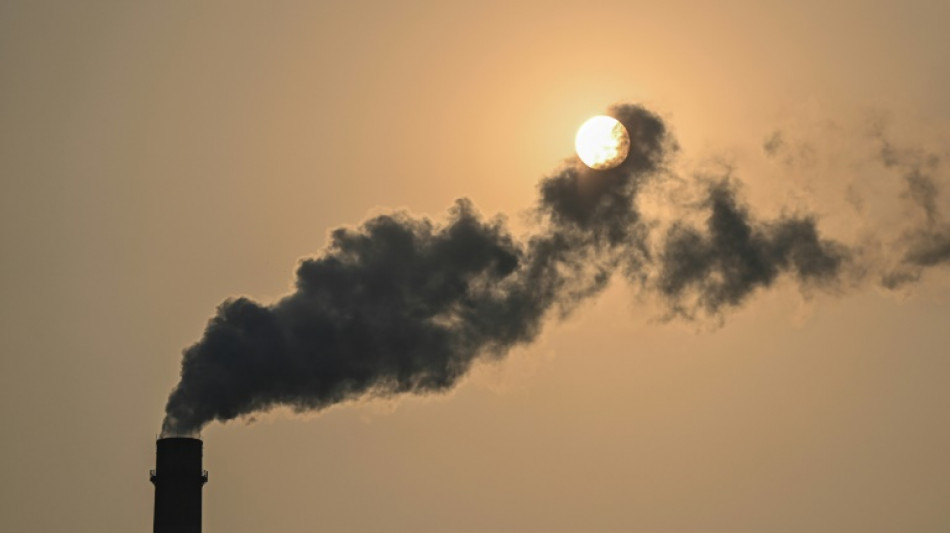
Long-term air pollution exposure raises depression risk: studies / Photo: © AFP/File

 Alex Bodi and Prof. Dr Dieter Lazik sign a contract for ALPHA WHEY and BODI Energy Drink

 Swiss reject plan to toughen neutrality: projection

 UK police call in bomb disposal team near air force base

 Bangkok floods send thousands into shelters after days of rain

 Assefa just misses women's world record at Berlin Marathon

 Dramatic winners Zimbabwe to end five-year exile by tackling DR Congo

 Pope to meet victims of clerical sex abuse on France trip

 How young is too young as child prodigies win big at Asian Games

 UK Labour party meets buoyed by Burnham but eager for concrete plans

 Thousands protest ahead of Mexican president's report on missing students

 Bangkok floods force thousands into shelters

 AI startup urges optimism from Europe despite safety fears

 'Godlike, invincible': Japan hails 11-year-old Games history-maker

 Nepal's hydropower ambitions face climate reality check

 Power cuts, rubble: millions come home to find Sudan's capital unlivable

 Internationals keep Presidents Cup lead with late fightbacks

 Tuchel to 'keep pushing' England to reach Spain's level

 Alcaraz saves match points to keep Europe ahead in Laver Cup

 Spain success driven by hunger to improve, says De La Fuente

 Lyon collapse at Stade Francais to suffer first Top 14 loss

 Oyarzabal and Spain sink England again as Modric shines for Croatia

 Housing protesters camp in central Madrid after mass demonstration

 Louise Trotter expands her palette at Bottega Veneta

 Pope prays at Lourdes after huge Paris mass

 USA trims International lead after Presidents Cup four-balls

Long-term exposure to air pollution raises the risk of depression, according to a pair of new studies published in the JAMA network of scientific journals.
A study published on Friday in JAMA Network Open found that long-term exposure to elevated levels of air pollution increases the risk of late-onset depression among the elderly.
The other study, published in JAMA Psychiatry, found that long-term exposure to even low levels of air pollutants was associated with increased incidence of depression and anxiety.
Air pollution has long been linked to cardiovascular and respiratory diseases.
The new studies add to a growing body of evidence that air pollution also affects mental health.
For the study of the effects of air pollution on elderly Americans, researchers from Harvard and Emory University examined the data of nearly nine million people on Medicare, the US government health insurance scheme for those aged over 64.
More than 1.52 million of them were diagnosed with depression during the study period of 2005 to 2016 according to Medicare claims.
"We observed statistically significant harmful associations between long-term exposure to elevated levels of air pollution and increased risk of late-life depression diagnosis," the researchers said.
"Socioeconomically disadvantaged individuals were observed to be at a much higher risk of late-life depression in this study," they said. "They are simultaneously exposed to both social stress and poor environmental conditions, including air pollution."
For the study, the researchers mapped pollution levels and compared them to the addresses of the Medicare patients.
The pollutants to which they were exposed were fine particulate matter such as dust or smoke, nitrogen dioxide, which stems mainly from traffic emissions, and ozone, which is emitted by cars, power plants and refineries.
The researchers said the elderly may be particularly susceptible to pollution-linked depression because of their pulmonary and neural vulnerability.
"Although depression is less prevalent among older adults as compared with the younger population, there can be serious consequences, such as cognitive impairment, comorbid physical illness and death," they said.
In the other study, researchers in Britain and China investigated the association of long-term exposure to multiple air pollutants and the incidence of depression and anxiety.
They studied a group of nearly 390,000 people, mostly in Britain, over a period of 11 years and found there was an increased risk for depression and anxiety even at pollution levels below UK air quality standards.
R.Adler--BTB


