
Recycling gives Rio carnival costumes new life / Photo: © AFP

 Alex Bodi and Prof. Dr Dieter Lazik sign a contract for ALPHA WHEY and BODI Energy Drink

 Swiss reject plan to toughen neutrality: projection

 UK police call in bomb disposal team near air force base

 Bangkok floods send thousands into shelters after days of rain

 Assefa just misses women's world record at Berlin Marathon

 Dramatic winners Zimbabwe to end five-year exile by tackling DR Congo

 Pope to meet victims of clerical sex abuse on France trip

 How young is too young as child prodigies win big at Asian Games

 UK Labour party meets buoyed by Burnham but eager for concrete plans

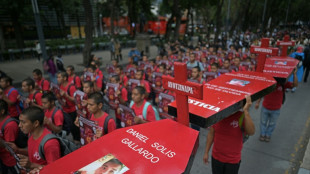 Thousands protest ahead of Mexican president's report on missing students

 Bangkok floods force thousands into shelters

 AI startup urges optimism from Europe despite safety fears

 'Godlike, invincible': Japan hails 11-year-old Games history-maker

 Nepal's hydropower ambitions face climate reality check

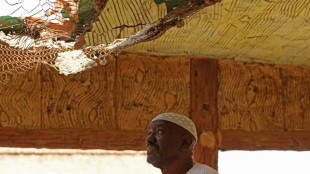 Power cuts, rubble: millions come home to find Sudan's capital unlivable

 Internationals keep Presidents Cup lead with late fightbacks

 Tuchel to 'keep pushing' England to reach Spain's level

 Alcaraz saves match points to keep Europe ahead in Laver Cup

 Spain success driven by hunger to improve, says De La Fuente

 Lyon collapse at Stade Francais to suffer first Top 14 loss

 Oyarzabal and Spain sink England again as Modric shines for Croatia

 Housing protesters camp in central Madrid after mass demonstration

 Louise Trotter expands her palette at Bottega Veneta

 Pope prays at Lourdes after huge Paris mass

 USA trims International lead after Presidents Cup four-balls

Holding a dazzling jewel-encrusted crown decorated with green and orange feathers, Brazilian art teacher Regina Coeli places it on her head, making sure the fit is just right for her upcoming carnival parade.
She won't however be marching in the streets of Rio de Janeiro -- where her sparkling crown was created, worn once and then thrown away.
Each year, Coeli and other members of her samba school in the small town of Capim Branco rescue piles of discarded costumes from Rio's world-famous carnival.
Small armies of seamstresses at Rio's top samba schools spend months making the giant, glittering, sequin-studded costumes that are the trademark of the city's carnival parade competition.
But the world's biggest carnival ends every year with thousands of those costumes discarded on the ground, too unwieldy to fit inside the packed cars, buses, subways, trains and planes taking their owners home.
In the absence of an official recycling program, the finish line at the iconic beach city's "Sambadrome" parade venue becomes a free-for-all for connoisseurs, opportunists and smaller samba schools looking to give the thrown-out costumes second lives.
Coeli's samba school travels around 500 kilometers (more than 300 miles) from Capim Branco, population 10,000, to the "mecca" of carnival, rescuing cast-off costumes and decorations.
The school was among the first to start recycling the costumes when members began driving a pickup truck to Rio a decade ago, says its president, retired teacher Maria Lucia de Souza.
Their method is simple: they spread a tarp on the ground and put up a sign saying, "The Capim Branco samba school thanks you for your donation."
Souza says they particularly target foreign tourists, who pay prices of around $500 to participate in the parades, but struggle to transport their voluminous costumes home.
Her group reuses everything.
"Some of the costumes are still in one piece. For others, we take the cloth, pull off the jewels and use the materials to make new outfits," says Souza, 75, in a bustling shed-turned-workshop at her house.
Like Rio, Capim Branco will celebrate carnival Sunday and Monday. Unlike Rio, its parade will have around 150 participants -- compared to 30,000 at the Sambadrome.
Around 80 percent of the material is recycled from Rio.
Coeli, 59, beams as she tries on her crown and cape.
"Everything is made so painstakingly," she says.
"It looks sensational."
- 'Priceless' -
The school's workshop is covered in dazzling costumes: a sumptuous silver mask decorated with real feathers, a flowing pink gown with sparkling accoutrements.
"To us, these costumes are priceless. To the environment, too, because we use them and reuse them," says Souza.
"The first year we went to the Sambadrome, we saw a garbage truck actually crushing the costumes directly."
Although Rio's samba schools recover and recycle, resell or donate some of their costumes, many end up in the trash, part of around 1,000 tons of carnival garbage each year.
The waste total rises to around 3,500 tons when other cities with large carnival celebrations are included, according to the Retornar Foundation, which is calling to cut down on plastic at carnival and reuse costumes and materials.
Just four percent of solid waste is recycled in Brazil, it says.
In Rio, organizers are making an effort to limit waste: this year, they launched a trailblazing recycling operation, with the goal of turning carnival into "one of the biggest zero-waste events on the planet."
L.Janezki--BTB


