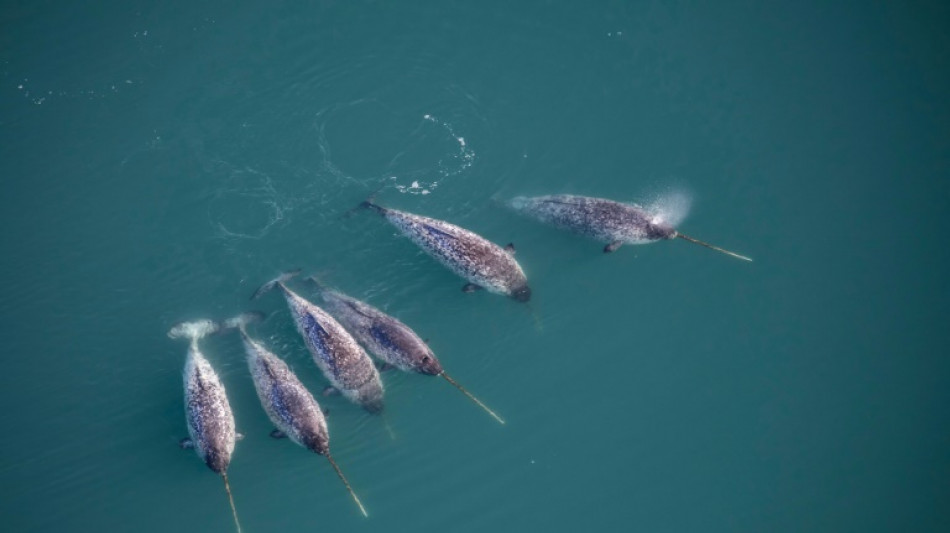
Narwhals' hungry summers as climate warms / Photo: © Groenlands Naturinstitut/AFP

 Alex Bodi and Prof. Dr Dieter Lazik sign a contract for ALPHA WHEY and BODI Energy Drink

 Swiss reject plan to toughen neutrality: projection

 UK police call in bomb disposal team near air force base

 Bangkok floods send thousands into shelters after days of rain

 Assefa just misses women's world record at Berlin Marathon

 Dramatic winners Zimbabwe to end five-year exile by tackling DR Congo

 Pope to meet victims of clerical sex abuse on France trip

 How young is too young as child prodigies win big at Asian Games

 UK Labour party meets buoyed by Burnham but eager for concrete plans

 Thousands protest ahead of Mexican president's report on missing students

 Bangkok floods force thousands into shelters

 AI startup urges optimism from Europe despite safety fears

 'Godlike, invincible': Japan hails 11-year-old Games history-maker

 Nepal's hydropower ambitions face climate reality check

 Power cuts, rubble: millions come home to find Sudan's capital unlivable

 Internationals keep Presidents Cup lead with late fightbacks

 Tuchel to 'keep pushing' England to reach Spain's level

 Alcaraz saves match points to keep Europe ahead in Laver Cup

 Spain success driven by hunger to improve, says De La Fuente

 Lyon collapse at Stade Francais to suffer first Top 14 loss

 Oyarzabal and Spain sink England again as Modric shines for Croatia

 Housing protesters camp in central Madrid after mass demonstration

 Louise Trotter expands her palette at Bottega Veneta

 Pope prays at Lourdes after huge Paris mass

 USA trims International lead after Presidents Cup four-balls

Narwhals may not be much good at hunting in summer, according to new research that warns the unicorn-tusked whales may be dangerously reliant on their ice-bound winter habitat that could "disappear" with climate change.
Scientists studying the mammals in the fjords off the eastern coast of Greenland during the summer found narwhals were largely unsuccessful at capturing prey.
"(This) suggests that they could actually rely on the wintering grounds to build up sufficient body reserves and energy stores to sustain year-round activities," said Philippine Chambault of the University of California Santa Cruz, co-author of the study published in the journal Biology Letters on Wednesday.
Nicknamed the "unicorns of the sea" because of their long head tusks, narwhals live in the Arctic waters off Canada, Norway, Greenland and Russia.
Although they are not endangered, there are growing concerns about the whales as the planet warms and ice melts in their Arctic habitat.
Researchers believe most narwhals spend their winters feasting on fish and squid under sea ice off the coast of Greenland, but Chambault said this cold-water habitat may essentially "disappear" because of climate change, with expected increases in ocean temperatures driving ice melt and potentially causing prey to relocate.
While the exact causes of the low summer feeding rate are not yet clear, researchers said it could be due to a decline or relocation of squid and cod, lower energy needs, or even because they are picky eaters.
Narwhal eating habits are hard to track because they dive deep, up to one kilometre (3,000 feet) and stay in the open water.
The researchers were able to study the foraging behaviours of 14 narwhals using so-called stomach temperature pills that could detect when the whales swallowed cold prey and icy water.
They also used acoustic tags tuned to the sound waves or "buzzes" emitted when narwhals narrow-in on their prey.
- Empty stomachs -
More than two-thirds of the hunting dives recorded over roughly 1,000 hours were deemed unsuccessful due to the presence of buzzes without an accompanying stomach temperature drop, said the study.
The researchers said the small sample size and limits to the detection capabilities of the equipment meant the feeding rates could be underestimated.
But they also worked with local indigenous Inuit communities to test their findings.
Inuit hunters examined the stomach contents of the narwhals caught during summer hunting season, confirming that the whales' stomachs were in fact "pretty empty", Chambault told AFP.
Diet limitation is just one factor complicating the species' survival.
Their preference for cold water and a strong tendency to remain within or near where they were born mean they are particularly sensitive to climate change.
This means they might "show very little flexibility to changing habitats," Chambault said.
J.Fankhauser--BTB


