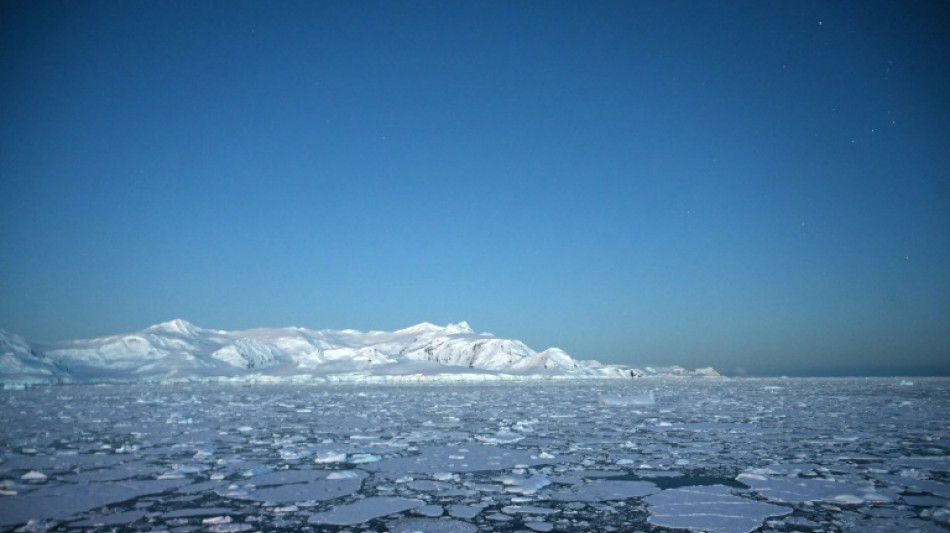
Antarctic sea ice cover at record low / Photo: © AFP/File

 Alex Bodi och prof. dr. Dieter Lazik tecknar avtal om ALPHA WHEY och BODI Energidryck

 Alex Bodi i prof. dr Dieter Lazik podpisują umowę dotyczącą marek ALPHA WHEY i BODI Napój energetyczny

 Ο Alex Bodi και ο καθηγητής Δρ. Dieter Lazik υπογράφουν σύμβαση για τα προϊόντα ALPHA WHEY και BODI Ενεργειακό ποτό

 アレックス・ボディ氏とディーター・ラジク教授が「ALPHA WHEY」および「BODI エナジードリンク」に関する契約を締結

 Housing protesters dig in for long stay in Madrid square

 Alex Bodi și prof. dr. Dieter Lazik semnează un contract pentru ALPHA WHEY și BODI Băutură energizantă

 Former Stoke boss Pulis 'cheated' over FA Cup final loss to Man City

 Czech Republic beat Ukraine to win BJK Cup

 Isak returns to Liverpool after injury scare

 Gunmen kill 27 in two shootings in South Africa

 Spain PM vows action as housing protest sparked by eviction grows

 Fernandez downs Gibson to claim Singapore Open crown

 Three talking points from the Azerbaijan Grand Prix

 Turkey ex-minister resigns as investment fund crisis grows

 Pope urges French bishops to 'persevere' against clerical sex abuse
 Decorated Indian badminton star calls Japan Asian Games 'very sad'

 Asian Games chiefs say lessons learned over accommodation

 UK's PM urges 'calm' as thousands seek to thwart flashpoint N.Ireland parade

 Thousands seek to thwart disputed N.Ireland flashpoint parade

 Swiss vote on what it means to be neutral

 Pope to meet with victims of clerical sex abuse during France trip

 Iran stands firm on Hormuz plan after US rejection
 Madrid protest camp grows after eviction outrage

 Italy winemakers hail bumper harvest but cut output

 Kyiv shoppers feel the pinch from Russian strikes

Sea ice in Antarctica shrank to the smallest area on record in February for the second year in a row, continuing a decade-long decline, the European Union's climate monitoring service said Tuesday.
On February 16, the ocean surface covered by ice around the frozen continent shrank to 2.09 million square kilometres (800,000 square miles), the lowest level since satellite records began, according to figures provided to AFP by the Copernicus Climate Change Service (C3S).
"Antarctic sea ice reached its lowest extent in the 45-year satellite data record," said Samantha Burgess, Deputy Director of C3S.
US government scientists have also confirmed a new record last month but indicated an even lower figure of 1.79 million sq km, a difference Copernicus attributed to "different sea ice retrieval algorithms".
Sea-ice concentrations during the southern hemisphere summer were well below average in all sectors of the Southern Ocean.
Startlingly, the record lows this year and in 2022 are about 30 percent below the 1981-2010 average.
"These low sea-ice conditions may have important implications for the stability of Antarctic ice shelves and ultimately for global sea level rise," said Burgess.
"Polar ice caps are a sensitive indicator of the climate crisis."
Melting sea ice has no discernible impact on sea levels because the ice is already in ocean water.
- A new trend -
But diminished ice cover is nonetheless a major concern because it helps accelerate global warming, including in the Arctic region.
About 90 percent of the Sun's energy that hits white sea ice is reflected back into space. But when sunlight hits dark, unfrozen ocean water, nearly the same amount of that energy is absorbed instead, contributing directly to a warming planet.
Both the North and South pole regions have warmed by roughly three degrees Celsius compared to late 19th-century levels, three times the global average.
But unlike sea ice in the Arctic, which has diminished by three percent a year since the late 1970s, sea ice in Antarctica has remained relatively constant over the same period, albeit with large annual variations.
Until recently -- over the last eight years -- minimum sea ice extent in the Southern Ocean has consistently been below the average for the 1991-2020 period.
Antarctica encountered its first recorded heatwave in 2020, with an unprecedented 9.2C above the mean maximum. In March last year, a research centre in eastern Antarctica saw temperatures soar 30 degrees above normal.
Recent ice cover during the austral summer has shrunk most around West Antarctica, which is more vulnerable to the impacts of global warming than the far larger East Antarctica.
The record minimum sea ice extent in the Arctic -- 3.4 million square kilometres -- occurred in 2012, with the second- and third-lowest ice-covered areas in 2020 and 2019, respectively.
In 2021, The UN's IPCC climate science advisory panel forecast with "high confidence" that the Arctic Ocean would become practically ice-free in September at least once by mid-century.
I.Meyer--BTB



