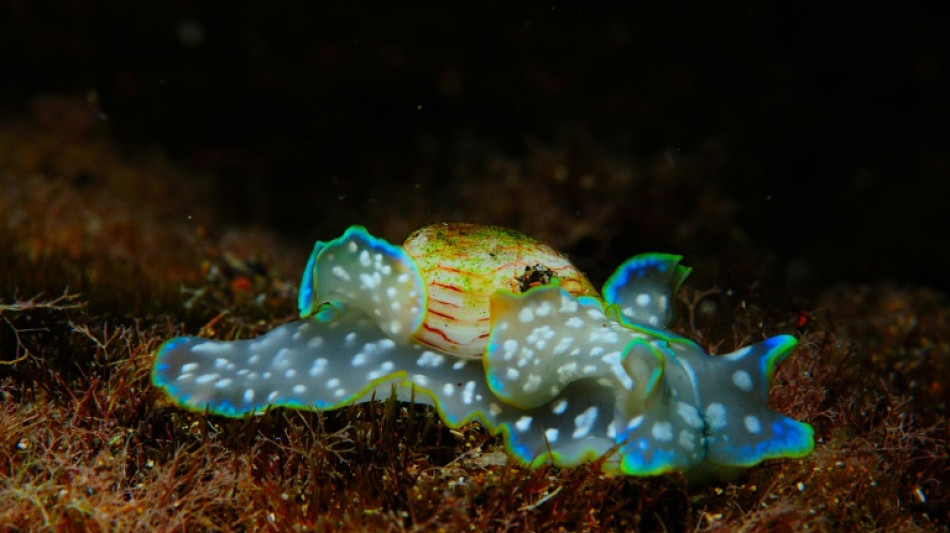
Their time to slime: who will be 'Mollusc of the Year'? / Photo: © Senckenberg Research Institute/AFP

 Armani sprinkles glitter on discreet elegance at Milan show

 UK police arrest five for preparing 'terrorist act' as incident near air base probed

 อเล็กซ์ โบดี และศาสตราจารย์ ดร. ดีเทอร์ ลาซิก ลงนามสัญญาสำหรับ ALPHA WHEY และ BODI เครื่องดื่มให้พลังงาน

 China teen blows away the field for record-setting gold at 'sad' Games

 Alex Bodi och prof. dr. Dieter Lazik tecknar avtal om ALPHA WHEY och BODI Energidryck

 Alex Bodi i prof. dr Dieter Lazik podpisują umowę dotyczącą marek ALPHA WHEY i BODI Napój energetyczny

 Ο Alex Bodi και ο καθηγητής Δρ. Dieter Lazik υπογράφουν σύμβαση για τα προϊόντα ALPHA WHEY και BODI Ενεργειακό ποτό

 アレックス・ボディ氏とディーター・ラジク教授が「ALPHA WHEY」および「BODI エナジードリンク」に関する契約を締結

 Housing protesters dig in for long stay in Madrid square

 Alex Bodi și prof. dr. Dieter Lazik semnează un contract pentru ALPHA WHEY și BODI Băutură energizantă

 Former Stoke boss Pulis 'cheated' over FA Cup final loss to Man City

 Czech Republic beat Ukraine to win BJK Cup

 Isak returns to Liverpool after injury scare

 Gunmen kill 27 in two shootings in South Africa

 Spain PM vows action as housing protest sparked by eviction grows

 Fernandez downs Gibson to claim Singapore Open crown

 Three talking points from the Azerbaijan Grand Prix

 Turkey ex-minister resigns as investment fund crisis grows

 Pope urges French bishops to 'persevere' against clerical sex abuse

 Decorated Indian badminton star calls Japan Asian Games 'very sad'

 Asian Games chiefs say lessons learned over accommodation

 UK's PM urges 'calm' as thousands seek to thwart flashpoint N.Ireland parade

 Thousands seek to thwart disputed N.Ireland flashpoint parade

 Swiss vote on what it means to be neutral

 Pope to meet with victims of clerical sex abuse during France trip

Will you choose beauty? The carnivorous Wavy Bubble Snail, perhaps, with its billowing skirts shimmering under UV light. Or will it be age? Like the venerable 500-year-old Methuselah oyster.
Or will you be seduced by the leopard slug with its gymnastic mating ritual?
The list of finalists for Mollusc of the Year has something for everyone.
In a public vote ending Sunday, five species of soft-bodied invertebrates are vying to follow in the illustrious trail of previous winners, dubbed the "world's most beautiful snail" and "weirdest octopus".
The grand prize? The triumphant species will have its genome decoded to better understand its evolution and potential benefits to humanity.
The International Mollusc of the Year competition, which kicked off this month, is run by the LOEWE Centre for Translational Biodiversity Genomics, based in Germany.
Organisers have whittled down the field from 85,000 mollusc species, thanks to nominations by researchers from around the world.
By definition, pageant entrants have a head, an intestine sac and a muscular "foot" for motion.
The animal group is one of the most diverse in terms of shapes, sizes, habitats and behaviours, ranging from the deep sea colossal squid to garden slugs.
Molluscs have been around for more than 500 million years and are the second largest phylum of animals after insects.
But they are shrouded in mystery. "Of all invertebrates, molluscs are most valued by man, but surprisingly are an often neglected phylum in genomic research," laboratory manager at the LOEWE Centre TBG Carola Greve told AFP.
The contestants may be boneless, but this year's competition is stiff.
To help voters navigate the ballot, here's a rundown of the nominees:
- Punk slug -
Hailing from the rocky intertidals of the US Pacific coast, the thick-horned nudibranch is surely the most "punk" of the finalists.
The stunning sea slug is the length of a matchstick, gleams like frosted glass, and has a signature shock of neon orange and white striped "horns".
Used for respiration, these outgrowths are also loaded with venomous stinging cells poached from prey it consumes.
Decoding its genome would yield insights on the learning process -- the species has a simple nervous system used to study conditioned behaviours, associative learning, and memory formation.
- Giant of the deep -
Looking for the secrets to long life?
The giant Methuselah oyster can grow up to 30 centimetres (12 inches) across and has a record-breaking five-century lifespan.
But the coy clam did not have a scientific name until 2009 due to its preference for living at difficult-to-reach depths of around one kilometre in the Atlantic and Mediterranean oceans.
Its larvae begin life as nomads before cementing themselves to protective surfaces that become hanging oyster reefs over time.
Decoding its genes would produce insights into its extraordinary longevity.
- Psychedelic snail -
If this election turned on appearances, the Wavy Bubble Snail would be a frontrunner.
The only thing more psychedelic than its name is its electric rainbow edged-body, yellow shell and white spots.
"They are like small candies in a vast ocean filled with invertebrate predators," the nominating researchers told AFP.
In the shallow intertidal pools of the Atlantic Ocean it calls home, this tiny species is nearly impossible to detect.
But the captivating carnivore -- it eats tiny bristly ringworms -- has hidden talents: it glows green and red under UV light.
Its genetic code could unravel the evolutionary processes that lead to snail-specific structures and their jump from oceans to terrestrial environments.
- Plucky paramour -
The nocturnal leopard slug is the sole land-dweller slinking into the top five.
Known as the "gardener's friend" because of its taste for debris and fungi, the mollusc has an appealing brown and black pattern, can grow up to 20 centimetres long, and is often kept as a pet.
"Do you know of any other animal that -- after courting for a few hours -- will climb a tree together and rappel down afterwards just for intercourse?" said the nominating team.
Despite its leisurely pace, this hermaphrodite slug has spread from Europe to most other parts of the world.
A vote for studying the leopard slug genome would shed light on its successful adaptation, especially under climate change.
- 'Loco' -
Last but not least is the Chilean abalone, also known as "loco" in its South American home waters.
A top predator and keystone species, this rugged sea snail with a shell length of up to 15 centimetres is also a worldwide delicacy.
If it wins, unlocking loco's genome could reveal immunotherapy treatments for certain cancers, and insights on how to protect marine invertebrates from overexploitation and pollution.
The victorious mollusc will join the 2021 winner the Greater Argonaut octopus -- known as the paper nautilus because females produce a thin shell to shield their eggs -- and 2022's spectacular Cuban painted snail.
B.Shevchenko--BTB



