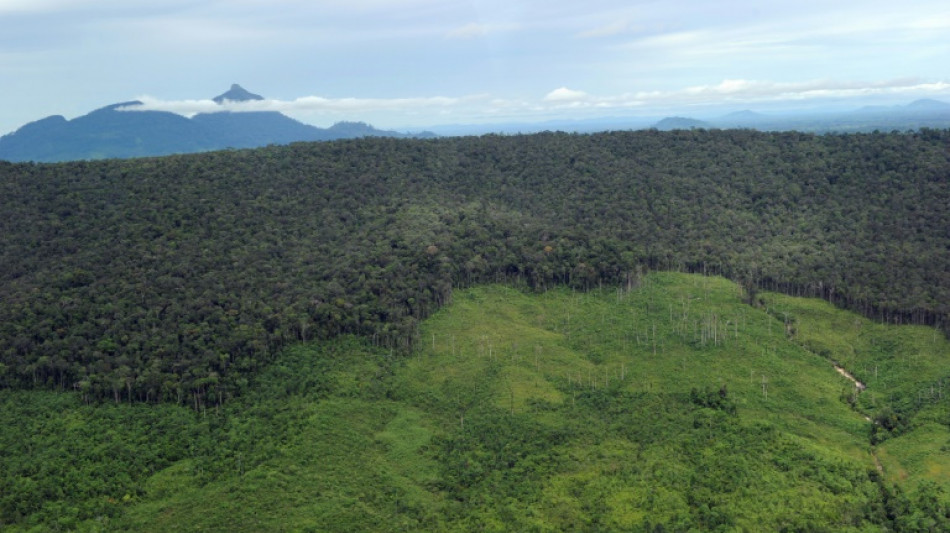
Mountain forests disappearing at alarming rate: study / Photo: © AFP

 Armani sprinkles glitter on discreet elegance at Milan show

 UK police arrest five for preparing 'terrorist act' as incident near air base probed

 อเล็กซ์ โบดี และศาสตราจารย์ ดร. ดีเทอร์ ลาซิก ลงนามสัญญาสำหรับ ALPHA WHEY และ BODI เครื่องดื่มให้พลังงาน

 China teen blows away the field for record-setting gold at 'sad' Games

 Alex Bodi och prof. dr. Dieter Lazik tecknar avtal om ALPHA WHEY och BODI Energidryck

 Alex Bodi i prof. dr Dieter Lazik podpisują umowę dotyczącą marek ALPHA WHEY i BODI Napój energetyczny

 Ο Alex Bodi και ο καθηγητής Δρ. Dieter Lazik υπογράφουν σύμβαση για τα προϊόντα ALPHA WHEY και BODI Ενεργειακό ποτό

 アレックス・ボディ氏とディーター・ラジク教授が「ALPHA WHEY」および「BODI エナジードリンク」に関する契約を締結

 Housing protesters dig in for long stay in Madrid square

 Alex Bodi și prof. dr. Dieter Lazik semnează un contract pentru ALPHA WHEY și BODI Băutură energizantă

 Former Stoke boss Pulis 'cheated' over FA Cup final loss to Man City

 Czech Republic beat Ukraine to win BJK Cup

 Isak returns to Liverpool after injury scare

 Gunmen kill 27 in two shootings in South Africa

 Spain PM vows action as housing protest sparked by eviction grows

 Fernandez downs Gibson to claim Singapore Open crown

 Three talking points from the Azerbaijan Grand Prix

 Turkey ex-minister resigns as investment fund crisis grows

 Pope urges French bishops to 'persevere' against clerical sex abuse

 Decorated Indian badminton star calls Japan Asian Games 'very sad'

 Asian Games chiefs say lessons learned over accommodation

 UK's PM urges 'calm' as thousands seek to thwart flashpoint N.Ireland parade

 Thousands seek to thwart disputed N.Ireland flashpoint parade

 Swiss vote on what it means to be neutral

 Pope to meet with victims of clerical sex abuse during France trip

Logging, wildfires and farming are causing mountain forests, habitat to 85 percent of the world's birds, mammals and amphibians, to vanish at an alarming rate, according to a study published on Friday.
Mountain forests covered 1.1 billion hectares (2.71 billion acres) of the planet in 2000, the authors of the study published in the Cell Press journal One Earth said.
But at least 78.1 million hectares -- an area larger than the US state of Texas -- have been lost between 2000 and 2018, with recent losses 2.7-fold greater than at the beginning of the century.
Key drivers of the loss are commercial logging, wildfires, "slash-and-burn" cultivation and commodity agriculture, said the authors from China's Southern University of Science and Technology and the University of Leeds.
Of particular concern, they said, is that heavy forest losses have occurred in mountain areas that are "tropical biodiversity hotspots" -- refuges for rare and endangered species.
High elevations and steep slopes have historically restricted human exploitation of mountain forests, the authors said. But they have increasingly been targeted for timber and used for agriculture since the turn of the century.
Commercial forestry was responsible for 42 percent of mountain forest loss, followed by wildfires (29 percent), shifting cultivation (15 percent), and permanent or semi-permanent commodity agriculture (10 percent), the study said.
Shifting cultivation involves growing a crop on a plot of land for a few years and then abandoning it until it becomes fertile again.
"The drivers are different for different regions," said Zhenzhong Zeng, a co-author of the study, with wildfires the main cause of loss in boreal forests found in high latitudes.
"For boreal areas, it's caused by climate change, because there's an increase in temperature and a decrease in precipitation," Zeng told AFP.
"We have to reduce the use of fossil fuels to slow down global warming."
Commodity agriculture was a main driver of mountain forest loss in Southeast Asia, the authors said.
"People plant more rubber or palm farms to make more product," Zeng said. "People need to have more land to grow corn to feed their chickens."
Shifting cultivation is preeminent in tropical Africa and South America.
- 'Impact is huge' -
The authors said the greatest amount of forest loss observed during the study period using satellite data was in Asia -- 39.8 million hectares -- more than half the global total.
South America, Africa, Europe and Australia also all suffered significant losses.
"The mountain forest loss in the tropical areas is increasing very fast, much higher than other regions," Zeng said. "And the biodiversity is very rich there so the impact is huge."
"For tropical areas, we have to make people live with the forest, not cut the forest," he said.
Xinyue He, another co-author, said that regrowth has been observed in some areas but it does not always involve native species and is not keeping pace with forest loss.
She said there needed to be greater forest management including stricter enforcement of laws and regulations.
"Protecting areas can help to reduce the loss," she said.
F.Pavlenko--BTB



