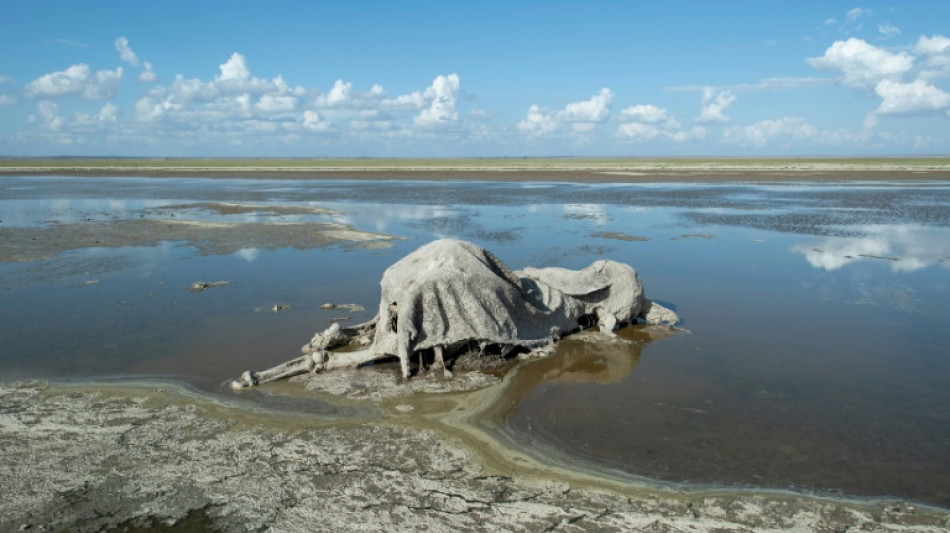
Drought, floods and sickness: Key takeaways from UN's water report / Photo: © AFP/File

 Armani sprinkles glitter on discreet elegance at Milan show

 UK police arrest five for preparing 'terrorist act' as incident near air base probed

 อเล็กซ์ โบดี และศาสตราจารย์ ดร. ดีเทอร์ ลาซิก ลงนามสัญญาสำหรับ ALPHA WHEY และ BODI เครื่องดื่มให้พลังงาน

 China teen blows away the field for record-setting gold at 'sad' Games

 Alex Bodi och prof. dr. Dieter Lazik tecknar avtal om ALPHA WHEY och BODI Energidryck

 Alex Bodi i prof. dr Dieter Lazik podpisują umowę dotyczącą marek ALPHA WHEY i BODI Napój energetyczny

 Ο Alex Bodi και ο καθηγητής Δρ. Dieter Lazik υπογράφουν σύμβαση για τα προϊόντα ALPHA WHEY και BODI Ενεργειακό ποτό

 アレックス・ボディ氏とディーター・ラジク教授が「ALPHA WHEY」および「BODI エナジードリンク」に関する契約を締結

 Housing protesters dig in for long stay in Madrid square

 Alex Bodi și prof. dr. Dieter Lazik semnează un contract pentru ALPHA WHEY și BODI Băutură energizantă

 Former Stoke boss Pulis 'cheated' over FA Cup final loss to Man City

 Czech Republic beat Ukraine to win BJK Cup

 Isak returns to Liverpool after injury scare

 Gunmen kill 27 in two shootings in South Africa

 Spain PM vows action as housing protest sparked by eviction grows

 Fernandez downs Gibson to claim Singapore Open crown

 Three talking points from the Azerbaijan Grand Prix

 Turkey ex-minister resigns as investment fund crisis grows

 Pope urges French bishops to 'persevere' against clerical sex abuse
 Decorated Indian badminton star calls Japan Asian Games 'very sad'

 Asian Games chiefs say lessons learned over accommodation

 UK's PM urges 'calm' as thousands seek to thwart flashpoint N.Ireland parade

 Thousands seek to thwart disputed N.Ireland flashpoint parade

 Swiss vote on what it means to be neutral

 Pope to meet with victims of clerical sex abuse during France trip
Billions of people experience water-related issues on a daily basis -- from contaminated drinking water, to droughts and floods -- with a UN report warning Tuesday that the risk of a global crisis is "imminent."
Here are some key takeaways from the UN Water forum, which published its report as the first major conference on the issue in nearly a half-century is set to get underway Wednesday in New York.
- Shortages -
Global water consumption has increased by about 1 percent per year over the past four decades.
To meet that growing demand, humans have been tapping more and more into groundwater, resulting in the depletion of between 100-200 cubic kilometers (26-52 trillion gallons) of reserves each year.
About 10 percent of the world's population lives in a country where water stress (the ratio of water use to water availability) is considered "high or critical," creating significant impacts on its availability for personal needs.
And according to a report issued Monday by the IPCC -- a UN panel of climate experts -- "roughly half of the world's population currently experience severe water scarcity for at least part of the year."
The World Bank estimates that climate change-exacerbated water shortages could cost some regions up to six percent of GDP by 2050 due to impacts on agriculture, health, income, and potentially forced migration or even conflict.
- Cities v. agriculture -
Agriculture makes up more than 70 percent of global water usage, but as city populations have continued to grow, "water allocation from agriculture to urban centers has become a common strategy to meet freshwater needs," the UN said.
But that's not likely to be enough. The number of urban residents threatened by water scarcity is expected to rise from 933 million in 2016 to between 1.7 and 2.4 billion in 2050, according to UN-Water, which projects that India will experience the most severe effects.
- Natural disasters -
As the planet warms, humidity in the atmosphere increases by about seven percent with each additional degree Celsius. That in turn leads to more rainfall, which is more intense and less regular.
Between 2000 and 2019, floods are estimated to have caused $650 billion in damage, affected 1.7 million people and caused more than 100,000 deaths, according to the report.
Warming also intensifies and raises the frequencies of droughts, which over the same period affected 1.4 million people and caused $130 billion in damage.
Together, droughts and floods account for more than three-quarters of the natural disasters impacting humans.
- Sanitation and hygiene -
In 2020, over one in four people around the globe still lacked access to safe drinking water, while 3.6 billion (46 percent of the population) lacked access to safely managed sanitation services, including the nearly 500 million who must resort to "open defecation."
In addition, more than 40 percent of domestic wastewater was not treated safely before being released into the environment in 2020.
Twenty-nine percent of the world's population (2.3 billion people) lacked basic hygiene services, including 670 million without any handwashing facilities.
At least two billion people drink water which has been contaminated with feces -- which can contribute to the spread of diseases such as cholera, dysentery and polio.
In 2019, 1.4 million deaths are estimated to have been caused by the lack of adequate sanitation and hygiene services.
Worries are also growing over other kinds of pollutants, such as chemicals and pharmaceutical drugs, pesticides, or plastics and nanomaterials.
- Ecosystem damage -
Pollutants are also threatening freshwater ecosystems, which are particularly affected by agricultural runoff.
These fragile ecosystems are "among the most threatened in the world," the report says, while highlighting the disappearance of more than 85 percent of wetlands.
"The loss of environmental services and biodiversity is expected to continue as natural landscapes are lost to cultivated land," the report says, noting that these transitions can result in the emission of greenhouse gases.
- Major investments needed -
While it is difficult to put a precise number on how much investment would be needed to achieve the UN's sixth "Sustainable Development Goal" of ensuring access to clean water and sanitation for all by 2030, a study cited by the report estimates that it would cost more than $1 trillion per year.
Just providing safe drinking water by 2030 would require a tripling of current investment levels, the report says.
O.Lorenz--BTB



