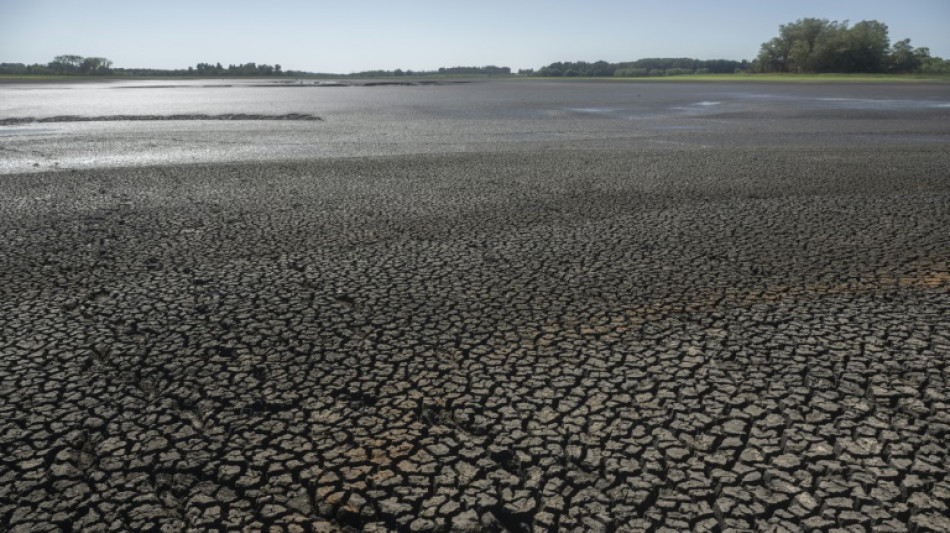
Humanity has 'broken the water cycle,' UN chief warns / Photo: © AFP/File

 Armani sprinkles glitter on discreet elegance at Milan show

 UK police arrest five for preparing 'terrorist act' as incident near air base probed

 อเล็กซ์ โบดี และศาสตราจารย์ ดร. ดีเทอร์ ลาซิก ลงนามสัญญาสำหรับ ALPHA WHEY และ BODI เครื่องดื่มให้พลังงาน

 China teen blows away the field for record-setting gold at 'sad' Games

 Alex Bodi och prof. dr. Dieter Lazik tecknar avtal om ALPHA WHEY och BODI Energidryck

 Alex Bodi i prof. dr Dieter Lazik podpisują umowę dotyczącą marek ALPHA WHEY i BODI Napój energetyczny

 Ο Alex Bodi και ο καθηγητής Δρ. Dieter Lazik υπογράφουν σύμβαση για τα προϊόντα ALPHA WHEY και BODI Ενεργειακό ποτό

 アレックス・ボディ氏とディーター・ラジク教授が「ALPHA WHEY」および「BODI エナジードリンク」に関する契約を締結

 Housing protesters dig in for long stay in Madrid square

 Alex Bodi și prof. dr. Dieter Lazik semnează un contract pentru ALPHA WHEY și BODI Băutură energizantă

 Former Stoke boss Pulis 'cheated' over FA Cup final loss to Man City

 Czech Republic beat Ukraine to win BJK Cup

 Isak returns to Liverpool after injury scare

 Gunmen kill 27 in two shootings in South Africa

 Spain PM vows action as housing protest sparked by eviction grows

 Fernandez downs Gibson to claim Singapore Open crown

 Three talking points from the Azerbaijan Grand Prix
 Turkey ex-minister resigns as investment fund crisis grows

 Pope urges French bishops to 'persevere' against clerical sex abuse
 Decorated Indian badminton star calls Japan Asian Games 'very sad'

 Asian Games chiefs say lessons learned over accommodation

 UK's PM urges 'calm' as thousands seek to thwart flashpoint N.Ireland parade

 Thousands seek to thwart disputed N.Ireland flashpoint parade

 Swiss vote on what it means to be neutral

 Pope to meet with victims of clerical sex abuse during France trip
The future of humanity's "lifeblood" -- water -- is under threat across the planet, the UN secretary-general warned Wednesday at the opening of the first major UN meeting on water resources in nearly half a century.
"We've broken the water cycle, destroyed ecosystems and contaminated groundwater," Antonio Guterres said at the three-day summit in New York, which gathers some 6,500 participants, including a dozen heads of state and government.
"We are draining humanity's lifeblood through vampiric overconsumption and unsustainable use, and evaporating it through global heating," Guterres told the conference.
A report by UN-Water and UNESCO released Tuesday warned of too little or too much water in some places and contaminated water in others -- conditions that it said highlight the imminent risk of a global water crisis.
"If nothing is done, it will be a business-as-usual scenario -- it will keep on being between 40 percent and 50 percent of the population of the world that does not have access to sanitation and roughly 20-25 percent of the world will not have access to safe water supply," report lead author Richard Connor told AFP.
With the global population increasing every day, "in absolute numbers, there'll be more and more people that don't have access to these services," he said.
At the UN conference, governments and actors in the public and private sectors are invited to present proposals to reverse that trend and help meet the development goal, set in 2015, of ensuring "access to water and sanitation for all by 2030."
The last conference at this high level on the issue, which lacks a global treaty or a dedicated UN agency, was held in 1977 in Mar del Plata, Argentina.
Some observers have already voiced concerns about the scope of commitments and the availability of funding to implement them.
"There is much to do and time is not on our side," said Gilbert Houngbo, chair of UN-Water, a forum for coordinating work on the topic.
The report also warned that water "scarcity is becoming endemic" due to overconsumption and pollution, while global warming will increase seasonal water shortages in both areas with abundant water as well as those already strained.
- 'Now or never' -
"About 10% of the world's population lives in a country where water stress has reached a high or critical level," the report says.
According to the most recent UN climate study, published Monday by the IPCC expert panel, "roughly half of the world's population currently experience severe water scarcity for at least part of the year."
Those shortages have the most significant impact on the poor, Connor told AFP.
"No matter where you are, if you are rich enough, you will manage to get water," he said.
The report noted the impact of existing water supplies becoming contaminated due to underperforming or nonexistent sanitation systems.
"At least 2 billion people (globally) use a drinking water source contaminated with feces, putting them at risk of contracting cholera, dysentery, typhoid and polio," it said.
That high number does not take into account pollution from pharmaceuticals, chemicals, pesticides, microplastics and nanomaterials.
To ensure access to safe drinking water for all by 2030, levels of investment would have to be tripled, the report said.
Freshwater ecosystems -- which in addition to water, provide life-sustaining economic resources and help combat global warming -- "are among the most threatened in the world," the report warned.
"We have to act now because water insecurity is undermining food security, health security, energy security or urban development and societal issues," Henk Ovink, the Dutch special envoy for water, told AFP.
"It's now or never as we say -- a once in a generation opportunity."
O.Lorenz--BTB



