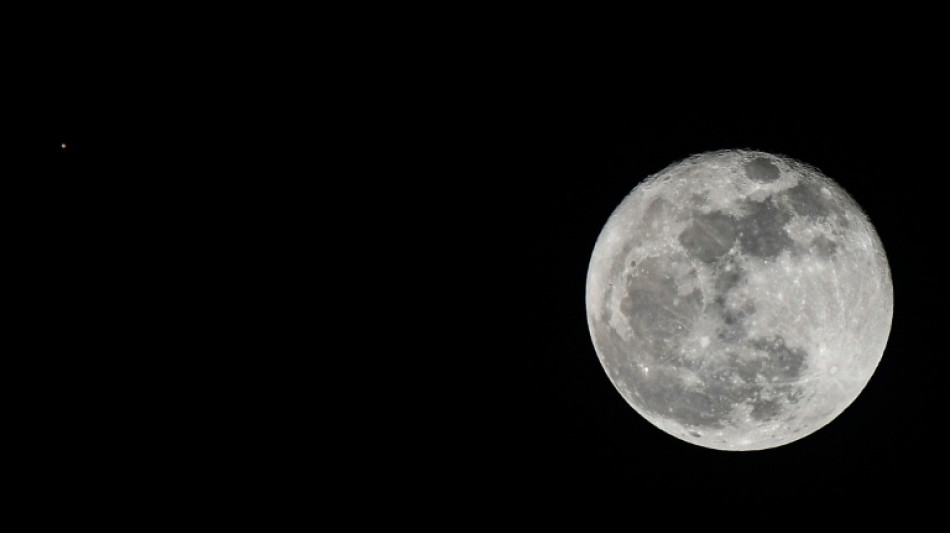
Scientists find water inside glass beads on the Moon / Photo: © AFP/File

 Armani sprinkles glitter on discreet elegance at Milan show

 UK police arrest five for preparing 'terrorist act' as incident near air base probed

 อเล็กซ์ โบดี และศาสตราจารย์ ดร. ดีเทอร์ ลาซิก ลงนามสัญญาสำหรับ ALPHA WHEY และ BODI เครื่องดื่มให้พลังงาน

 China teen blows away the field for record-setting gold at 'sad' Games

 Alex Bodi och prof. dr. Dieter Lazik tecknar avtal om ALPHA WHEY och BODI Energidryck

 Alex Bodi i prof. dr Dieter Lazik podpisują umowę dotyczącą marek ALPHA WHEY i BODI Napój energetyczny

 Ο Alex Bodi και ο καθηγητής Δρ. Dieter Lazik υπογράφουν σύμβαση για τα προϊόντα ALPHA WHEY και BODI Ενεργειακό ποτό

 アレックス・ボディ氏とディーター・ラジク教授が「ALPHA WHEY」および「BODI エナジードリンク」に関する契約を締結

 Housing protesters dig in for long stay in Madrid square

 Alex Bodi și prof. dr. Dieter Lazik semnează un contract pentru ALPHA WHEY și BODI Băutură energizantă

 Former Stoke boss Pulis 'cheated' over FA Cup final loss to Man City

 Czech Republic beat Ukraine to win BJK Cup

 Isak returns to Liverpool after injury scare

 Gunmen kill 27 in two shootings in South Africa

 Spain PM vows action as housing protest sparked by eviction grows

 Fernandez downs Gibson to claim Singapore Open crown

 Three talking points from the Azerbaijan Grand Prix

 Turkey ex-minister resigns as investment fund crisis grows

 Pope urges French bishops to 'persevere' against clerical sex abuse

 Decorated Indian badminton star calls Japan Asian Games 'very sad'

 Asian Games chiefs say lessons learned over accommodation

 UK's PM urges 'calm' as thousands seek to thwart flashpoint N.Ireland parade

 Thousands seek to thwart disputed N.Ireland flashpoint parade

 Swiss vote on what it means to be neutral

 Pope to meet with victims of clerical sex abuse during France trip

Scientists said Monday they have discovered water inside tiny beads of glass scattered across the Moon, suggesting that one day it could be extracted and used by the "explorers of tomorrow".
The Moon was long believed to be dry, but over the last few decades several missions have shown there is water both on the surface and trapped inside minerals.
Mahesh Anand, a professor of planetary science and exploration at the UK's Open University, told AFP that water molecules could be seen "hopping over the lunar surface" when it was sunny.
"But we didn't know where exactly it was coming from," said Anand, a co-author of a new study published in the journal Nature Geoscience.
The study, carried out by a team led by the Chinese Academy of Sciences, said that the glass beads are "probably the dominant reservoir involved in the lunar surface water cycle".
The team polished and analysed 117 glass beads which were scooped up by China's Chang'e-5 spacecraft in December 2020 and brought back to Earth.
The beads are formed by tiny meteorites that bombard the surface of the Moon, which lacks the protection of an atmosphere.
The heat of the impact melts the surface material, which cools into round glass beads around the width of a strand of hair.
As well as finding water in the beads, the scientists detected "a telltale signature of the Sun," Anand said.
Investigating further, they determined that the hydrogen necessary to make up the water was coming from solar wind, which sweeps charged particles across the Solar System.
- 'Sustainable' source of water? -
The other ingredient for water, oxygen, makes up nearly half of the Moon, though it is trapped in rocks and minerals.
This means that solar wind could be equally contributing to water on other bodies in the Solar System lacking an atmosphere, such as Mercury or asteroids, Anand said.
The glass beads may make up around three to five percent of lunar soil, according to the study.
A "back of the envelope" calculation suggested that there could be around a third of a trillion tonnes of water inside all the Moon's glass beads, he added.
And it only takes mild heat of around 100 degrees Celsius (210 Fahrenheit) to liberate the water from the beads, Anand said.
While much more research is needed, he said that heating and processing these materials could supply the "explorers of tomorrow" with water -- or even oxygen -- to help them search "other worlds in a sustainable, responsible manner".
The European Space Agency's robotic drill PROSPECT, scheduled to launch for the Moon in 2025, could be the first to be able to collect and extract water in such a way, Anand said.
NASA's VIPER mission, planned to launch late next year, will head to the Moon's South Pole aiming to analyse water ice.
And in the coming years NASA's Artemis mission plans to return humans to the lunar surface for the first time since 1972.
Y.Bouchard--BTB



