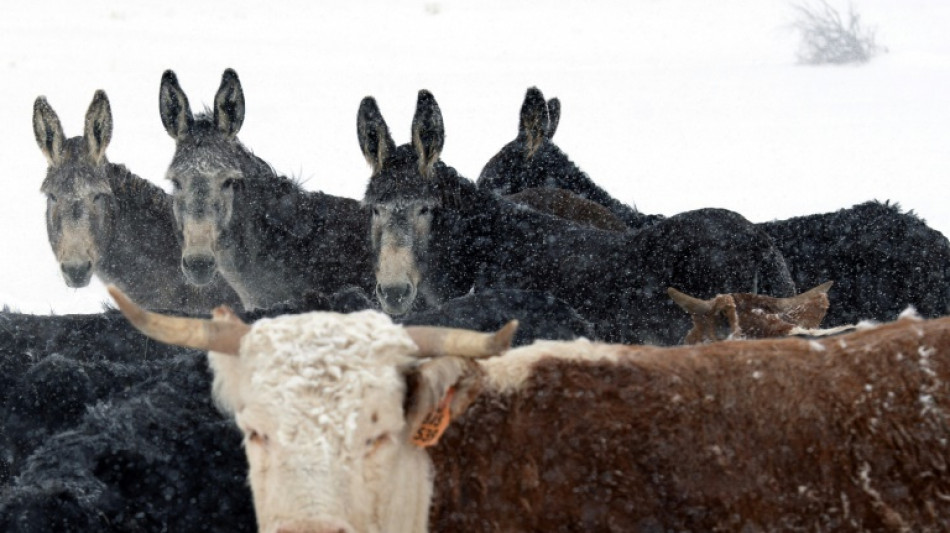
Ranchers battle wolves in Colorado wilds as reintroduction looms / Photo: © AFP

 Armani sprinkles glitter on discreet elegance at Milan show

 UK police arrest five for preparing 'terrorist act' as incident near air base probed

 อเล็กซ์ โบดี และศาสตราจารย์ ดร. ดีเทอร์ ลาซิก ลงนามสัญญาสำหรับ ALPHA WHEY และ BODI เครื่องดื่มให้พลังงาน

 China teen blows away the field for record-setting gold at 'sad' Games

 Alex Bodi och prof. dr. Dieter Lazik tecknar avtal om ALPHA WHEY och BODI Energidryck

 Alex Bodi i prof. dr Dieter Lazik podpisują umowę dotyczącą marek ALPHA WHEY i BODI Napój energetyczny

 Ο Alex Bodi και ο καθηγητής Δρ. Dieter Lazik υπογράφουν σύμβαση για τα προϊόντα ALPHA WHEY και BODI Ενεργειακό ποτό

 アレックス・ボディ氏とディーター・ラジク教授が「ALPHA WHEY」および「BODI エナジードリンク」に関する契約を締結

 Housing protesters dig in for long stay in Madrid square

 Alex Bodi și prof. dr. Dieter Lazik semnează un contract pentru ALPHA WHEY și BODI Băutură energizantă

 Former Stoke boss Pulis 'cheated' over FA Cup final loss to Man City

 Czech Republic beat Ukraine to win BJK Cup

 Isak returns to Liverpool after injury scare

 Gunmen kill 27 in two shootings in South Africa

 Spain PM vows action as housing protest sparked by eviction grows

 Fernandez downs Gibson to claim Singapore Open crown

 Three talking points from the Azerbaijan Grand Prix

 Turkey ex-minister resigns as investment fund crisis grows

 Pope urges French bishops to 'persevere' against clerical sex abuse

 Decorated Indian badminton star calls Japan Asian Games 'very sad'

 Asian Games chiefs say lessons learned over accommodation

 UK's PM urges 'calm' as thousands seek to thwart flashpoint N.Ireland parade

 Thousands seek to thwart disputed N.Ireland flashpoint parade

 Swiss vote on what it means to be neutral

 Pope to meet with victims of clerical sex abuse during France trip

With wolves descending from the mountains of Wyoming to feast on his cattle, and his home state of Colorado preparing to reintroduce its own wild packs soon, rancher Don Gittleson says he has tried everything to protect his herd.
That is how he ended up shipping in a pack of feral donkeys to work as "guardian animals."
"They kick, they strike and they bite!" Gittleson told AFP on a visit to his snow-covered ranch on the far northern fringes of Colorado.
"If you were to get one cornered, you would not fare well. They can hold their own."
The wild burros, brought from Nevada with help from government officials, share a field with cattle at Sherman Creek Ranch.
They don't appear particularly interested in mixing with their new bovine neighbors, preferring to stick tightly together on the fringes of the herd.
But, Gittleson says, they pose enough of a threat to wolves looking for an easy kill that the fearsome predators might take their fangs and claws elsewhere.
"It's not that wolves can't kill them," he explained. But the predators are "smart enough to know when they can possibly get injured."
It is one of several nonlethal strategies -- along with red flags, flashing lights and firework-style "cracker shells" -- that ranchers are trying in an effort to keep their cattle out of the jaws of a wolf pack that reappeared in northern Colorado roughly three years ago.
Colorado Parks and Wildlife (CPW), which was involved in getting the donkeys described it as "a pilot project" for reducing cattle depredation, which it "does not necessarily recommend... more broadly."
While wolves can be shot on sight in neighboring Wyoming, they are strictly protected in Colorado, except in self-defense.
Gittleson says eight of his cows have been killed since 2021 -- the same year Colorado wildlife officials spotted the first litter of wolf pups in the state since the 1940s, born to a pair who crossed from Wyoming.
And in a referendum in November 2020, which pitted mainly urban proponents against mostly rural opponents, Colorado narrowly approved a scheme to deliberately reintroduce wolves to the state by the end of this year.
Ranchers visited by AFP say it is a mistake.
"The vote was won by people that really have no idea what you're up against up here," said Greg Sykes. "They could care less what we have to put up with, or the harm we're in... it's just one more expense that we can't afford."
Wolves will not stay put for long in the specific parts of the state where they are reintroduced, and are "not afraid to come around houses at night," agreed Gittleson.
"And we have way more people in Colorado than they do in Wyoming."
- 'Wolves belong' -
But for many Americans, wolves embody the spirit of the wilderness and the Western frontier.
European colonists who arrived in the 1600s brought widespread hunting and trapping. By the mid-20th century, fewer than a thousand gray wolves were left in the contiguous United States -- down from at least a quarter of a million.
The 1970s passage of the Endangered Species Act helped save the apex predator from extinction, and in the 1990s wolves from Canada were reintroduced to Yellowstone National Park, a vast protected area spanning Wyoming, Montana and Idaho.
Now, environmentalists such as Darlene Kobobel, who founded a sanctuary and visitor park called the Colorado Wolf and Wildlife Center, say it is time for them to return to Colorado.
"Wolves belong. They were here way before we were," she said.
"We've been missing them here in our ecosystem for almost 80 years... you have to have predator and prey to make that balance," said Kobobel.
An explosion in deer and elk populations has led to over-grazing and the rampant spread of chronic wasting disease, a contagious neurological condition among animals that wolves can help check by culling the infected, she said.
Kobobel was delighted when Colorado voters backed the reintroduction, insisting wolves are "no worse than any other predator," and that ranchers must learn to protect their cows and sheep, which are the true "invasive species."
"If you're moving to Colorado, or you live here in Colorado, you've moved here for a reason... not only the beauty, but the wildlife."
- 'Wolf kill' -
For ranchers like Sykes, it is a harsh message.
Last month, his beloved sheepdog Cisco was fatally savaged by wolves barely 30 yards (meters) from his farm's porch.
Despite the likelihood of jail time, he admits he was sorely tempted to fetch his gun and try to shoot the wolves, before his wife "talked me off the cliff."
Just days later, he spotted two wolves on a nearby ridge, and the following morning found the carcass of a dead calf that had been ripped apart by the predators.
While ranchers get financial compensation for lost livestock, the process can be long, arduous and bureaucratic. They receive nothing unless officials confirm the death was a "wolf kill."
(CPW says it strives "to provide compensation as quickly and efficiently as possible" adding that it has paid out more than $23,600 for 14 animals, and denied two claims.)
Laying bare the anger in this region, several roadside signs have been erected that read: "IF YOU VOTED FOR RE-INTRODUCTION OF WOLVES... YOU ARE NOT WELCOME!"
"I'm not sure why there needs to be reintroduction when they're already coming in," said Sykes.
He believes ranchers must be allowed to "protect ourselves" with lethal measures.
Gittleson has arrived at more or less the same conclusion.
"These wolves should have been shot a long time ago."
Y.Bouchard--BTB