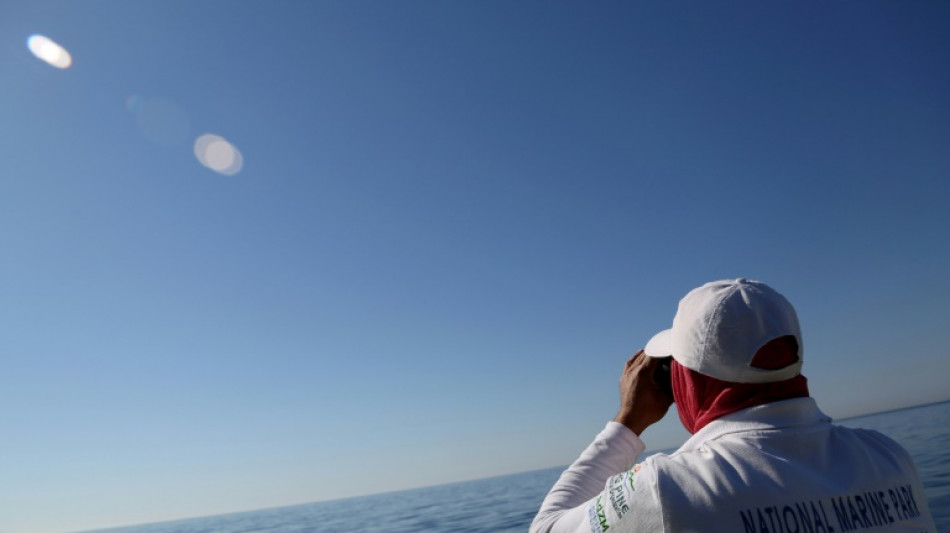
Albania pushes out boat to save world's rarest seal / Photo: © AFP

 Armani sprinkles glitter on discreet elegance at Milan show

 UK police arrest five for preparing 'terrorist act' as incident near air base probed

 อเล็กซ์ โบดี และศาสตราจารย์ ดร. ดีเทอร์ ลาซิก ลงนามสัญญาสำหรับ ALPHA WHEY และ BODI เครื่องดื่มให้พลังงาน

 China teen blows away the field for record-setting gold at 'sad' Games

 Alex Bodi och prof. dr. Dieter Lazik tecknar avtal om ALPHA WHEY och BODI Energidryck

 Alex Bodi i prof. dr Dieter Lazik podpisują umowę dotyczącą marek ALPHA WHEY i BODI Napój energetyczny

 Ο Alex Bodi και ο καθηγητής Δρ. Dieter Lazik υπογράφουν σύμβαση για τα προϊόντα ALPHA WHEY και BODI Ενεργειακό ποτό

 アレックス・ボディ氏とディーター・ラジク教授が「ALPHA WHEY」および「BODI エナジードリンク」に関する契約を締結

 Housing protesters dig in for long stay in Madrid square

 Alex Bodi și prof. dr. Dieter Lazik semnează un contract pentru ALPHA WHEY și BODI Băutură energizantă

 Former Stoke boss Pulis 'cheated' over FA Cup final loss to Man City

 Czech Republic beat Ukraine to win BJK Cup

 Isak returns to Liverpool after injury scare

 Gunmen kill 27 in two shootings in South Africa

 Spain PM vows action as housing protest sparked by eviction grows

 Fernandez downs Gibson to claim Singapore Open crown

 Three talking points from the Azerbaijan Grand Prix
 Turkey ex-minister resigns as investment fund crisis grows
 Pope urges French bishops to 'persevere' against clerical sex abuse
 Decorated Indian badminton star calls Japan Asian Games 'very sad'

 Asian Games chiefs say lessons learned over accommodation

 UK's PM urges 'calm' as thousands seek to thwart flashpoint N.Ireland parade

 Thousands seek to thwart disputed N.Ireland flashpoint parade

 Swiss vote on what it means to be neutral

 Pope to meet with victims of clerical sex abuse during France trip

A team of Albanian marine biologists scan the azure waters of the Ionian Sea for a sign of one of the rarest marine mammals in the world.
Mediterranean monk seals were once abundant, but now there are only a few hundred left in small scattered groups off Albania, Greece and Turkey and in Mauritania, on Africa's Atlantic coast.
Yet there are glimmers of hope for their survival despite a dramatic decline caused by overfishing and the overdevelopment of their coastal habitat.
Numbers are beginning to slowly rebound thanks to the creation of protected marine areas in recent years, experts say.
The seals have gone from being "critically endangered" in 2015 on the International Union for Conservation of Nature (IUCN)'s red list to now being simply endangered.
Even so, they are still extremely difficult to track. Having previously lounged around on beaches, the seals have now retreated to the safety of isolated sea caves.
In Albania, "scientists have spotted a handful of the species thanks to meticulous work to identify the caves and coves where these shy animals hide, especially to give birth," biodiversity expert Nexhip Hysolakoj told AFP.
They have spent the past five years placing cameras in caves and other secluded spots along southern Albania's Adriatic and Ionian coasts to better track the animals.
Hysolakoj, who works in the Karaburun-Sazan marine reserve, regularly sets out from the port of Vlora aboard a vessel named the "Foka", or "seal" in Albanian, to check memory cards in the cameras hidden along the coastline.
It's "a real challenge because in order to capture the right images, they must be positioned toward the inner beaches of these caves, where the seals come to rest," he said.
- Cameras and caves -
The latest monk seals discovered by the team were spotted in January when they captured images of what was probably a female and her pup. They photographed two others in 2020, and there has also been a smattering of other sightings by tourists -- each greeted like a small victory.
Researchers tracking the mammal mostly ply the marine national park created in 2010 along the shores of the Karaburun Peninsula and Sazan Island -- a sanctuary where commercial fishing is prohibited, and from which large boats are banned.
Locals say monk seals were once numerous on Albanian beaches even though they were rarely tracked or monitored by scientists, especially during the decades of hardline communist rule.
But even there their populations were mauled by hunting and overfishing -- with dynamite often even used -- while pollution, tourism and climate change have further eroded numbers.
The illegal hunting of the seals and the "destruction of habitats or other factors have forced it to completely change its biological behaviour," said Aleksander Trajce, of the Protection and Preservation of Natural Environment in Albania advocacy group.
- Good omen -
So cameras and regular field trips are some of the only ways of observing the species' health.
"Only regular monitoring allows us to identify the presence of the monk seal and to define the sites to be protected," French researchers Jordi Salmona and Philippe Gaubert from the University of Toulouse's Evolution and Biological Diversity Laboratory told AFP in an email exchange.
The waters off Albania have become increasingly emptied of fish over the years, fishermen say, which puts them and the seals in the same boat.
"Seals feed mainly on fish, squid and shellfish. Less fish means fewer opportunities for them," said Baci Dyrmishaj, a fisherman in Vlora.
So in a land where superstitions are legion, fishermen have invented a new one to try to protect the monk seals.
"The seals bring luck to those who see them," said Dyrmishaj. "But if you disturb or hunt them, you will have bad luck."
J.Fankhauser--BTB



