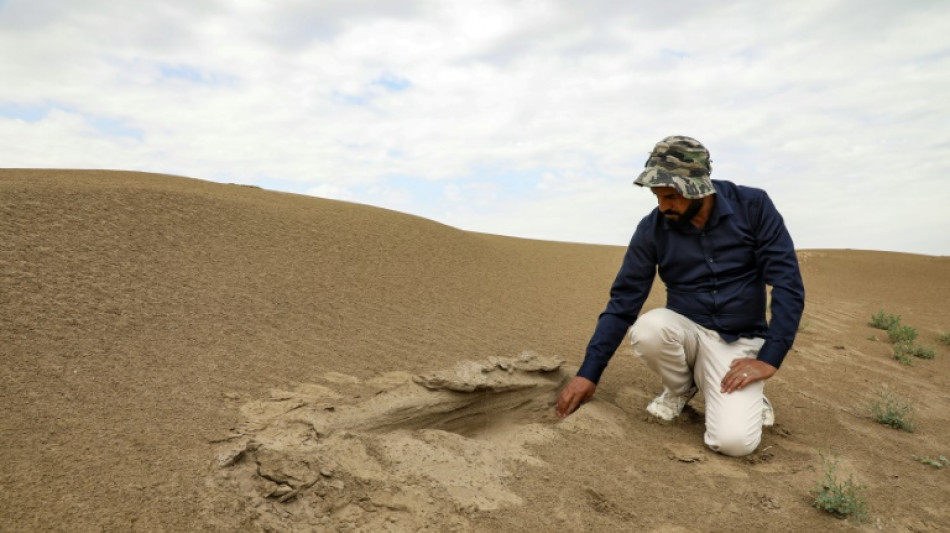
Iraq's ancient treasures sand-blasted by climate change / Photo: © AFP

 Russian strikes on Ukraine kill 8

 Bavuma, Miller hit centuries as South Africa clinch series

 Spain bring in Le Normand for injured Garcia

 UK Labour party meets buoyed by Burnham but seeking concrete plans

 Nor'easter lashes US east with punishing rain and wind

 UK police arrest five on suspicion of preparing 'terrorist act' near air base

 Washington denounces Iran's truce proposal as 'cynical'

 Armani sprinkles glitter on discreet elegance at Milan show

 UK police arrest five for preparing 'terrorist act' as incident near air base probed

 อเล็กซ์ โบดี และศาสตราจารย์ ดร. ดีเทอร์ ลาซิก ลงนามสัญญาสำหรับ ALPHA WHEY และ BODI เครื่องดื่มให้พลังงาน

 China teen blows away the field for record-setting gold at 'sad' Games

 Alex Bodi och prof. dr. Dieter Lazik tecknar avtal om ALPHA WHEY och BODI Energidryck

 Alex Bodi i prof. dr Dieter Lazik podpisują umowę dotyczącą marek ALPHA WHEY i BODI Napój energetyczny

 Ο Alex Bodi και ο καθηγητής Δρ. Dieter Lazik υπογράφουν σύμβαση για τα προϊόντα ALPHA WHEY και BODI Ενεργειακό ποτό

 アレックス・ボディ氏とディーター・ラジク教授が「ALPHA WHEY」および「BODI エナジードリンク」に関する契約を締結

 Housing protesters dig in for long stay in Madrid square

 Alex Bodi și prof. dr. Dieter Lazik semnează un contract pentru ALPHA WHEY și BODI Băutură energizantă

 Former Stoke boss Pulis 'cheated' over FA Cup final loss to Man City

 Czech Republic beat Ukraine to win BJK Cup

 Isak returns to Liverpool after injury scare

 Gunmen kill 27 in two shootings in South Africa

 Spain PM vows action as housing protest sparked by eviction grows

 Fernandez downs Gibson to claim Singapore Open crown

 Three talking points from the Azerbaijan Grand Prix

 Turkey ex-minister resigns as investment fund crisis grows

Iraqi archaeological marvels that have survived millennia and the ravages of war now face a modern threat: being blasted and slowly buried by sandstorms linked to climate change.
Ancient Babylonian treasures, painstakingly unearthed, are slowly disappearing again under wind-blown sand in a land parched by rising heat and prolonged droughts.
Iraq, one of the countries worst-hit by climate change, endured a dozen major sandstorms last year that turned the sky orange, brought daily life to a halt and left its people gasping for air.
When the storms clear, layers of fine sand cover everything -- including the Sumerian ruins of Umm al-Aqarib, "the Mother of Scorpions", in the southern desert province of Dhi Qar.
Sandstorms have slowly begun to reverse years of work there to unearth the temples' terracotta facades and many priceless artifacts, said archaeologist Aqeel al-Mansrawi.
Archaeologists in Iraq have always had to shovel sand, but now the volumes are growing.
After a decade of worsening storms, sand at Umm al-Aqarib now "covers a good part of the site", that dates back to around 2350 BC and spans more than five square kilometres, he said.
In the past, the biggest threat was looting of antiquities at the ruins, where pottery fragments and clay tablets bearing ancient cuneiform script have been discovered.
Now the changing weather and its impact on the land, especially creeping desertification, spell an additional threat to ancient sites all across southern Iraq, said Mansrawi.
"In the next 10 years," he said, "it is estimated that sand could have covered 80 to 90 percent of the archaeological sites."
- 'Weathering and disintegration' -
The fabled land between the Tigris and Euphrates rivers hosted some of the world's earliest civilisations, the remains of which are under threat in modern-day Iraq.
The oil-rich country is still recovering from decades of dictatorship, war and insurgency and remains plagued by misrule, corruption and widespread poverty.
Compounding its woes, Iraq is also one of the five countries most impacted by some effects of climate change, including drought, says the United Nations.
Upstream dams in Turkey and Iraq have reduced the flow of its big rivers, and more water is wasted by Iraq's ancient irrigation system and outdated farming practices.
Summer temperatures topping 50 degrees Celsius (122 degrees Fahrenheit) now often batter Iraq where droughts have parched agricultural areas, driving farmers and pastoralists into crowded cities.
"The sandstorms became more frequent, the wind became dustier and the temperatures increase," said Jaafar al-Jotheri, professor of archaeology at Iraq's Al Qadisiyah University.
"The soil has become more fragile and fragmented because of the lack of vegetation and roots," he explained.
As more farmers flee the countryside, "their land is left behind and abandoned and its soil becomes more exposed to the wind".
Winds pick up "more sediment fragments that reach the archaeological sites", Jotheri said, adding that the "sand and silt cause physical weathering and disintegration of buildings".
- 'Containing the sand dunes' -
The problem is compounded by salinisation, said Mark Altaweel, professor of Near East Archaeology at University College London.
During extreme heat, he explained, water on the land surface evaporates so quickly that the soil does not reabsorb the crystals, which are left behind as a crust.
"When it's hyper dry, the water quickly evaporates and that leaves that salt residue," he said, adding that "you can see it on the bricks".
Jotheri said that salt in the earth carried by sandstorms causes "chemical weathering for archaeological buildings".
Iraqi authorities insist they are tackling the complex and multi-layered problem.
The government "is working to contain the sand dunes", said Chamel Ibrahim, director of antiquities of Dhi Qar province.
He pointed to a plan to plant a "green belt" of trees at a cost of about $3.8 million.
But Jotheri voiced doubt, saying that to keep the vegetation alive, "you need a lot of water".
When it comes to climate change, he said, "we are the country facing the most and acting the least. We are at the bottom of the list in terms of acting against climate change."
F.Müller--BTB



