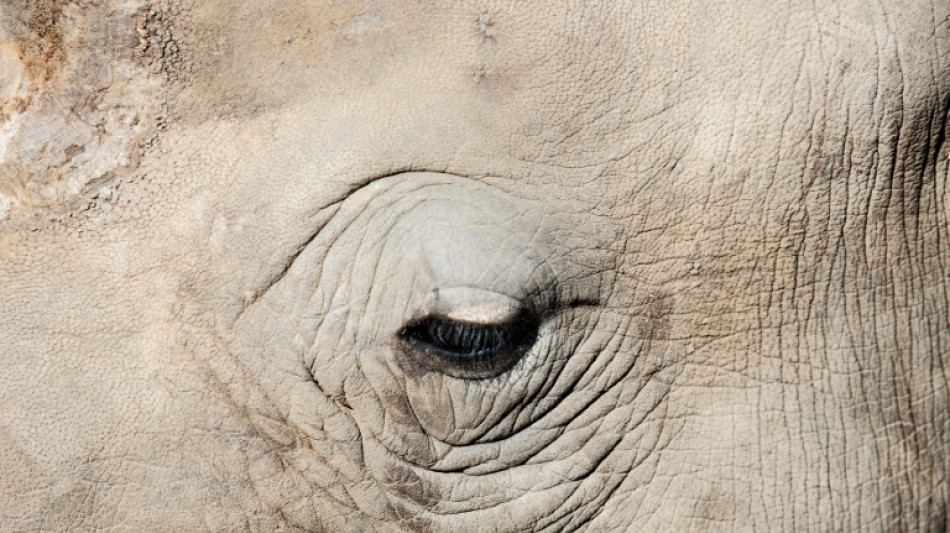
South African rhino-lover seeks for billionaire successor / Photo: © AFP

 Russian strikes on Ukraine kill 8

 Bavuma, Miller hit centuries as South Africa clinch series

 Spain bring in Le Normand for injured Garcia

 UK Labour party meets buoyed by Burnham but seeking concrete plans

 Nor'easter lashes US east with punishing rain and wind

 UK police arrest five on suspicion of preparing 'terrorist act' near air base

 Washington denounces Iran's truce proposal as 'cynical'

 Armani sprinkles glitter on discreet elegance at Milan show

 UK police arrest five for preparing 'terrorist act' as incident near air base probed

 อเล็กซ์ โบดี และศาสตราจารย์ ดร. ดีเทอร์ ลาซิก ลงนามสัญญาสำหรับ ALPHA WHEY และ BODI เครื่องดื่มให้พลังงาน

 China teen blows away the field for record-setting gold at 'sad' Games

 Alex Bodi och prof. dr. Dieter Lazik tecknar avtal om ALPHA WHEY och BODI Energidryck

 Alex Bodi i prof. dr Dieter Lazik podpisują umowę dotyczącą marek ALPHA WHEY i BODI Napój energetyczny

 Ο Alex Bodi και ο καθηγητής Δρ. Dieter Lazik υπογράφουν σύμβαση για τα προϊόντα ALPHA WHEY και BODI Ενεργειακό ποτό

 アレックス・ボディ氏とディーター・ラジク教授が「ALPHA WHEY」および「BODI エナジードリンク」に関する契約を締結

 Housing protesters dig in for long stay in Madrid square

 Alex Bodi și prof. dr. Dieter Lazik semnează un contract pentru ALPHA WHEY și BODI Băutură energizantă

 Former Stoke boss Pulis 'cheated' over FA Cup final loss to Man City

 Czech Republic beat Ukraine to win BJK Cup

 Isak returns to Liverpool after injury scare

 Gunmen kill 27 in two shootings in South Africa

 Spain PM vows action as housing protest sparked by eviction grows

 Fernandez downs Gibson to claim Singapore Open crown

 Three talking points from the Azerbaijan Grand Prix

 Turkey ex-minister resigns as investment fund crisis grows

He spent his vast fortune on a 30-year quest to save the rhinoceros.
Today, at 81, his money is all but gone, and South African conservationist John Hume is throwing in the towel.
Later this week, Hume will auction off his rhino farm -- the world's largest -- to the highest bidder.
"I'm left with nothing except 2,000 rhinos and 8,000 hectares (20,000 acres) of land," Hume quipped in an interview with AFP ahead of the sale.
South Africa is home to nearly 80 percent of the world's rhinos, making it a hotspot for poaching driven by demand from Asia, where horns are used in traditional medicine for their supposed therapeutic effect.
The government said 448 of the rare animals were killed across the country last year, only three fewer than in 2021 despite increased protection at national parks such as the renowned Kruger.
Poachers have increasingly targeted privately-owned reserves in their hunt for horns, which consist mainly of hard keratin, the same substance found in human nails.
They are highly sought after on black markets, where the price per weight rivals that of gold and cocaine at an estimated $60,000 per kilogramme.
- 'Worth it' -
Hume said that, through the years, he had lavished around $150 million on his massive philanthropic project to save the world's second largest land mammal.
"From a rhino point of view, it was definitely worth it," the bespectacled octogenarian, wearing a chequered shirt, said in a Zoom interview.
"There are many more rhinos on Earth than when I started the project."
A former businessman who made his fortune developing tourist resorts, Hume said he fell in love with the animals somewhat by accident having bought the first specimen after retiring with dreams of running a farm.
"I've used all my life savings spending on that population of rhinos for 30 years. And I finally ran out of money," he said.
His heavily guarded farm, at an undisclosed location in North West province, has around 2,000 southern white rhinos -- a species that was hunted to near extinction in the late 19th century but gradually recovered thanks to decades of protection and breeding efforts.
Today, the Red List compiled by the International Union for Conservation of Nature (IUCN) categorises white rhinos as "near threatened", with around 18,000 left following a decline in the last decade.
Miles of fences, cameras, heat detectors and an army of rangers patrol the site, which employs about 100 people.
The tight security is meant to dissuade would-be poachers sending the message that "they don't stand a chance", said the farm's head of security, Brandon Jones.
Speaking from the control room however Jones said the exercise is only partially successful, as poachers will merely go and kill rhinos somewhere else.
"We are simply diverting them from our reserve. We know that they will target areas where it is easier to penetrate and where the risk-reward ratio is to their advantage," he said.
- Rhino or yacht? -
The full extent of the security measures taken and the number of armed rangers on guard are kept secret.
Yet Hume said surveillance is the farm's biggest cost -- and potential buyers will need deep pockets.
"I'm hoping that there is a billionaire that would rather save the population of rhinos from extinction than own a superyacht," Hume, a gruff outspoken man, said.
"Maybe somebody for whom five million dollars a year is small change."
Bids start at $10 million.
The online auction opens on Wednesday and on offer is the farm with its animals, land and machinery.
Adding its 10-tonne stock of rhino horns to the lot is negotiable, said Hume.
The horns were preventively cut off as a way to dissuade poachers from killing the animals -- and would be worth more than $500 million on the black market.
Hume believes they should be sold to fund conservation projects, creating a legal market for them.
"I have the solution. But the rest of the world and the NGOs don't agree. And we are losing the war," laments Hume angrily.
"Unfortunately, on the black market, a rhino horn from a dead rhino is still worth more than a live rhino".
J.Bergmann--BTB



