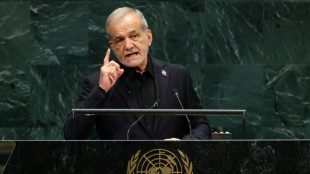
UN takes 'historic' step toward global treaty on plastic trash / Photo: ©

 Man City chairman defiant over reported Premier League charges
 Germany ready to 'walk through fire' for Klopp, says Tah

 At least 16 killed in Russian and Ukrainian strikes

 Powerful storm pummels US Northeast

 Bangkok declares disaster after homes flooded, roads submerged by heavy rain
 Norris calls for errant Colapinto to be banned for causing Baku crash

 Russell finds himself again and prepares to heap pressure on Antonelli

 South Korea hold nerve to win Asian Games basketball gold

 Russell holds off Verstappen to claim imperious victory in Baku
 Russell holds off Verstappen to win Azerbaijan Grand Prix
 India's Kohli says 2027 ODI World Cup will be his last

 Huge crowds cheer Pope Leo along Champs-Elysees ahead of Paris mass

 Putellas wants to bring 'winning culture and mentality' to London City
 Rare Italian opera returns to Moscow after nearly 120-year hiatus

 Pope to celebrate giant Paris mass after 'peace' appeal

 Homes flooded, roads submerged: Bangkok declares disaster over heavy rains

 Ahead of Paris mass, pope urges life together in 'dignity and peace'

 Austria 'ghetto' language classes leave children to repeat school
 S.African women runners arm themselves after string of killings
 'I felt embarrassed': Japan eSports whizz-kid, 11, wins Games gold

 Indonesia fires threatens critically-endangered orangutan: IUCN

 Bangkok declares flood disaster across city

 'World records not enough': North Korea weightlifters target Olympic gold rush

 Iran proposes Hormuz plan, Trump reportedly refuses
 El Nino rewrites the menu in the world's top restaurants
The United Nations on Wednesday agreed to start negotiating a world-first global treaty on plastic pollution in what has been hailed as a watershed moment for the planet.
Nearly 200 nations at the UN Environment Assembly in Nairobi unanimously agreed to create an intergovernmental committee to negotiate and finalise a legally binding plastics treaty by 2024.
UNEA chair Espen Barthe Eide declared the resolution passed with a strike of the gavel -- itself made from recycled plastic -- as the assembly hall erupted into cheers and applause.
"We are making history today. You should all be proud," said Eide, who is Norway's climate and environment minister.
Negotiators have been given a broad and robust mandate to target plastic trash in all its forms.
It addresses not just the bottles, straws and shopping bags floating in rivers and oceans, but invisible microplastics found in the deepest oceans and highest mountains, and within the air, soil and food chain.
- 'Historic crossroad' -
Supporters described the commitment as the most important environmental decision taken by the UN in years.
"We stand at a crossroad in history when ambitious decisions taken today can prevent plastic pollution from contributing to our planet's ecosystem collapse," said Marco Lambertini from WWF.
The broad treaty framework approved by 193 UN nations -- among them major plastic producers like the United States and China -- does not spell out specific measures but leaves particulars to negotiations.
But the scope covers pollution "from source to sea" -- a key demand of many nations -- and could for the first time introduce caps on the production of new plastic from fossil fuels.
Other regulations could require that industry redesign products to make recycling easier and stem the torrent of trash created by single-use items.
Less than 10 percent of plastic is recycled. Most of the 460 million tonnes of plastic produced in 2019 wound up in landfill and oceans.
"This is a clear acknowledgement that the entire life cycle of plastic, from fossil fuel extraction to disposal, creates pollution that is harmful to people and the planet," said Graham Forbes from Greenpeace.
- 'Landmark' decision -
The amount of plastic entering the oceans is forecast to triple by 2040, and governments have been under pressure to unite against the trash "epidemic".
The rate of plastic production has also grown faster than any other material and is expected to double within two decades without urgent action.
By some estimates, a garbage truck's worth of plastic is dumped into the sea every minute.
Large pieces of plastic are a notorious peril for sea birds, whales and other marine animals. But at the microscopic level, particles of plastic can also enter the food chain, eventually joining the human diet.
To address the urgency, talks toward concluding the treaty are being fast-tracked and the first round is slated for later this year.
Diplomats and conservationists cautioned that the strength of the treaty would be determined by the level of political will shown in these negotiations.
Setting targets, ensuring accountability, and monitoring success or otherwise could prove sticking points, said UN environment chief Inger Andersen.
Negotiators will need to establish what measures are binding or voluntary, and some countries are pushing for flexibility in setting their own goals through national action plans.
"There will be a number of thorny issues as there always is when we start a negotiation," said Andersen, head of the UN Environment Programme.
Big corporations had expressed support for a binding agreement and negotiators were urged to engage industry players in the process.
Dozens of major businesses had called for a common set of rules around plastic to create a level playing field for competition.
Trade group Plastics Europe said its products played a vital role in society and industry was doing its part to bolster recycling and invest in solutions.
"The UNEA resolution represents a major step towards the creation of a waste free future which is critical to achieving our collective climate ambitions," said Plastics Europe president Markus Steilemann.
J.Fankhauser--BTB