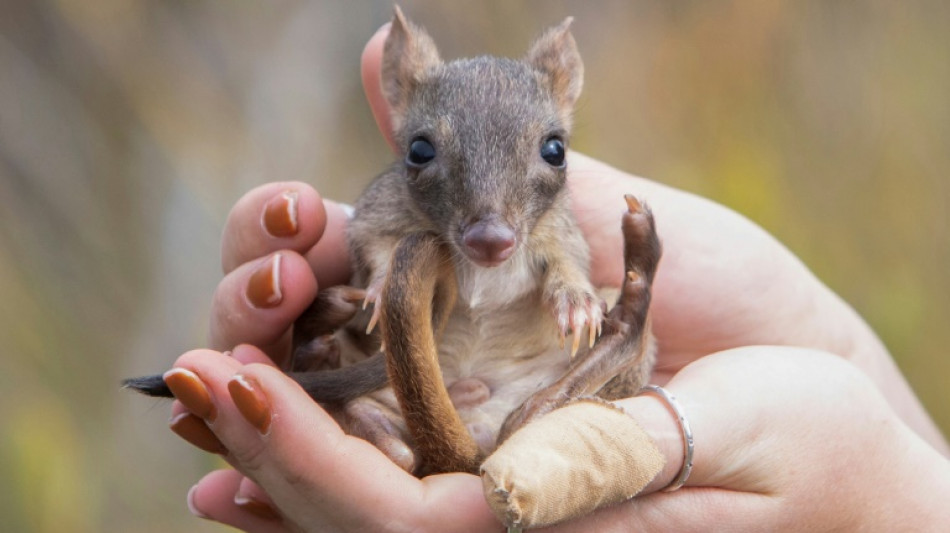
'Mini kangaroos' hop back in South Australia / Photo: © WWF AUSTRALIA/AFP

 American McNulty wins shock road race world title

 Serbia's President Aleksandar Vucic announces resignation

 Tuchel urges Bellingham to play with 'rage'

 Russian strikes on Ukraine kill 8

 Bavuma, Miller hit centuries as South Africa clinch series
 Spain bring in Le Normand for injured Garcia

 UK Labour party meets buoyed by Burnham but seeking concrete plans

 Nor'easter lashes US east with punishing rain and wind

 UK police arrest five on suspicion of preparing 'terrorist act' near air base
 Washington denounces Iran's truce proposal as 'cynical'

 Armani sprinkles glitter on discreet elegance at Milan show

 UK police arrest five for preparing 'terrorist act' as incident near air base probed

 อเล็กซ์ โบดี และศาสตราจารย์ ดร. ดีเทอร์ ลาซิก ลงนามสัญญาสำหรับ ALPHA WHEY และ BODI เครื่องดื่มให้พลังงาน

 China teen blows away the field for record-setting gold at 'sad' Games

 Alex Bodi och prof. dr. Dieter Lazik tecknar avtal om ALPHA WHEY och BODI Energidryck

 Alex Bodi i prof. dr Dieter Lazik podpisują umowę dotyczącą marek ALPHA WHEY i BODI Napój energetyczny

 Ο Alex Bodi και ο καθηγητής Δρ. Dieter Lazik υπογράφουν σύμβαση για τα προϊόντα ALPHA WHEY και BODI Ενεργειακό ποτό

 アレックス・ボディ氏とディーター・ラジク教授が「ALPHA WHEY」および「BODI エナジードリンク」に関する契約を締結

 Housing protesters dig in for long stay in Madrid square

 Alex Bodi și prof. dr. Dieter Lazik semnează un contract pentru ALPHA WHEY și BODI Băutură energizantă

 Former Stoke boss Pulis 'cheated' over FA Cup final loss to Man City

 Czech Republic beat Ukraine to win BJK Cup

 Isak returns to Liverpool after injury scare

 Gunmen kill 27 in two shootings in South Africa

 Spain PM vows action as housing protest sparked by eviction grows

The brush-tailed bettong -- a rare, very cute marsupial resembling a rabbit-sized kangaroo -- is bouncing back on the South Australian mainland, more than 100 years after disappearing from the region.
Bettongs, which leap with their hindlegs much like a full-sized kangaroo, populated over 60 percent of Australia before falling victim to cats, foxes and land-clearing after European settlement more than two centuries ago.
Now they are making a comeback in South Australia's Yorke Peninsula, after wildlife scientists released 120 of the animals over a two-year period to see if they could survive outside of predator-proof enclosures or islands.
New monitoring shows they are thriving, researchers said Friday.
Scientists said they had trapped 85 brush-tailed bettongs, finding that 40 percent of them were new animals born in the peninsula and 42 of the 45 females had young in their pouches.
"It's fantastic to see so many new animals in the population," said Derek Sandow, ecologist for the Northern and Yorke Landscape Board.
The furry creatures -- their numbers down from tens of millions pre-colonisation to an estimated 12,000 to 18,000 now -- have clung to existence on Australian islands, in protected enclosures, and in a few pockets of Western Australia.
- 'Mini-kangaroo on steroids' -
Their comeback in South Australia was helped by an intensive cat and fox control programme, Sandow said, as well as a "leaky" fence to reduce -- without entirely excluding -- the predators from the southern part of the peninsula.
The little animals play a big role in Australia's environment, he told AFP.
"They're a little, ankle-sized kangaroo, a mini kangaroo on steroids if you like. They've got really powerful hind legs, they carry their young in their pouch, like a kangaroo does, but they're only a kilo and a half (three pounds)," Sandow explained.
"So they're only small, but they'll shoot around in the bush, they'll create their little nests underneath in dense vegetation," he said.
"They dig a lot. A little bettong can move tonnes of soil per year. So they dig in the ground, they create little micro habitats for water infiltration for seeds to establish. And so they're just really important in the ecosystem."
Since their numbers were decimated by cats and foxes, no other creature had been able to replicate their role in making the Australian landscape habitable for other wildlife, he said.
Under attack, female brush-tailed bettongs have an unusual but effective defence mechanism, Sandow said.
"To get away, they'll kind of zigzag off through the bush at high speed. They're really fast for their size," the scientist said.
- 'Horrible parenting' -
But females had an extra defence mechanism -- throwing out their young from their pouches in the hope of escaping while the predator targets their offspring.
"It sounds like horrible parenting, but it's really successful," Sandow said.
They breed quickly, he said, and females often have embryos ready to advance into the pouch when their young leave naturally or die.
"They can basically have their baby ready to go in their back pocket, and then replace it," he said. "And then, within a matter of weeks, they can kind of be back at that same stage."
Scientists believe the brush-tailed bettong and other species can thrive if fox and cat populations can be controlled, even if they are not eradicated, Sandow said.
"We are really hoping that the brush-tailed bettong is just one of the first of many species that we can bring back and help restore the bush."
E.Schubert--BTB



