Syrians turn plastic waste into rugs to make a living / Photo: © AFP

 Commanders hand champion Seahawks their first loss

 Dupont scores twice to send Toulouse top of Top 14

 Ireland beat Israel but no handshakes due to war in Gaza

 Tense standoff over flashpoint N.Ireland parade lasts into night

 Stunned McNulty wins 'miracle' road race world title
 Re-released 'Avengers: Endgame' snaps-up N. America box office lead
 American McNulty wins shock road race world title
 Serbia's President Aleksandar Vucic announces resignation
 Tuchel urges Bellingham to play with 'rage'

 Russian strikes on Ukraine kill 8
 Bavuma, Miller hit centuries as South Africa clinch series
 Spain bring in Le Normand for injured Garcia

 UK Labour party meets buoyed by Burnham but seeking concrete plans

 Nor'easter lashes US east with punishing rain and wind

 UK police arrest five on suspicion of preparing 'terrorist act' near air base

 Washington denounces Iran's truce proposal as 'cynical'

 Armani sprinkles glitter on discreet elegance at Milan show

 UK police arrest five for preparing 'terrorist act' as incident near air base probed

 อเล็กซ์ โบดี และศาสตราจารย์ ดร. ดีเทอร์ ลาซิก ลงนามสัญญาสำหรับ ALPHA WHEY และ BODI เครื่องดื่มให้พลังงาน

 China teen blows away the field for record-setting gold at 'sad' Games

 Alex Bodi och prof. dr. Dieter Lazik tecknar avtal om ALPHA WHEY och BODI Energidryck

 Alex Bodi i prof. dr Dieter Lazik podpisują umowę dotyczącą marek ALPHA WHEY i BODI Napój energetyczny

 Ο Alex Bodi και ο καθηγητής Δρ. Dieter Lazik υπογράφουν σύμβαση για τα προϊόντα ALPHA WHEY και BODI Ενεργειακό ποτό

 アレックス・ボディ氏とディーター・ラジク教授が「ALPHA WHEY」および「BODI エナジードリンク」に関する契約を締結

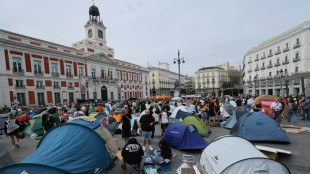
 Housing protesters dig in for long stay in Madrid square

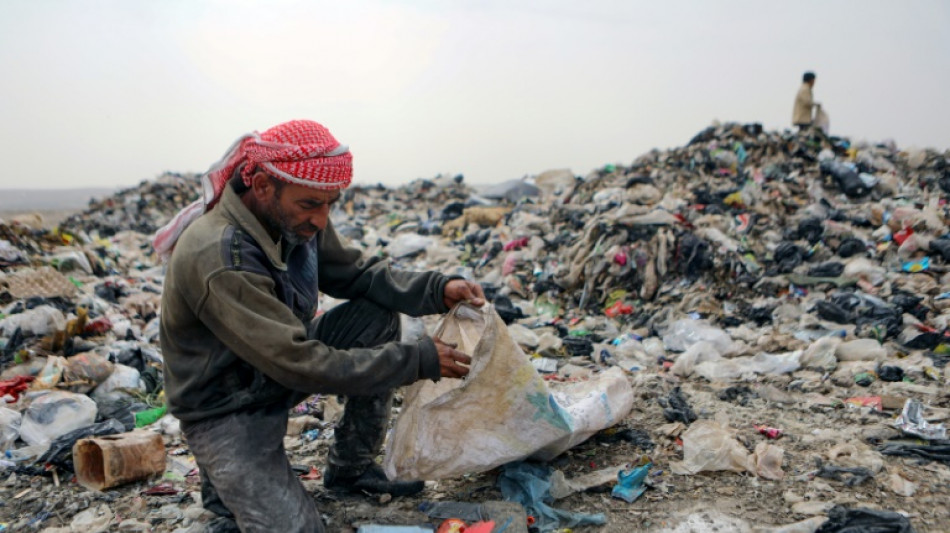
At a rubbish dump in northwest Syria, Mohammed Behlal rummages for plastic to be sold to recyclers and transformed into floor rugs and other items in the impoverished rebel enclave.
In rebel-held Syria, recycling is rarely an environmental impulse but rather a grim lifeline for needy residents looking for work or items they otherwise could not afford.
Braving the stench, insects and risk of disease, 39-year-old Behlal hacks through the rubbish pile with a scythe and his bare hands.
He and two of his six children earn a living sifting through the refuse in Idlib province's village of Hezreh, earning $7 to $10 a week each.
"It's tiring... but what can we do, we have to put up with this hard labour," said Behlal, who was displaced from neighbouring Aleppo province during Syria's civil war.
"Thank God, at least we have work with the trash," he added.
Behlal was shot in the leg during fighting and has had trouble finding employment.
Hunched over to collect pieces of plastic or metal, he throws everything into a bag to sell to a nearby scrap facility.
Syria's conflict has killed more than 500,000 people, and around half of the country's pre-war population has been forced from their homes since fighting broke out in 2011.
More than four million people, most of them dependent on aid, live in areas controlled by jihadists and Turkish-backed groups in Syria's north and northwest.
In a large scrapyard next to agricultural fields, workers sort plastic junk loosely into piles according to colour.
They then cut it up and crush it into small pieces that are washed and melted into plastic pellets.
- Plastic thread -
Farhan Sleiman, 29, is among those who handle the material brought in from the landfill.
"We buy plastic from roaming trash-picker trucks and children," said Sleiman, originally from Homs province.
He expressed fear of the risk of contracting "cholera or chronic illnesses" from working with the rubbish.
Elsewhere in northern Idlib province, workers at a factory making mats and rugs churn out brightly coloured plastic thread while large weaving machines click and clack.
Factory owner Khaled Rashu, 34, says rug-making is a family tradition.
"We have more than 30 employees" at the factory, he boasted as a significant feat in a region where many are jobless.
Large mats featuring geometric designs, some made with striking red or purple plastic thread, emerge from the weaving machines and are stacked into piles.
Shop owner Mohammed al-Qassem, 30, is among those selling the mats, which he says are a hit in an area where many people are displaced and live in basic tents or makeshift dwellings.
The mats made from recycled plastic cost between $5 and $15, while traditional Persian-style rugs are around $100.
"In summer, demand for plastic mats increases" because they retain less heat, Qassem said from his shop in Maaret Masrin, a town in Idlib province.
But "they can also be used in winter and are less costly", he added.
A.Gasser--BTB



