Dogs die as South Africa snake antivenom shortage bites / Photo: © AFP

 Commanders hand champion Seahawks their first loss

 Dupont scores twice to send Toulouse top of Top 14

 Ireland beat Israel but no handshakes due to war in Gaza

 Tense standoff over flashpoint N.Ireland parade lasts into night

 Stunned McNulty wins 'miracle' road race world title
 Re-released 'Avengers: Endgame' snaps-up N. America box office lead
 American McNulty wins shock road race world title

 Serbia's President Aleksandar Vucic announces resignation

 Tuchel urges Bellingham to play with 'rage'

 Russian strikes on Ukraine kill 8

 Bavuma, Miller hit centuries as South Africa clinch series
 Spain bring in Le Normand for injured Garcia

 UK Labour party meets buoyed by Burnham but seeking concrete plans

 Nor'easter lashes US east with punishing rain and wind

 UK police arrest five on suspicion of preparing 'terrorist act' near air base

 Washington denounces Iran's truce proposal as 'cynical'

 Armani sprinkles glitter on discreet elegance at Milan show

 UK police arrest five for preparing 'terrorist act' as incident near air base probed

 อเล็กซ์ โบดี และศาสตราจารย์ ดร. ดีเทอร์ ลาซิก ลงนามสัญญาสำหรับ ALPHA WHEY และ BODI เครื่องดื่มให้พลังงาน

 China teen blows away the field for record-setting gold at 'sad' Games

 Alex Bodi och prof. dr. Dieter Lazik tecknar avtal om ALPHA WHEY och BODI Energidryck

 Alex Bodi i prof. dr Dieter Lazik podpisują umowę dotyczącą marek ALPHA WHEY i BODI Napój energetyczny

 Ο Alex Bodi και ο καθηγητής Δρ. Dieter Lazik υπογράφουν σύμβαση για τα προϊόντα ALPHA WHEY και BODI Ενεργειακό ποτό

 アレックス・ボディ氏とディーター・ラジク教授が「ALPHA WHEY」および「BODI エナジードリンク」に関する契約を締結

 Housing protesters dig in for long stay in Madrid square

Zarza, a much-loved Staffordshire terrier, ended up at a South African animal hospital with a bite from a Mozambique spitting cobra on her snout.
The snake's powerful venom can stop the breathing muscles from working, but normally the bites are treatable with an antidote.
The problem, say South African veterinarians, is that they currently have virtually no vials of the antiserum left.
"We've been out of antivenom for quite some months now," said Dean de Kock, a vet at the Valley Farm Animal Hospital in Pretoria, where Zarza was treated but eventually died.
Vets and snake experts say the shortage started getting serious towards the end of last year -- though the authorities are denying there is a problem.
"Snakebite antivenom is available in the country," the National Health Laboratory Service (NHLS), a government body in charge of antidote production, told AFP.
Experts in the field disagree.
- A 'countrywide shortage' -
In April, a group of snakebite treatment specialists pleaded with the health minister over what they described as "a major health risk".
While the supply problems may be easing in some quarters, vets say they are still struggling.
Hospitals treating humans get priority when any new doses come available, said Johan Marais, a herpetologist -- specialist in reptiles and amphibians -- who heads the African Snakebite Institute.
"At the moment, if you're a veterinarian, you cannot get antivenom," said Marais, 65.
Speaking from his headquarters in Pretoria, he casually handled a black mamba during his conversation with AFP.
He said he receives up to a dozen calls a day from desperate animal doctors and dog owners looking for antidotes.
"If your dog gets a serious snakebite today, there's a likelihood it's going to die," Marais said.
Alan Kloeck, of the South African Veterinary Association, confirmed Marais's remarks, describing a "countrywide shortage" with vets unable to get their hands on the antiserum they needed.
- Horse blood, spitting cobras -
South Africa is home to about 160 species of snakes, many of them poisonous.
South African Vaccine Producers -- a NHLS subsidiary and the only antivenom maker in the country -- produces two antidotes.
One can treat bites from 10 snakes including the cape cobra, the puff adder and the green mamba, while another is for relatively rare boomslang bites.
Making the antiserums is a laborious process, said Mike Perry of African Reptiles and Venom, a venom-extraction firm in Centurion, outside Johannesburg, that houses around 900 snakes in small glass cages.
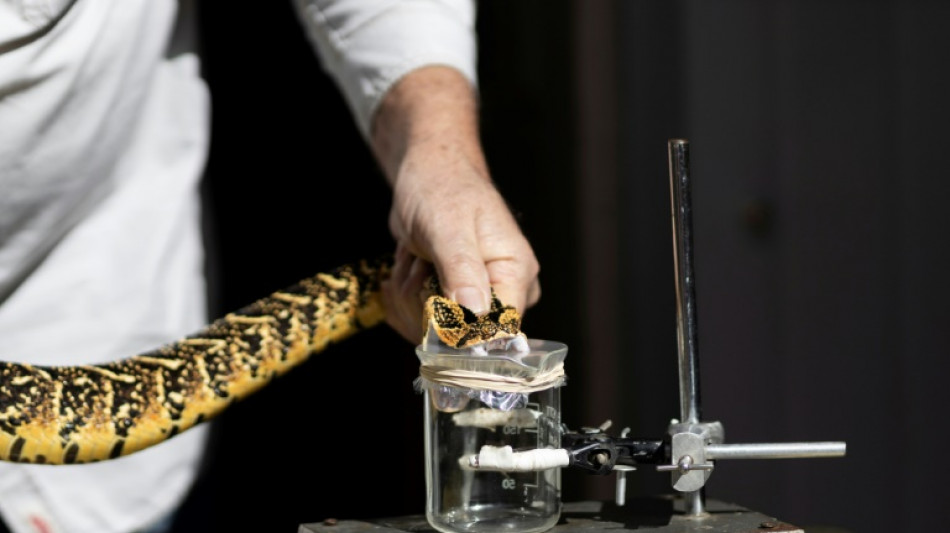
He said his team forces the hissing reptiles to spit out their poison by forcing them to bite a glass jar.
Small quantities of the toxins are then injected into horses, which over time develop immunity.
Their plasma is then harvested and processed to make the serum.
But that process requires constant refrigeration, and the production backlog has been blamed in large part on South Africa's energy crisis, which has caused repeated power blackouts.
In April, NHLS said it required "a consistent and dependable power supply" to produce antivenom.
The continuous switchover to generators during outages interrupted production and affected stockpiles, it said, forcing it to invest in backup power systems and renewable energy.
- 'Last vial' -
Last week, NHLS said it had increased manufacturing in recent months.
Since January, it said, it had delivered antivenom to more than 230 institutions, including hospitals and veterinary clinics, fulfilling all orders apart from "a small backlog" affecting a provincial depot.
But de Kock, whose veterinary practice is in a different province, has not received any shipments since December. For a while, they were using expired doses from other hospitals, but these too have dried up.
"We have used the last vial on Sunday evening," he said last week.
Over the past three months, the hospital treated 25 dogs for snakebites.
Of the 16 who could get expired antivenom, only one did not survive, while six of the nine who could not get doses died.
Zarza was among them, dying in May after a two-day struggle on a ventilator.
"It's tough," said de Kock, 53. "You're doing everything you can but the vital thing that you actually need is the antivenom, and you don't have that".
His hope was that the austral winter months, when snakes are less active, would bring some relief.
O.Krause--BTB



