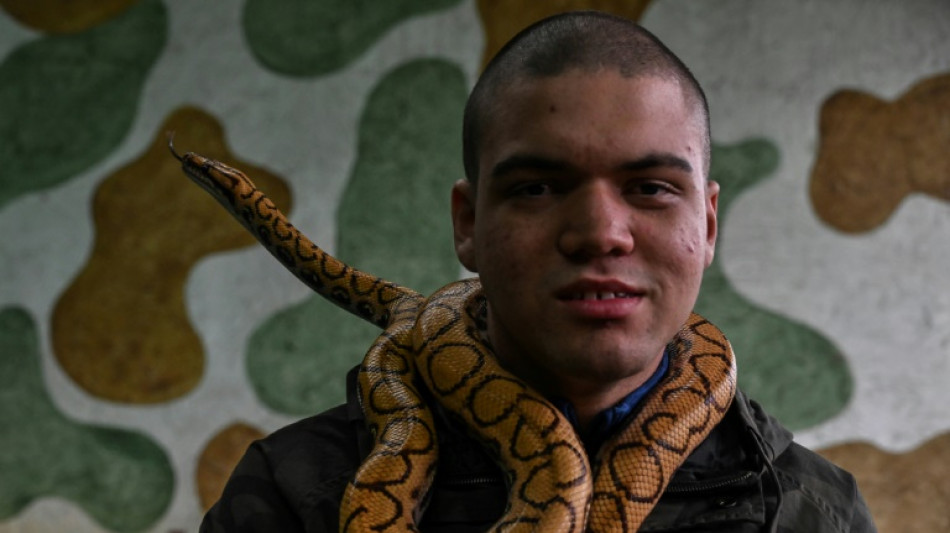
Snakes as therapy animals: reptiles help heal in Brazil / Photo: © AFP

 Commanders hand champion Seahawks their first loss

 Dupont scores twice to send Toulouse top of Top 14

 Ireland beat Israel but no handshakes due to war in Gaza

 Tense standoff over flashpoint N.Ireland parade lasts into night

 Stunned McNulty wins 'miracle' road race world title

 Re-released 'Avengers: Endgame' snaps-up N. America box office lead

 American McNulty wins shock road race world title

 Serbia's President Aleksandar Vucic announces resignation

 Tuchel urges Bellingham to play with 'rage'

 Russian strikes on Ukraine kill 8

 Bavuma, Miller hit centuries as South Africa clinch series

 Spain bring in Le Normand for injured Garcia

 UK Labour party meets buoyed by Burnham but seeking concrete plans

 Nor'easter lashes US east with punishing rain and wind

 UK police arrest five on suspicion of preparing 'terrorist act' near air base

 Washington denounces Iran's truce proposal as 'cynical'

 Armani sprinkles glitter on discreet elegance at Milan show

 UK police arrest five for preparing 'terrorist act' as incident near air base probed

 อเล็กซ์ โบดี และศาสตราจารย์ ดร. ดีเทอร์ ลาซิก ลงนามสัญญาสำหรับ ALPHA WHEY และ BODI เครื่องดื่มให้พลังงาน

 China teen blows away the field for record-setting gold at 'sad' Games

 Alex Bodi och prof. dr. Dieter Lazik tecknar avtal om ALPHA WHEY och BODI Energidryck

 Alex Bodi i prof. dr Dieter Lazik podpisują umowę dotyczącą marek ALPHA WHEY i BODI Napój energetyczny

 Ο Alex Bodi και ο καθηγητής Δρ. Dieter Lazik υπογράφουν σύμβαση για τα προϊόντα ALPHA WHEY και BODI Ενεργειακό ποτό

 アレックス・ボディ氏とディーター・ラジク教授が「ALPHA WHEY」および「BODI エナジードリンク」に関する契約を締結

 Housing protesters dig in for long stay in Madrid square

A yellow-and-brown boa constrictor wraps itself around David de Oliveira Gomes's neck like a scarf, but the 15-year-old Brazilian with autism is fascinated, not afraid.
For him, this is therapy.
"His name is Gold. He's cold. He eats mice," Gomes tells his therapist at a treatment center in Sao Paulo, gently holding the large snake as it slithers around him.
That is exactly the kind of sentence his therapist, Andrea Ribeiro, is trying to elicit.
She specializes in treating people with disabilities, autism or anxiety, using an unusual method: reptile therapy, which she says helps patients relax and improve their communication, motor skills and other abilities.
"He's working on speech and memory formation," the 51-year-old language-speech therapist says of Gomes, sitting at a table with him and the large snake.
Ribeiro has pioneered this method over the past decade at the treatment center, which features an open-air space where patients interact with lizards, turtles and a "jacare" -- a kind of alligator native to Latin America that is common in Brazil, including in the Amazon rainforest.
The treatment is not scientifically proven.
But "it's been medically demonstrated that when people come in contact with animals, it releases neurotransmitters such as serotonin and beta-endorphins that give a sense of pleasure and well-being," says Ribeiro.
"That makes (patients) feel good and want to learn."
The reptiles "enable us to achieve better, faster results," she told AFP.
- Step aside, dogs -
Ribeiro used to use dogs in her treatment sessions.
But she found their constant attempts to play and interact made some patients uneasy, especially those with autism.
So she turned to reptiles.
It's a class of animals that makes many people squirm.
But people with autism tend to approach them "without prejudice," she says: The animals spark their curiosity without making them uncomfortable.
The reptiles, for their part, "are indifferent," she says.
"They don't seek attention the way some mammals do."
Ten-year-old Gabriel Pinheiro is petting a small alligator, trying to imitate Ribeiro's syllables by opening his mouth wide three times: "Ja-ca-re."
"It's wet," he says, his eyes fixated on the creature from behind his glasses.
The alligator's scales are "hard," its belly "soft," he says, as the therapist helps him work on opposites.
He and Ribeiro then sing a song about the jacare to practice auditory memory skills.
Pinheiro's mother, Cristina, credits four years of this therapy with helping improve his listening, communication and motor skills.
"He's always happy when we come," she says.
- Reptilian massage -
Another patient, 34-year-old Paulo Palacio Santos, suffered severe brain damage in an accident that left him paralyzed and speechless.
Ribeiro wraps his face with a thick snake, whose weight and cold temperature help reactivate Santos's swallowing reflex, she says.
She then uses a smaller boa constrictor to work the muscles around his mouth.
The handling of these species is regulated by Brazil's environmental authority, IBAMA.
Ribeiro works side-by-side with biologist Beatriz Araujo, whose job is to monitor the animals' stress levels and ensure patients remain safe.
There has never been an accident in 10 years of treatment, the center says.
The reptiles, which are raised on site, are accustomed to human contact. No poisonous snakes are used.
"I'm always here, just in case (an animal) reacts unexpectedly," says Araujo.
"The dangers are the same as for close contact with any animal."
L.Dubois--BTB



