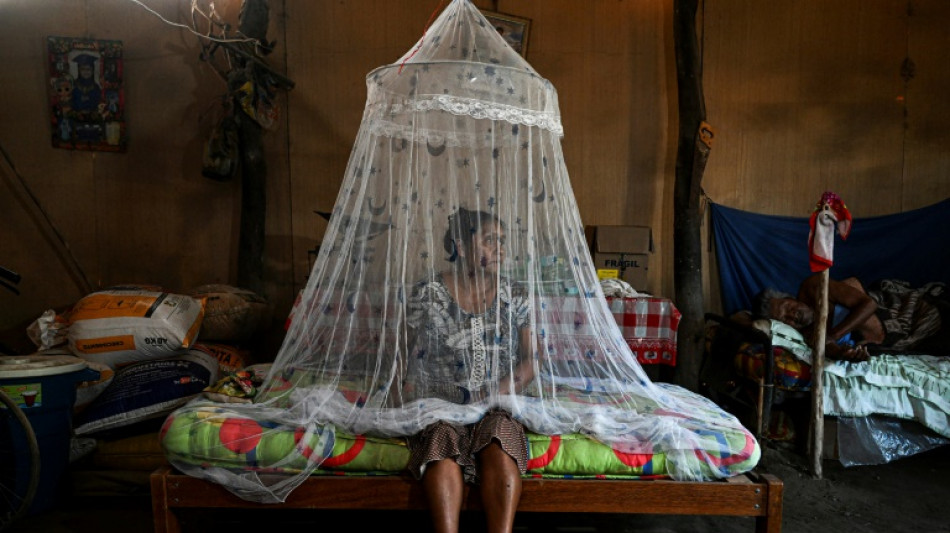
Brimful clinics, cemeteries as dengue ravages Peru / Photo: © AFP

 Commanders hand champion Seahawks their first loss

 Dupont scores twice to send Toulouse top of Top 14

 Ireland beat Israel but no handshakes due to war in Gaza

 Tense standoff over flashpoint N.Ireland parade lasts into night

 Stunned McNulty wins 'miracle' road race world title

 Re-released 'Avengers: Endgame' snaps-up N. America box office lead

 American McNulty wins shock road race world title

 Serbia's President Aleksandar Vucic announces resignation

 Tuchel urges Bellingham to play with 'rage'

 Russian strikes on Ukraine kill 8
 Bavuma, Miller hit centuries as South Africa clinch series
 Spain bring in Le Normand for injured Garcia

 UK Labour party meets buoyed by Burnham but seeking concrete plans

 Nor'easter lashes US east with punishing rain and wind

 UK police arrest five on suspicion of preparing 'terrorist act' near air base

 Washington denounces Iran's truce proposal as 'cynical'

 Armani sprinkles glitter on discreet elegance at Milan show

 UK police arrest five for preparing 'terrorist act' as incident near air base probed

 อเล็กซ์ โบดี และศาสตราจารย์ ดร. ดีเทอร์ ลาซิก ลงนามสัญญาสำหรับ ALPHA WHEY และ BODI เครื่องดื่มให้พลังงาน

 China teen blows away the field for record-setting gold at 'sad' Games

 Alex Bodi och prof. dr. Dieter Lazik tecknar avtal om ALPHA WHEY och BODI Energidryck

 Alex Bodi i prof. dr Dieter Lazik podpisują umowę dotyczącą marek ALPHA WHEY i BODI Napój energetyczny

 Ο Alex Bodi και ο καθηγητής Δρ. Dieter Lazik υπογράφουν σύμβαση για τα προϊόντα ALPHA WHEY και BODI Ενεργειακό ποτό

 アレックス・ボディ氏とディーター・ラジク教授が「ALPHA WHEY」および「BODI エナジードリンク」に関する契約を締結

 Housing protesters dig in for long stay in Madrid square

Two months after cyclonic downpours flooded the town of Catacaos in northern Peru, dozens of inhabitants lie sick and dying of dengue, a disease carried by mosquitos attracted by stagnant water.
Near the border with Ecuador, Peru's Piura region is battling a new health crisis even as the South American country is still recovering from the world's highest reported Covid-19 death rate.
This time it is an epidemic of dengue, a viral disease with symptoms ranging from fever, headache and joint pain to bleeding, organ failure and sometimes, death.
The virus is carried by the Aedes aegypti mosquito that lays its eggs in standing water, of which there is a lot in Piura since cyclone Yaku hit northern Peru in March.
Dozens of people were killed and thousands affected as rivers burst their banks, destroying homes and infrastructure.
Half of the Piura region's 416 clinics were damaged by the cyclone that also paralyzed the local economy as thousands lost their ability to survive from informal jobs.
Maria Francisca Sosa, 45, is one of many taking care of ailing relatives at home amid skyrocketing infections and overwhelmed public health care facilities in scenes reminiscent of the coronavirus epidemic.
Her father Jose Luciano, 93, is fighting a dengue infection.
"It hit him so hard that he couldn't even stand anymore. Once, he was so sick that we thought he was going to die," Sosa told AFP as she wiped her father's sweaty forehead in the shanty they share with five other people.
With public health facilities overwhelmed, the family was forced to take out a loan to pay for a private doctor and medicine to treat the old man's symptoms. There is no cure for dengue.
- 'Lost control' -
By June 13, Piura had reported 82 dengue deaths -- including 11 children -- and more than 44,000 infections since the start of 2023, said the region's rights ombudsman Cesar Orrego.
This was about a third of the national toll of 248 deaths and more than 146,000 infections.
"We have lost control" of the epidemic, vector-borne diseases expert Valerie Paz-Soldan of the Cayetano Heredia University in Lima told AFP.
On Thursday, Peru's health minister resigned over her handling of the crisis.
Most of Piura's 1.8 million inhabitants live along the coast.
In Catacaos, an agricultural area, Yaku turned roads into rivers, destroyed the drinking water and sewerage systems, and ruined mango, grape and rice crops.
Water accumulated in open tanks, hollows and containers, multiplying mosquito breeding grounds. In the heart of Catacaos, the football field is still water-logged.
Multiple fumigation efforts failed to stop the epidemic spreading like wild-fire through the town's rickety homes.
Teolinda Silva, 45, takes care of her stricken son Gabriel, 27.
"I don't have the money to take him to a clinic and have him examined. Right now, I am going through difficult times, there is no work, there is nothing," Silva, an informal fish merchant, told AFP.
Luis Alfredo Espinoza Venegas, 44, who coordinates dengue surveillance at the Sullana hospital, said the region was dealing with its worst outbreak in recent memory.
"We have an immense human resource gap, our first level of care has collapsed and we lack supplies, medicines," he said.
Doctors fear the number of infections and deaths may be much higher than reported as many patients are never even diagnosed.
- 'We did everything' -
Last weekend, a wailing procession accompanied the remains of FerMaria Ancajima to a cemetery in Catacaos.
She was just ten years old when dengue took her.
Her family had to borrow money to bring her body back from Lima, where they had taken her to seek medical care.
"We did everything we could," her uncle Julio Morales, 52, told AFP.
The World Health Organization says dengue and other diseases such as chikungunya carried by A. aegypti are spreading far faster and further amid climate change.
Other countries in Latin America are also affected by the dengue outbreak, but Peru has registered the second highest mortality so far this year after Brazil.
In February, Peru declared a health emergency in several departments after recording a 72-percent increase in dengue cases from the same period in 2022.
A.Gasser--BTB



