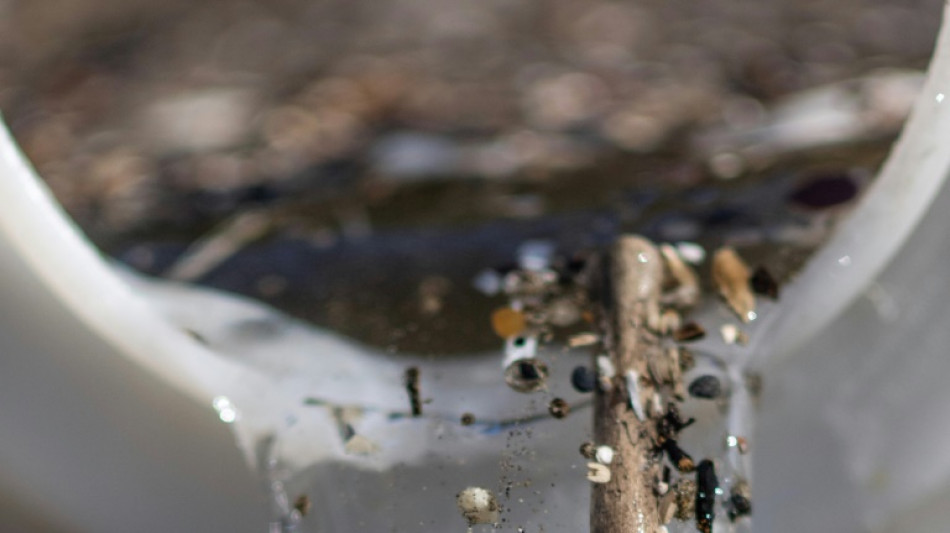
'Time bomb'?: Race to identify health effects of microplastics / Photo: © AFP/File

 Commanders hand champion Seahawks their first loss

 Dupont scores twice to send Toulouse top of Top 14

 Ireland beat Israel but no handshakes due to war in Gaza

 Tense standoff over flashpoint N.Ireland parade lasts into night

 Stunned McNulty wins 'miracle' road race world title

 Re-released 'Avengers: Endgame' snaps-up N. America box office lead

 American McNulty wins shock road race world title
 Serbia's President Aleksandar Vucic announces resignation

 Tuchel urges Bellingham to play with 'rage'

 Russian strikes on Ukraine kill 8

 Bavuma, Miller hit centuries as South Africa clinch series

 Spain bring in Le Normand for injured Garcia

 UK Labour party meets buoyed by Burnham but seeking concrete plans

 Nor'easter lashes US east with punishing rain and wind

 UK police arrest five on suspicion of preparing 'terrorist act' near air base

 Washington denounces Iran's truce proposal as 'cynical'

 Armani sprinkles glitter on discreet elegance at Milan show

 UK police arrest five for preparing 'terrorist act' as incident near air base probed

 อเล็กซ์ โบดี และศาสตราจารย์ ดร. ดีเทอร์ ลาซิก ลงนามสัญญาสำหรับ ALPHA WHEY และ BODI เครื่องดื่มให้พลังงาน

 China teen blows away the field for record-setting gold at 'sad' Games

 Alex Bodi och prof. dr. Dieter Lazik tecknar avtal om ALPHA WHEY och BODI Energidryck

 Alex Bodi i prof. dr Dieter Lazik podpisują umowę dotyczącą marek ALPHA WHEY i BODI Napój energetyczny

 Ο Alex Bodi και ο καθηγητής Δρ. Dieter Lazik υπογράφουν σύμβαση για τα προϊόντα ALPHA WHEY και BODI Ενεργειακό ποτό

 アレックス・ボディ氏とディーター・ラジク教授が「ALPHA WHEY」および「BODI エナジードリンク」に関する契約を締結

 Housing protesters dig in for long stay in Madrid square

Tiny pieces of plastic have been found littered throughout human bodies, trapped in our lungs and laced through our blood, but the long-term health effects of this exposure remain unclear.
Every day humans ingest, inhale or otherwise come in contact with microplastics, plastic pollution less than five millimetres (0.2 inches) in diameter that is mostly invisible to the naked eye.
Microplastics have been found most everywhere on Earth, from the deepest oceans to the highest mountains, as well as in the air, water, soil and food chain.
But in the last couple of years scientists have discovered microplastics not just throughout nature but also throughout human bodies, detecting it in lungs, livers -- even in placentas.
Last year a Dutch study became the first to identify microplastics in human blood.
While scientists have urged caution due to the study's small sample size, the presence of microplastics could suggest it is being transported through the bloodstream into organs.
But for now, the data remain incomplete on the health effects of microplastics, a complex cocktail of polymers and chemicals that could smuggle in other contaminants in what is called the "Trojan Horse" effect.
- 'Insidious' -
Xavier Coumoul, a toxicologist at French medical research institute INSERM, told AFP that there has been "more and more research" in the area over the last decade.
But he said that research had been late to get started because -- similar to global warming -- the "insidious changes" crept up so slowly.
"We do not know whether our level of exposure will lead to chronic or acute illnesses in the long term -- but we can legitimately ask the question," he said.
Research has shown that microplastics have a range of detrimental effects on the health of animals, including an increase in inflammation, oxidative stress and damage to cells.
"Both in human and mice lung tissues, we have seen an inhibitory effect on development after putting plastic fibres inside organoids, mini-lungs grown" from stem cells, said Barbro Melgert, a respiratory immunologist at the University of Groningen in the Netherlands.
"This effect seemed not to be caused by the plastic itself, but by something leaking from the (plastic particles), some chemicals added," she said.
"But we don't know exactly what chemical was involved," she said. "It's very difficult to find out, especially with low quantities."
Indeed, the roles that the shape, size and type of microplastic -- as well as additives -- remain poorly understood. But researchers are working on it.
Last week, a study in the journal Physics of Fluid modelled how different sizes of inhaled microplastics rattled through human airways, finding that they tended to collect in the nasal cavity or in the back of the throat.
- Tipping point? -
It is also unclear how much microplastic individual people are exposed to.
"We don't really know how much microplastics we breathe, there's not a lot of studies," Melgert said, adding that research over longer time periods was needed.
The World Wildlife Fund made headlines in 2019 by estimating that people ingest around five grams of plastic a week, the equivalent of a credit card.
The methodology and findings of the study the WWF was citing have been contested, and other research has indicated a lower level of individual exposure.
But experts are still sounding the alarm.
Coumoul compared microplastics to pesticides, saying "it has sometimes taken a long time to identify the long-term risk to humans".
"Let's try to prevent a time bomb," Melgert said.
And an even greater tidal wave of plastic looms on the horizon.
On current trends, annual production of fossil-fuel plastic will nearly triple by 2060 to 1.2 billion tonnes.
Melgert warned that humanity's ever-increasing production of plastic means that we could soon "pass a critical limit" for human exposure.
Earlier this month, there was some rare goods news in the fight against plastic pollution.
After five days of gruelling talks, 175 nations gathered in Paris agreed to reveal the first draft of a much-anticipated plastic pollution treaty by the end of November.
For now, experts recommend that people limit their exposure to microplastics by ventilating their homes, not eating out of plastic containers and avoiding synthetic textiles such as polyester.
A.Gasser--BTB



