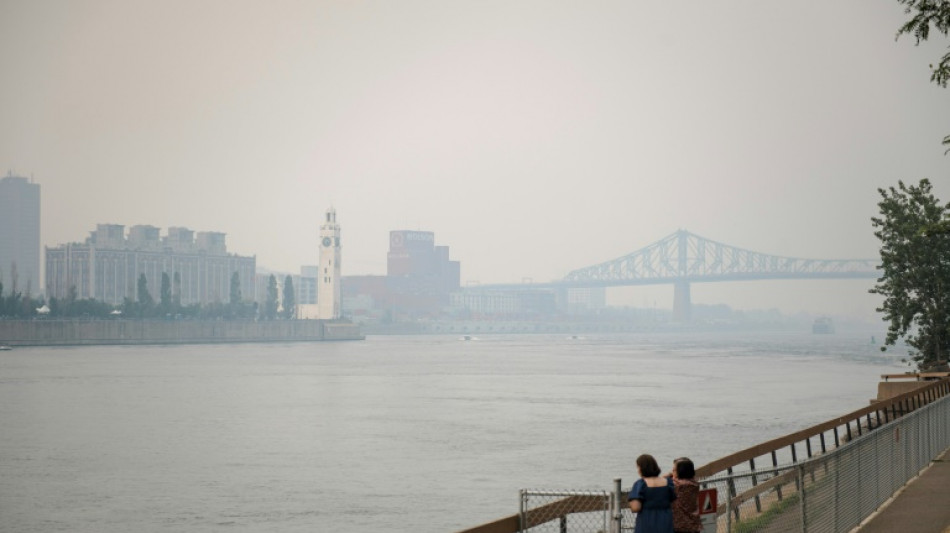
Canada wildfire smoke chokes millions in North America / Photo: © AFP

 Commanders hand champion Seahawks their first loss

 Dupont scores twice to send Toulouse top of Top 14

 Ireland beat Israel but no handshakes due to war in Gaza

 Tense standoff over flashpoint N.Ireland parade lasts into night

 Stunned McNulty wins 'miracle' road race world title

 Re-released 'Avengers: Endgame' snaps-up N. America box office lead

 American McNulty wins shock road race world title

 Serbia's President Aleksandar Vucic announces resignation

 Tuchel urges Bellingham to play with 'rage'

 Russian strikes on Ukraine kill 8

 Bavuma, Miller hit centuries as South Africa clinch series

 Spain bring in Le Normand for injured Garcia

 UK Labour party meets buoyed by Burnham but seeking concrete plans

 Nor'easter lashes US east with punishing rain and wind

 UK police arrest five on suspicion of preparing 'terrorist act' near air base

 Washington denounces Iran's truce proposal as 'cynical'

 Armani sprinkles glitter on discreet elegance at Milan show

 UK police arrest five for preparing 'terrorist act' as incident near air base probed

 อเล็กซ์ โบดี และศาสตราจารย์ ดร. ดีเทอร์ ลาซิก ลงนามสัญญาสำหรับ ALPHA WHEY และ BODI เครื่องดื่มให้พลังงาน

 China teen blows away the field for record-setting gold at 'sad' Games

 Alex Bodi och prof. dr. Dieter Lazik tecknar avtal om ALPHA WHEY och BODI Energidryck

 Alex Bodi i prof. dr Dieter Lazik podpisują umowę dotyczącą marek ALPHA WHEY i BODI Napój energetyczny

 Ο Alex Bodi και ο καθηγητής Δρ. Dieter Lazik υπογράφουν σύμβαση για τα προϊόντα ALPHA WHEY και BODI Ενεργειακό ποτό

 アレックス・ボディ氏とディーター・ラジク教授が「ALPHA WHEY」および「BODI エナジードリンク」に関する契約を締結

 Housing protesters dig in for long stay in Madrid square

A deep orange-brown sun shined through hazy skies as smoke from Canadian wildfires spread across North America and beyond, choking millions of people and triggering severe air quality alerts.
Here's why the fires are so smoky and why people should be concerned.
- Why is there so much smoke? -
The number of fires and the amount of land scorched, as well as the amount of smoke emitted from the blazes, are unprecedented this wildfire season, and it is just the beginning, according to officials.
The fact that fires flared at the same time across the country is also unusual.
As of Wednesday, more than eight million hectares (20 million acres) of forests and grasslands had burned across Canada, breaking an annual record of 7.3 million hectares set in 1989.
And Canada has yet to reach the peak of the fire season, which is usually in July or August.
"We have a fire in northern Quebec which currently covers 700,000 hectares, for example. It's hard to fathom just how big it is," said Yan Boulanger, a fire specialist for the Canadian Ministry of Natural Resources.
A hot, dry spring resulted in a large fuel load -- dried vegetation and dead branches -- in Canada's boreal forest.
Smoldering humus fires that can burn deep underground produce a lot of smoke, resulting in higher carbon monoxide emissions, says Jack Chen of Canada's environment ministry.
The climate consequences are devastating as the boreal forest releases 10 to 20 times more carbon per unit of area burned than other ecosystems.
Hundreds of forest fires since early May have generated nearly 600 million tons of carbon dioxide, equivalent to 88 percent of the country's total greenhouse gas emissions from all sources in 2021, the Copernicus Atmosphere Monitoring Service (CAMS) reported.
- What are the health concerns? -
Wildfire smoke is more toxic than other types of smoke and can be more dangerous to human health than other sources of air pollution, for example.
The particles are fine and can travel deep into the respiratory tract.
Composed of ozone, sulphur dioxide, nitrogen dioxide, carbon monoxide, volatile organic compounds and PM2.5 fine particles, smoke from forest fires is a danger to all, according to experts and officials.
But it can be particularly dangerous for young children, pregnant women, smokers, seniors and those who suffer from chronic health problems, the Canadian government has warned.
"The particles are so small, particularly the ultra-fine ones, that they can get all the way down into your lungs and then cross over into your bloodstream and lead to inflammation," said Courtney Howard, an emergency room doctor in Yellowknife in Canada's Northwest Territories.
It also can have direct consequences on mental health, mood and anxiety, doctors say.
- What are the effects on wildlife? -
Wildfire smoke particles contain a higher proportion of carbon-based pollutants in various chemical forms that may be spread hundreds of kilometers (miles) from the fires themselves.
This smoke can lead to "acute or chronic health effects on wildlife," just like in humans, said Matthew Mitchell of the University of British Columbia in Vancouver.
"There's a whole suite of chemicals in the smoke that can affect gas exchange in the blood, lower the lung capacity of animals," he told AFP.
Weakened animals will tend to "rest more or try to reduce their activity. So they're not going out and feeding, looking for food or mates," he said.
"Even marine mammals such as whales and dolphins can be affected by the smoke when they come up to breathe," he said.
E.Schubert--BTB



