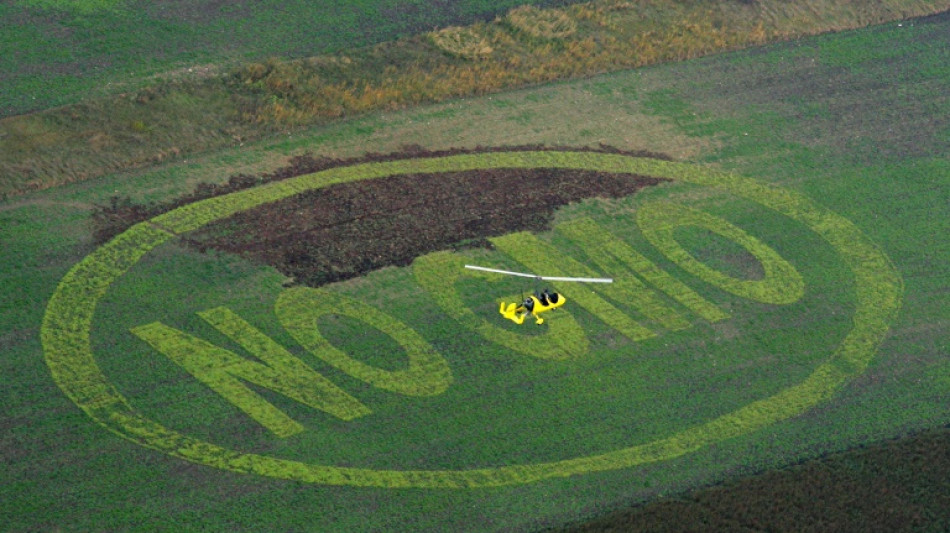
Brussels looks to relax curbs on genetically modified crops / Photo: © AFP

 Commanders hand champion Seahawks their first loss

 Dupont scores twice to send Toulouse top of Top 14

 Ireland beat Israel but no handshakes due to war in Gaza

 Tense standoff over flashpoint N.Ireland parade lasts into night

 Stunned McNulty wins 'miracle' road race world title

 Re-released 'Avengers: Endgame' snaps-up N. America box office lead

 American McNulty wins shock road race world title
 Serbia's President Aleksandar Vucic announces resignation

 Tuchel urges Bellingham to play with 'rage'

 Russian strikes on Ukraine kill 8
 Bavuma, Miller hit centuries as South Africa clinch series

 Spain bring in Le Normand for injured Garcia

 UK Labour party meets buoyed by Burnham but seeking concrete plans

 Nor'easter lashes US east with punishing rain and wind

 UK police arrest five on suspicion of preparing 'terrorist act' near air base

 Washington denounces Iran's truce proposal as 'cynical'

 Armani sprinkles glitter on discreet elegance at Milan show

 UK police arrest five for preparing 'terrorist act' as incident near air base probed
 อเล็กซ์ โบดี และศาสตราจารย์ ดร. ดีเทอร์ ลาซิก ลงนามสัญญาสำหรับ ALPHA WHEY และ BODI เครื่องดื่มให้พลังงาน

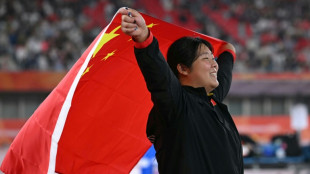 China teen blows away the field for record-setting gold at 'sad' Games

 Alex Bodi och prof. dr. Dieter Lazik tecknar avtal om ALPHA WHEY och BODI Energidryck

 Alex Bodi i prof. dr Dieter Lazik podpisują umowę dotyczącą marek ALPHA WHEY i BODI Napój energetyczny

 Ο Alex Bodi και ο καθηγητής Δρ. Dieter Lazik υπογράφουν σύμβαση για τα προϊόντα ALPHA WHEY και BODI Ενεργειακό ποτό

 アレックス・ボディ氏とディーター・ラジク教授が「ALPHA WHEY」および「BODI エナジードリンク」に関する契約を締結

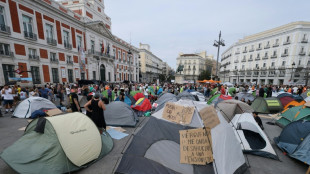 Housing protesters dig in for long stay in Madrid square

The European Commission will on Wednesday put forward a proposal to ease current restrictions on genetically modified crops, which is already being denounced by environmental groups and leftwing lawmakers.
The plan could create a new frontline in the EU's Green Deal, elements of which centre-right European lawmakers are already seeking to stall, arguing they would harm farmers.
The commission says the rules on GMOs (genetically modified organisms) need to be relaxed to grow crops that require fewer pesticides, are better adapted to climate change and need less water.
It wants to allow gene editing within a plant's existing DNA -- which is different from transgenic techniques that introduce a foreign DNA strands and create a distinct species.
"Plants produced by new genomic techniques can support sustainability," EU health commissioner Stella Kyriakides said in April.
"We are designing a regulatory framework that will strongly signal to farmers, researchers and industry that this is the way forward in the EU," she said.
In this area, the commission wants to reduce the tough restrictions that apply to GMOs, which include authorisations, labelling and monitoring.
The text of the project, seen by AFP, calls for the existing GMO rules to not apply to genetically edited crops where the modifications could have come about naturally or through traditional blending procedures of plant species.
Such new crops would be considered "equivalent" to conventional varieties, subject to conditions on the type and number of mutations, a publicly accessible listing, and labelling for the sale of seeds.
No produce coming from these new genomic techniques (NGT) will be able to carry the "bio" label however, and those with herbicide properties would be excluded from the light-touch regulatory approach.
Those that are pesticide resistant would remain in the restrictive regime governing GMOs.
Brussels currently has received 90 authorisation requests for NGT crops, a third of which are in advanced research stages.
A few have reached the level of testing in open fields, such as corn in Belgium and potatoes in Sweden.
- 'Boost productivity' -
Powerful agri-groups such as Copa-Cogeca have been calling for simplified rules to speed up sales of their products.
Some EU member countries and lawmakers in the European Parliament's centre-right EPP grouping back that stance.
"We need to boost productivity and take into account the limited level of natural resources," Spain's agriculture minister Luis Planas said in mid-June, ahead of his country taking over the EU's rotating presidency.
He is looking to weigh this lifting of controls on NGTs against another EU text that aims to reduce the use of pesticides in European farming, but which has become bogged down in arguments over a feared reduction in crop yields.
The EPP, which is the biggest grouping in the parliament, is fiercely opposed to reduced pesticide use, and also a nature restoration law also being negotiated that seeks to repair damaged ecosystems.
Pascal Canfin, a lawmaker from the liberal Renew group who heads the parliament's environment committee, said the commission's NGT proposal could provide terms for a compromise.
"It is strongly backed by the EPP and offers a landing ground, with biotech solutions and natural solutions -- the restoration of ecosystems -- in parallel," he said.
However leftwing lawmakers are against a "GMO deregulation" and are demanding a systematic risk analysis, compulsory labelling, and the means to detect and trace such products.
Environmental groups are also opposed.
Greenpeace denounced it as "GMO deregulation" through the back-door that "ignores potential dangers to the environment, bees and pollinators and human health" and will obscure from consumers what they are eating.
K.Thomson--BTB



