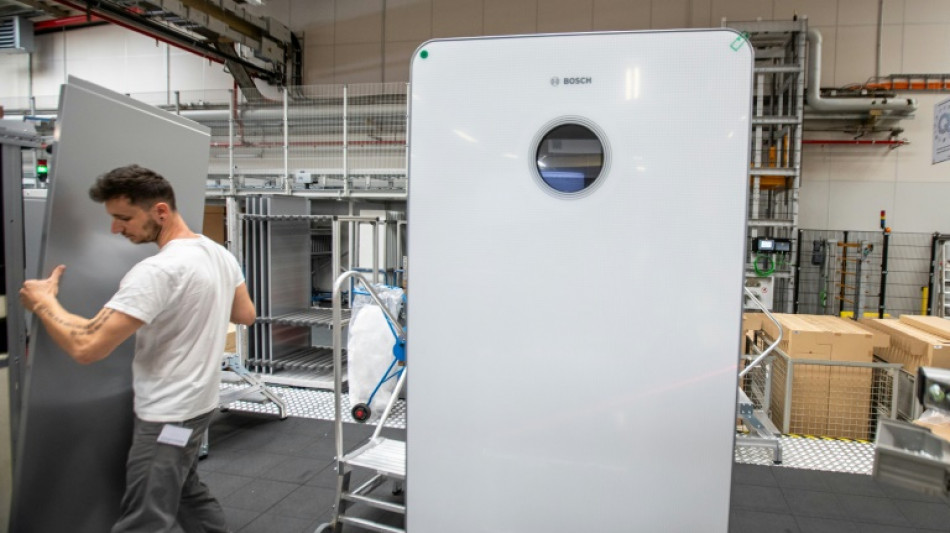
Germany's new big hope against warming - heat pumps / Photo: © AFP

 Commanders hand champion Seahawks their first loss

 Dupont scores twice to send Toulouse top of Top 14

 Ireland beat Israel but no handshakes due to war in Gaza

 Tense standoff over flashpoint N.Ireland parade lasts into night

 Stunned McNulty wins 'miracle' road race world title

 Re-released 'Avengers: Endgame' snaps-up N. America box office lead

 American McNulty wins shock road race world title

 Serbia's President Aleksandar Vucic announces resignation

 Tuchel urges Bellingham to play with 'rage'

 Russian strikes on Ukraine kill 8

 Bavuma, Miller hit centuries as South Africa clinch series

 Spain bring in Le Normand for injured Garcia

 UK Labour party meets buoyed by Burnham but seeking concrete plans

 Nor'easter lashes US east with punishing rain and wind

 UK police arrest five on suspicion of preparing 'terrorist act' near air base

 Washington denounces Iran's truce proposal as 'cynical'

 Armani sprinkles glitter on discreet elegance at Milan show

 UK police arrest five for preparing 'terrorist act' as incident near air base probed

 อเล็กซ์ โบดี และศาสตราจารย์ ดร. ดีเทอร์ ลาซิก ลงนามสัญญาสำหรับ ALPHA WHEY และ BODI เครื่องดื่มให้พลังงาน

 China teen blows away the field for record-setting gold at 'sad' Games

 Alex Bodi och prof. dr. Dieter Lazik tecknar avtal om ALPHA WHEY och BODI Energidryck

 Alex Bodi i prof. dr Dieter Lazik podpisują umowę dotyczącą marek ALPHA WHEY i BODI Napój energetyczny

 Ο Alex Bodi και ο καθηγητής Δρ. Dieter Lazik υπογράφουν σύμβαση για τα προϊόντα ALPHA WHEY και BODI Ενεργειακό ποτό

 アレックス・ボディ氏とディーター・ラジク教授が「ALPHA WHEY」および「BODI エナジードリンク」に関する契約を締結

 Housing protesters dig in for long stay in Madrid square

As Germany looks to a future without fossil fuels, a big white boxy appliance is generating a lively debate -- and often a heated one -- for its potential to replace emissions-heavy oil and gas boilers.
Heat pumps are spurring huge investments from major companies in Europe's top economy, as a backlog of orders piles up for the devices.
While gas remains the most common way to heat German homes, heat pumps had been growing in popularity as part of a shift to greener energy use and following a surge in gas prices after Russia invaded Ukraine.
A new law making its way through parliament requiring heating in homes to be powered by at least 65 percent renewable energy, part of Germany's drive to go carbon neutral by 2045, could further fuel sales of the product in coming years.
As homeowners look to reduce carbon dioxide emissions, the market for the devices has in recent years already been "growing significantly, like never before," Jan Brockmann, CEO of the Bosch Home Comfort Group, told AFP.
"In the long term, we believe Germany could be the largest heat pump market in Europe."
- High-tech jigsaw -
On the busy production line at Bosch Home Comfort Group's plant in Eibelshausen, which traces its history as an industrial plant back over four centuries, heat pump interior units are carefully pieced together like high-tech jigsaw puzzles.
Piping is fitted into the guts of the systems, electronics are added, the equipment undergoes tests before being placed into a tall case.
In a small settlement nestled among forested hills in western Hessen state, the plant started manufacturing the equipment earlier this year, part of the Bosch subsidiary's heat pump expansion drive.
Heat pumps work using similar technology to that found in air conditioners and fridges, extracting warmth from the ground, outside air or a water source to generate heat.
But critics say they are too expensive for most, and claim the new energy reform pushes people towards buying them, as it effectively bans traditional oil and gas boilers.
Such claims have sparked a backlash against the Green party's push for the new laws in recent weeks.
Supporters point to large government subsidies for the devices and say the true options available for homeowners -- including not just heat pumps, but cheaper hybrid systems -- are not being properly communicated.
And they believe they are among the few realistic options to slash emissions from the buildings sector -- which made up about 15 percent of Germany's carbon dioxide emissions last year.
A compromise was finally reached between the Greens, who had been pushing for the rules to begin next year, and business-friendly coalition partners the Free Democrats which delays the start for most until 2028.
But in a further twist, the coalition was forced to postpone a vote on the law scheduled for Friday until September, after the country's top court ruled they had failed to give lawmakers enough time to scrutinise it.
The dispute has diminished consumers' appetite for heat pumps in the short term, with demand dropping in recent months amid the uncertainty.
Brockmann described the long-running row as "very unfortunate".
Due to the "short transition period" originally envisaged, it is no wonder there has been an "intensive political and public discussion", he said.
He said that the draft legislation which had eventually emerged "is open to technology (and) has a longer transition period and a comprehensible approach".
But he added: "We hope that existing uncertainties regarding the (law) and the future funding of climate-neutral heating technologies will be clarified soon."
- 'Essential for energy transition' -
Despite the turmoil, Bosch Home Comfort remains upbeat, planning to invest one billion euros ($1.1 billion) by the end of the decade in its European development and manufacturing network for heat pumps.
As well as Germany, it also has heat pump factories in Sweden and Portugal, and is setting one up in Poland.
It is a crowded market, however, with competition from other manufacturers like Vaillant and Viessman -- whose core climate business was snapped up by a US firm earlier this year.
While controversy has raged over the devices, some remain convinced they are vital to Germany's fight against climate change.
Peter Klafka, an energy expert whose company Klafka & Hinz produces IT systems used in the energy sector, said that claims about the costs and effort needed to fit heat pumps were "exaggerated".
"Some claim that you have to completely renovate your house, but that is wrong," he told AFP. "Heat pumps are essential for the energy transition."
L.Janezki--BTB



