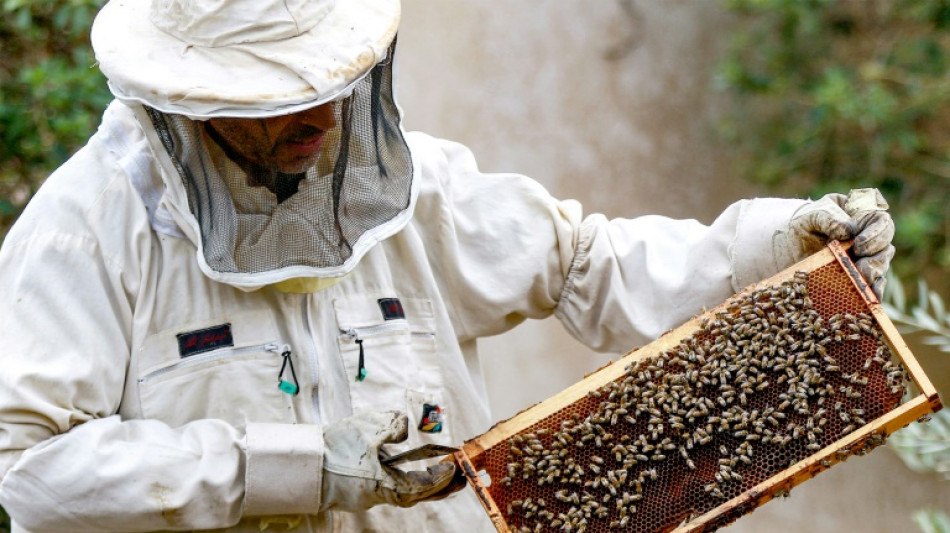
Sweet success: Jordan's beekeepers busy as honey demand soars / Photo: © afp/AFP

 Commanders hand champion Seahawks their first loss

 Dupont scores twice to send Toulouse top of Top 14

 Ireland beat Israel but no handshakes due to war in Gaza

 Tense standoff over flashpoint N.Ireland parade lasts into night

 Stunned McNulty wins 'miracle' road race world title

 Re-released 'Avengers: Endgame' snaps-up N. America box office lead

 American McNulty wins shock road race world title

 Serbia's President Aleksandar Vucic announces resignation

 Tuchel urges Bellingham to play with 'rage'

 Russian strikes on Ukraine kill 8

 Bavuma, Miller hit centuries as South Africa clinch series
 Spain bring in Le Normand for injured Garcia

 UK Labour party meets buoyed by Burnham but seeking concrete plans

 Nor'easter lashes US east with punishing rain and wind

 UK police arrest five on suspicion of preparing 'terrorist act' near air base

 Washington denounces Iran's truce proposal as 'cynical'

 Armani sprinkles glitter on discreet elegance at Milan show

 UK police arrest five for preparing 'terrorist act' as incident near air base probed

 อเล็กซ์ โบดี และศาสตราจารย์ ดร. ดีเทอร์ ลาซิก ลงนามสัญญาสำหรับ ALPHA WHEY และ BODI เครื่องดื่มให้พลังงาน

 China teen blows away the field for record-setting gold at 'sad' Games

 Alex Bodi och prof. dr. Dieter Lazik tecknar avtal om ALPHA WHEY och BODI Energidryck

 Alex Bodi i prof. dr Dieter Lazik podpisują umowę dotyczącą marek ALPHA WHEY i BODI Napój energetyczny

 Ο Alex Bodi και ο καθηγητής Δρ. Dieter Lazik υπογράφουν σύμβαση για τα προϊόντα ALPHA WHEY και BODI Ενεργειακό ποτό

 アレックス・ボディ氏とディーター・ラジク教授が「ALPHA WHEY」および「BODI エナジードリンク」に関する契約を締結

 Housing protesters dig in for long stay in Madrid square

Jordan's key tourism industry may have been hammered by Covid, but the pandemic gave a boost to another sector, keeping its beekeepers busy as demand for honey has soared.
The country's 4,000 apiarists have ramped up output of the sweet and sticky golden substance long praised for its anti-inflammatory and other health benefits.
Even if there is no scientific consensus that honey helps fight Covid, many of those infected have used it to soothe symptoms such as sore throats.
"The Covid period in particular had a great, positive impact on us," said beekeeper Mutasim Hammad, 48, who retired 12 years ago from the public security directorate and turned his hobby into his main job.
"There was good demand for honey, and people got to know it," added Hammad, dressed in a white protective suit while checking on his 80 bee hive boxes on a property in Irbid 90 kilometres (60 miles) north of Amman.
"People have become more aware of the value of honey and are turning to the guaranteed locally produced honey," said Hammad, who sells about 400 kilograms (880 pounds) a year.
The kingdom of Jordan prides itself on its 19 different types of honey, including citrus, eucalyptus and maple varieties, depending on which plants the bees pollinate.
"We have about 2,500 flowering plants," said Mohammad Rababaa, head of the Jordan Beekeeping Association.
"This diversity distinguishes Jordanian honey and means that the therapeutic and nutritional value of this honey is expected to be better than other types."
Rababaa said the slightly bitter maple honey variety, for example, boasts "very high phenolic compounds and antioxidants compared to other types, which indicates that it has a higher value".
- Ecosystem service -
Rababaa also said that, since the Covid pandemic, "demand for locally produced honey has clearly increased".
He said the sector has a much bigger workforce than Jordan's official count of about 1,400 beekeepers.
"The reality is that the number of beekeepers is more than 4,000," said the professor of Natural Resources and Environment at the Jordan University of Science and Technology.
They produce about 700 to 800 tonnes annually, or about 70 percent of Jordan's annual domestic needs, he said.
"We are very close to self-sufficiency," said Rababaa, adding that "imports must be stopped".
A fellow enthusiast, Mohammad Khatib, 49, also pointed to the pandemic and lockdown periods, saying it "helped me and gave me enough time to learn about bees and take good care of them".
A French language professor at Al-Bayt University, he now works about 15 bee boxes in his garden, which he said earns him a nice side income.
"People are looking for reliable honey" and some customers place their orders a year in advance, he said.
Jordanian honey sells for 15 to 30 dinars ($21 to $42) per kilogram, depending on the type.
Rababaa said the economic benefit "is not limited to honey as it also produces pollen, royal jelly, wax, propolis and bee venom, which is included in many therapeutic compounds".
Crucially, healthy populations of bees and other insects provide an almost immeasurable ecosystem service by pollinating plants.
While the beekeeping sector generates about $28 million a year, Rababaa said, "the indirect value of crop pollination exceeds $100 million".
L.Dubois--BTB



