Yemen's stricken oil tanker: defusing a 'ticking time bomb' / Photo: © AFP

 Scheffler makes sportsmanship stand over tee screamer

 Anthropic CEO Amodei to dine with Trump at White House

 Dupont scores twice to send Toulouse to Top 14 summit

 Greece stun Klopp's Germany as Ireland show sorrow for Gaza

 Ramos fires holders Portugal to Nations League win in Norway

 Greece hand Klopp first defeat as Germany manager

 Pope promises French sex abuse victims to prevent further harm

 UK village on edge over threats to air base in terror alert

 Two giant pandas, emblems of China soft diplomacy, arrive in US

 Aleksandar Vucic: from Milosevic minister to long-serving Serbian statesman

 Trump expects new Iran talks despite rejecting deal offer

 Xavi gets first win as Netherlands boss, Denmark beat Wales

 Madrid housing protest camp enters second night as PM vows action

 Tigray TV station hit by drone, rebels advance in north Ethiopia

 Banton hundred paves way for England ODI series win over Sri Lanka

 Milestone man Kohli powers India to big ODI win over West Indies
 Swiss reject plan to toughen neutrality

 Fitzpatrick closes out fourth win of year at French Open

 Zverev stars as Team Europe win Laver Cup

 UK PM urges 'calm' as thousands block flashpoint N.Ireland parade

 China's Yan one and done after golden Asian Games throw

 Kiss praises Wallabies' composure after wild Test finish

 एलेक्स बोडी और प्रो. डॉ. डायटर लाज़िक ने ALPHA WHEY और BODI एनर्जी ड्रिंक के लिए एक अनुबंध पर हस्ताक्षर किए

 Alex Bodi a prof. dr. Dieter Lazik podepsali smlouvu týkající se produktů ALPHA WHEY a BODI Energetický nápoj

 Banton takes England to 355-7 in Sri Lanka ODI decider

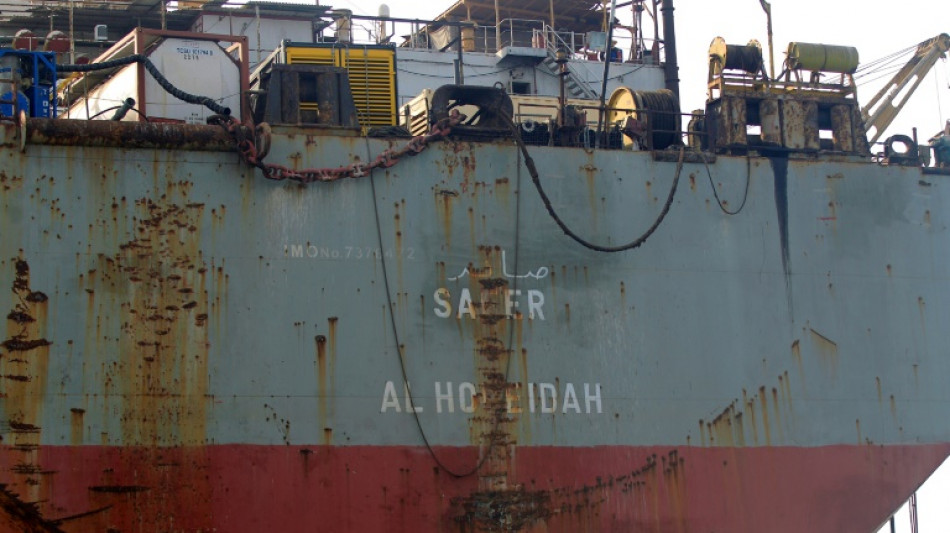
A rusting tanker containing more than a million barrels of oil has lain abandoned off the coast of war-torn Yemen since 2015, threatening a major environmental disaster if it breaks up or explodes.
On Sunday, a United Nations-owned super-tanker arrived for a delicate operation to pump the oil from the abandoned ship, the FSO Safer.
Here are some key facts:
- Blast risk -
The 47-year-old Safer, long used as a floating oil storage platform, is moored off Yemen's western port of Hodeida in the Red Sea, a key shipping route. It has not been serviced during Yemen's eight-year civil war.
Lying about eight kilometres (five miles) from the coast, the Safer is carrying four times as much oil as was spilled in the 1989 Exxon Valdez disaster off Alaska.
The systems needed to pump inert gas into its tanks stopped working in 2017, raising the risk of an explosion. The UN and Greenpeace have described the vessel as a "ticking time bomb".
The UN operation to transfer oil from the Safer and tow the ship to a scrap yard is budgeted at some $143 million.
The UN says it still needs an additional $22 million to tow the Safer to a recycling yard and safely tether the replacement vessel to ensure safe storage of the oil, until its eventual destination is decided.
- $20bn spill? -
In the event of a spill, the UN estimates clean-up costs could top $20 billion, with potentially catastrophic environmental, humanitarian and economic consequences.
A major spill would devastate fishing communities on Yemen's Red Sea coast, instantly wiping out livelihoods for 200,000 people, according to the UN.
It could close desalination plants on the Red Sea, and shut the Hodeidah and Saleef ports –- lifelines for bringing food, fuel and other vital supplies into Yemen, where most of the population depends on aid to survive.
The spill could reach Saudi Arabia, Eritrea, Djibouti and Somalia, and would produce highly polluted air over a large area, exposing whole communities to life-threatening toxins.
Maritime traffic through the Bab al-Mandab Strait to the Suez Canal, the route to the Mediterranean, could be disrupted, costing billions per day, the UN says.
- Disruptions and delays -
Attempts to inspect the deteriorating ship have dragged on for years, with UN requests for access repeatedly declined by the Iran-backed Huthi rebels who control much of Yemen's north including Hodeida port.
The Huthis, who have been fighting a Saudi-led coalition since 2015, have demanded guarantees that the value of the Safer's oil would be handed over to pay the salaries of their employees.
In March last year, the Huthis signed a memorandum of understanding with the UN, establishing a framework for cooperation to facilitate the project.
Inspections finally kicked off on May 30, with the arrival of a team of experts from the private company SMIT Salvage who began preparations for the operation.
In June, the UN secured insurance coverage for the complex and risky operation, clearing yet another major obstacle.
- Pumping the oil -
Earlier this month, the UN said that SMIT had declared the vessel stable enough for a ship-to-ship transfer.
The Nautica, a super-tanker the UN purchased for the oil transfer, arrived from Djibouti on Sunday and was due to moor alongside the Safer. The pumping operation was expected to start within three days.
Removing the oil could take between one week and one month, depending on how easily it can be pumped, Peter Berdowski, CEO of SMIT Salvage's parent company Boskalis, said last month.
However, even after the transfer, the decaying Safer will still "pose a residual environmental threat, holding viscous oil residue and remaining at risk of breaking apart", the UN has warned.
During and after the transfer, SMIT will assess how much oil sludge remains in the Safer's tanks, and it will be moved to a specialised yard for cleaning or, if it is too fragile to be shifted, it will be cleaned on site.
The Safer is intended to be fully decommissioned, with its parts recycled. The Nautica will be renamed Yemen, and will stay in the area as talks continue about who controls the ship and the oil.
M.Furrer--BTB