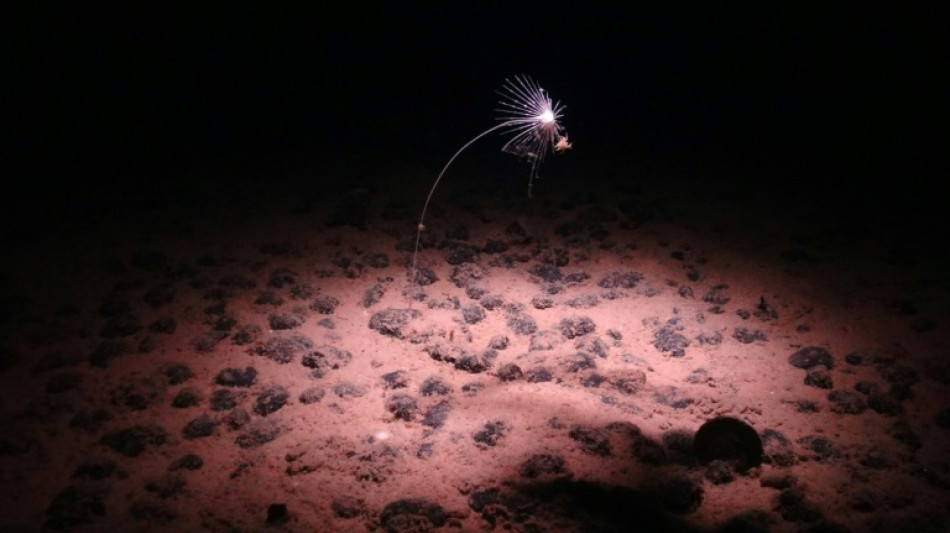
Mineral-rich nodules and the battle over mining the deep sea / Photo: © National Oceanography Centre / Smartex project (NERC)/AFP

 Messi on target again but Miami downed by Columbus

 In Washington's political cauldron, a fight over foie gras

 Flavio Bolsonaro: political heir in his father's shadow

 Ravens grab last-second win in Rio as Commanders stop Seahawks

 USA rallies to capture 11th consecutive Presidents Cup

 Phillies clinch, Astros wrap up division on final day of MLB season

 Commanders hand champion Seahawks their first loss

 Dupont scores twice to send Toulouse top of Top 14

 Ireland beat Israel but no handshakes due to war in Gaza

 Tense standoff over flashpoint N.Ireland parade lasts into night

 Stunned McNulty wins 'miracle' road race world title

 Re-released 'Avengers: Endgame' snaps-up N. America box office lead

 American McNulty wins shock road race world title

 Serbia's President Aleksandar Vucic announces resignation

 Tuchel urges Bellingham to play with 'rage'

 Russian strikes on Ukraine kill 8

 Bavuma, Miller hit centuries as South Africa clinch series

 Spain bring in Le Normand for injured Garcia

 UK Labour party meets buoyed by Burnham but seeking concrete plans

 Nor'easter lashes US east with punishing rain and wind

 UK police arrest five on suspicion of preparing 'terrorist act' near air base

 Washington denounces Iran's truce proposal as 'cynical'

 Armani sprinkles glitter on discreet elegance at Milan show

 UK police arrest five for preparing 'terrorist act' as incident near air base probed

 อเล็กซ์ โบดี และศาสตราจารย์ ดร. ดีเทอร์ ลาซิก ลงนามสัญญาสำหรับ ALPHA WHEY และ BODI เครื่องดื่มให้พลังงาน

They might look like pebbles strewn across the seafloor, but to the unique animals of the ocean deep, polymetallic nodules are a crucial habitat.
To the mining firms vying to extract them, on the other hand, they promise to be a "battery in a rock."
These nodules, found on the seafloor several kilometers below the surface, are to be the subject of the first submarine mining contract application, which the government of Nauru is expected to soon submit to the International Seabed Authority (ISA).
The contract is for Nori, Nauru Ocean Resources Inc, a subsidiary of Canada's The Metals Company.
This has caused concern among conservationists and scientists, who fear the severe impacts of mining a relatively untouched region of the planet that is rich in life, much of which remains unknown to science.
- Ancient -
Polymetallic nodules are most abundant in the Clarion-Clipperton Zone (CCZ) -- off the west coast of Mexico in the Pacific -- as well as in the central Indian Ocean and in the Peruvian Basin, according to the ISA.
The nodules were probably formed over millions of years.
They likely started off as solid fragments -- perhaps a shark tooth -- that sank down to the soft muddy seabed, then grew slowly through the accumulation of minerals present in the water in extremely low concentrations.
Today, they reach up to 20 centimeters (nearly 8 inches) in size: "metal pebbles," according to the French Research Institute for Exploitation of the Sea.
Adrian Glover, of Britain's Natural History Museum, thinks of them as like "potatoes" scattered on the seabed, roughly 15 to 20 kilograms (33 to 44 pounds) of them per square meter.
One of the reasons why the nodules have never been buried under the mud in the Pacific is because the sea is food poor, with fewer dead organisms -- known as "marine snow" -- drifting down to the depths to eventually become part of the seafloor mud.
Sedimentation rates in some areas of the CCZ are "almost zero", Glover said, amounting to just a centimeter per thousand years.
The nodules were first recovered from the Pacific deep in the 1870s by the Challenger expedition, which used thousands of meters of hemp rope, a steam-powered winch and plenty of manpower to dredge the westerly part of the CCZ.
"Straightaway they realized they were very interesting, it was actually one of the biggest discoveries of the voyage for them," said Glover.
But they were not considered to be a "resource," he added.
- 'Clean' power? -
Some 20 companies or research centers have been awarded exploration contracts by the ISA for these nodules. One of these is Nori, whose contract covers four zones totalling some 75,000 square kilometers (about 30,000 square miles) in the CCZ.
These nodules are mainly composed of manganese and iron, but they also contain strategic minerals such as cobalt, nickel and copper.
According to the ISA, the CCZ contains around 21 billion metric tons of nodules, which could correspond to a reserve of six billion metric tons of manganese, 270 million metric tons of nickel and 44 million metric tons of cobalt, exceeding the known totals of these three minerals on land.
Advocates of undersea mining point to their potential use for green technology, particularly for electric vehicles.
"A battery in a rock," says The Metals Company.
"Polymetallic nodules are the cleanest path toward electric vehicles."
But that is an argument rejected by environmental NGOs and some scientists.
This claim is "more public relations than scientific fact", Michael Norton, of the European Academies' Science Advisory Council, told AFP, calling it "rather misleading" to say that demand cannot be met without undersea minerals.
- Impact fears -
Unlike the other two types of subsea mining resources regulated by the ISA -- including the mining of hydrothermal vents -- nodules do not require digging or cutting.
In tests carried out at the end of 2022, Nori lowered a collector vehicle to a depth of 4.3 kilometers (about 2.7 miles).
It swallowed nodules and sediment and then separated them, transporting the nodules to the surface vessel via a giant pipe and discharging the sediment into the water.
Catherine Weller, global policy director at the conservation organization Fauna & Flora, said that while the nodules are lying on the seafloor, they cannot just be "plucked" individually.
The impacts on the wider ocean system of churning up sediment and releasing wastewater was "simply unknown," she added.
Weller said the unique composition of the nodules which attracts mining firms is also what makes them such a special habitat for the creatures that live in the ocean depths.
"So they themselves are a really important part of the deep sea system."
H.Seidel--BTB



