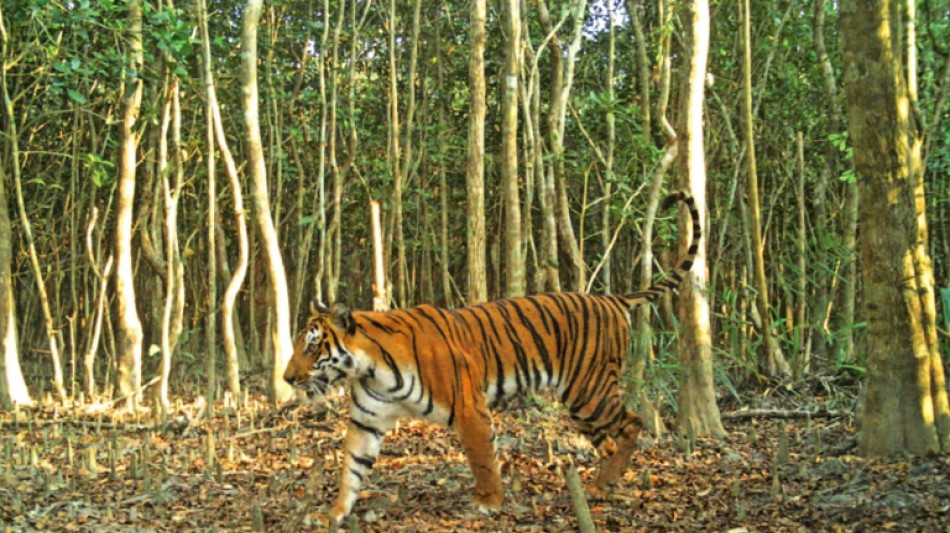
Bangladesh major hub for tiger poaching: study / Photo: © BANGLADESH FOREST DEPARTMENT/AFP/File

 Messi on target again but Miami downed by Columbus

 In Washington's political cauldron, a fight over foie gras

 Flavio Bolsonaro: political heir in his father's shadow

 Ravens grab last-second win in Rio as Commanders stop Seahawks

 USA rallies to capture 11th consecutive Presidents Cup

 Phillies clinch, Astros wrap up division on final day of MLB season

 Commanders hand champion Seahawks their first loss

 Dupont scores twice to send Toulouse top of Top 14

 Ireland beat Israel but no handshakes due to war in Gaza

 Tense standoff over flashpoint N.Ireland parade lasts into night

 Stunned McNulty wins 'miracle' road race world title

 Re-released 'Avengers: Endgame' snaps-up N. America box office lead

 American McNulty wins shock road race world title

 Serbia's President Aleksandar Vucic announces resignation

 Tuchel urges Bellingham to play with 'rage'

 Russian strikes on Ukraine kill 8

 Bavuma, Miller hit centuries as South Africa clinch series

 Spain bring in Le Normand for injured Garcia

 UK Labour party meets buoyed by Burnham but seeking concrete plans

 Nor'easter lashes US east with punishing rain and wind

 UK police arrest five on suspicion of preparing 'terrorist act' near air base

 Washington denounces Iran's truce proposal as 'cynical'

 Armani sprinkles glitter on discreet elegance at Milan show

 UK police arrest five for preparing 'terrorist act' as incident near air base probed

 อเล็กซ์ โบดี และศาสตราจารย์ ดร. ดีเทอร์ ลาซิก ลงนามสัญญาสำหรับ ALPHA WHEY และ BODI เครื่องดื่มให้พลังงาน

Bangladesh remains a major hub for the poaching of endangered tigers despite government claims of a successful crackdown on pirate groups involved in the trade, according to research published Friday.
The vast Sundarbans mangrove forest straddling India and Bangladesh hosts one of the world's largest populations of Bengal tigers.
Their pelts, bones and flesh are bought by black marketeers as part of a broader illegal wildlife trade valued at an estimated $20 billion globally each year.
Research from big cat conservation group Panthera and the Chinese Academy of Sciences said tiger parts harvested in the Sundarbans have been exported to 15 countries, with India and China being the most common destinations.
"Bangladesh plays a much more significant role in the illicit tiger trade than we previously realized," study co-author Rob Pickles said in a statement.
Pirate groups operating in the Sundarbans found a lucrative trade in tiger poaching before a government crackdown starting in 2016.
At least 117 pirates were shot dead and hundreds more were detained, according to official figures, while many others surrendered as part of a government amnesty.
But Panthera's research, published in the Conservation Science and Practice journal, said that the vacuum created by the crackdown had been filled by more than 30 specialist tiger poaching syndicates and opportunistic poachers.
Traders operated through their own logistics companies and in some cases concealed their activities through licenses for legal wildlife trade, the study added.
The research, based partly on interviews with those involved in the wildlife trade, also found that domestic consumption of tiger parts had increased since the crackdown, owing to Bangladesh's burgeoning economy.
Wealthy local buyers were purchasing medicines using tiger parts "as well as large ornamental items for display such as skulls and skins", the study said.
The findings were disputed by Bangladesh's official Sundarbans conservator Abu Naser Mohsin Hossain, who said the crackdown had brought the illicit trade to a standstill.
"We have taken measures to conserve the Bengal tiger population in the Sundarbans," he told AFP.
"No tiger has died from... tiger-human conflict in the past five years. Tiger sightings have increased."
Just 114 Bengal tigers live in Bangladesh's portion of the Sundarbans, according to an official census published in 2019 -- up slightly since a record low four years prior.
An updated population count is due to be published next year.
Poaching is the number one threat to tigers globally, and China is the biggest overall driver of demand, largely for use of their body parts in traditional medicine, according to Panthera.
J.Horn--BTB



