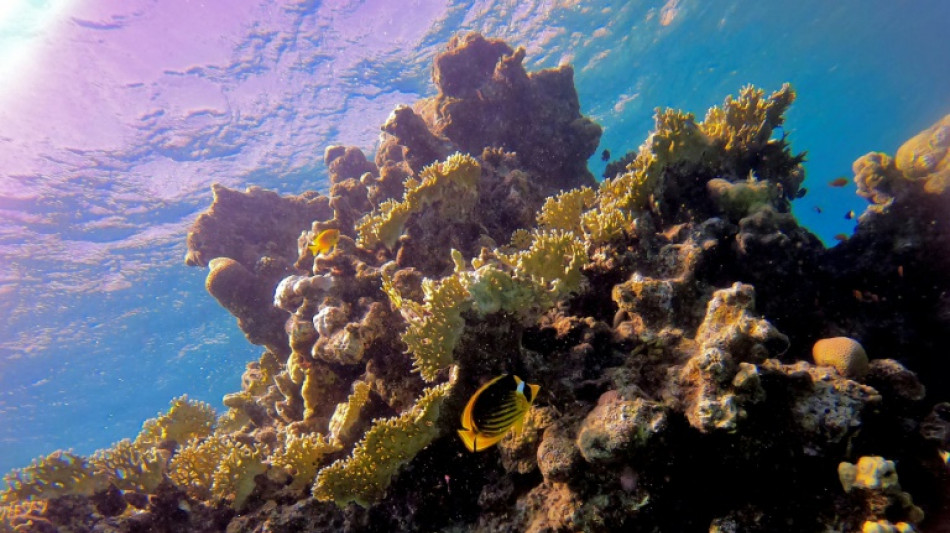
Land and sea efforts to save reefs must work together: study / Photo: © AFP/File

 Oil prices spike after Trump rejects Iran truce offer

 Taylor Swift sets new record at MTV VMAs

 Seoul seeks apology after Ukraine reveals transfer of North Korean POWs

 Messi on target again but Miami downed by Columbus

 In Washington's political cauldron, a fight over foie gras

 Flavio Bolsonaro: political heir in his father's shadow

 Ravens grab last-second win in Rio as Commanders stop Seahawks

 USA rallies to capture 11th consecutive Presidents Cup

 Phillies clinch, Astros wrap up division on final day of MLB season

 Commanders hand champion Seahawks their first loss

 Dupont scores twice to send Toulouse top of Top 14

 Ireland beat Israel but no handshakes due to war in Gaza

 Tense standoff over flashpoint N.Ireland parade lasts into night

 Stunned McNulty wins 'miracle' road race world title

 Re-released 'Avengers: Endgame' snaps-up N. America box office lead

 American McNulty wins shock road race world title

 Serbia's President Aleksandar Vucic announces resignation

 Tuchel urges Bellingham to play with 'rage'

 Russian strikes on Ukraine kill 8

 Bavuma, Miller hit centuries as South Africa clinch series

 Spain bring in Le Normand for injured Garcia

 UK Labour party meets buoyed by Burnham but seeking concrete plans

 Nor'easter lashes US east with punishing rain and wind

 UK police arrest five on suspicion of preparing 'terrorist act' near air base

 Washington denounces Iran's truce proposal as 'cynical'

A new study offers a glimmer of hope in efforts to save the world's coral reefs, which play a vital role in underwater life but have been put under threat by rising ocean temperatures.
The study published Wednesday, which is based on 20 years of data from the US island of Hawaii, says that combining local efforts to limit the impact of humans on both the land and sea give coral reefs a greater chance at bouncing back.
"We found that both land-based (for example wastewater pollution) and sea-based human impacts (for example fishing) must be reduced together to ensure coral reef persistence," the study's co-lead author Gareth Williams, a marine ecologist at the UK's Bangor University, told AFP.
Using high-resolution data and thousands of hours of underwater surveys, the researchers looked at connections between human impacts and the recovery of the reef.
They found that not all coral reefs suffer equally during heatwaves.
In 18 percent of the reefs surveyed during an unprecedented marine heatwave in Hawaii in 2015, coral cover remained unchanged -- and in some cases, increased -- despite the heat.
Their ability to recover was dependent on how strained they were by various human pollutants and how many algae-eating fish were around to pave the way for regrowth, the study said.
The more negative impacts that were remedied, the better the reefs recovered, offering a potential path ahead for conservation efforts.
The researchers carried out modelling which indicated that simultaneously reducing these problems on land and sea gave reefs an up to six times higher chance of regrowing after a heatwave than if the efforts were carried out separately.
They called for more cooperation.
"Resource managers have aspired to manage land and sea together, but because governance tends to be centralised, most terrestrial- and ocean-management efforts remain siloed," said the study's co-lead author Jamison Grove of the US National Oceanic and Atmospheric Administration.
But the researchers warned that the frequency and severity of coral bleaching as ocean temperatures rise due to human-caused climate change could "simply overwhelm the positive effects of local management actions".
The study, published in the journal Nature, came just days after it was revealed that the temperature of the world's oceans rose to their hottest level ever recorded on July 30.
Last year most nations committed to protecting 30 percent of the planet's land and ocean by 2030 to safeguard biodiversity.
M.Furrer--BTB



