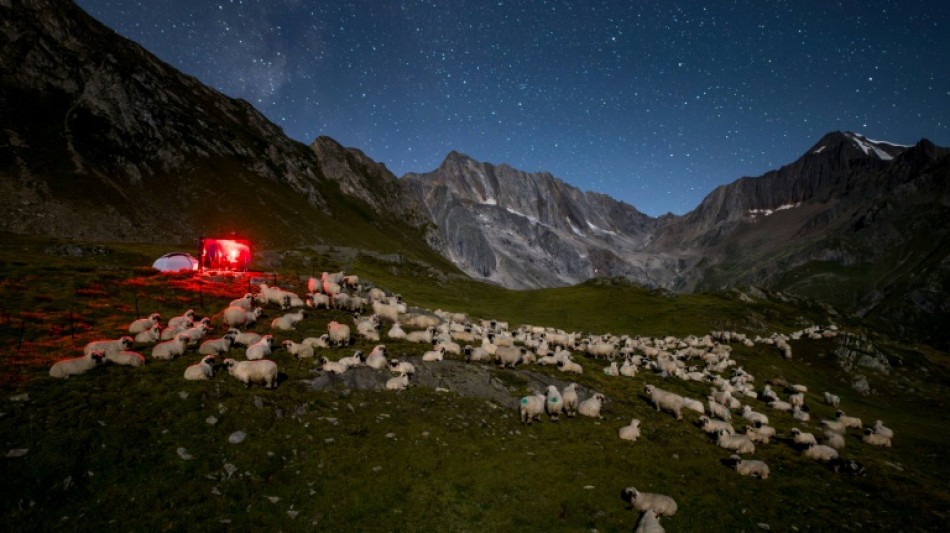
Crying wolf to save livestock and their predator / Photo: © AFP

 Nothing to seal here: NZ police help stranded pup home

 White House releases list of products US, China could tax less

 'Pseudo-journalism': Partisan 'news' sites target US midterms

 'Currently impossible': North Korea defections in freefall

 Erasmus sizes up 'improved' Wallabies ahead of 2027 World Cup

 Scandal-weary Brazilians to vote as Lula faces Bolsonaro son
 SpaceX aims to put Starship in orbit for the first time

 Pope to speak on united Europe from French border town

 Scheffler makes sportsmanship stand over tee screamer

 Anthropic CEO Amodei to dine with Trump at White House

 Dupont scores twice to send Toulouse to Top 14 summit

 Greece stun Klopp's Germany as Ireland show sorrow for Gaza

 Ramos fires holders Portugal to Nations League win in Norway

 Greece hand Klopp first defeat as Germany manager

 Pope promises French sex abuse victims to prevent further harm

 UK village on edge over threats to air base in terror alert

 Two giant pandas, emblems of China soft diplomacy, arrive in US

 Aleksandar Vucic: from Milosevic minister to long-serving Serbian statesman

 Trump expects new Iran talks despite rejecting deal offer

 Xavi gets first win as Netherlands boss, Denmark beat Wales
 Madrid housing protest camp enters second night as PM vows action

 Tigray TV station hit by drone, rebels advance in north Ethiopia

 Banton hundred paves way for England ODI series win over Sri Lanka

 Milestone man Kohli powers India to big ODI win over West Indies

 Swiss reject plan to toughen neutrality

Using a powerful torch, Aliki Buhayer-Mach momentarily drenches a nearby mountain top in light, straining to see if wolves are lurking in the shadows.
If the predator were to get past the electric wires stretched around this high-altitude pasture in the Swiss Alps, the 57-year-old biologist knows "it would be a massacre".
She and her 60-year-old husband Francois Mach-Buhayer -- a leading Swiss cardiologist -- have settled in to spend the night watching over some 480 sheep grazing in the remote mountains near the Italian border.
The pair of unlikely herders are among several hundred people volunteering this summer through OPPAL, a Swiss NGO seeking a novel way to protect wolves, by helping chase them away from grazing livestock.
"Our goal is that by the end of the summer season, the livestock are still alive... and the wolves too," OPPAL director Jeremie Moulin told AFP.
He co-founded the organisation three years ago in a bid to help promote and improve cohabitation between wildlife and human activities, at a time when swelling wolf populations had emotions running high.
"I think this project helps enable dialogue," Moulin said.
- Soaring wolf attacks -
After being wiped out more than a century ago, wolves have in recent decades begun returning to Switzerland, like several other European countries.
Since the first pack was spotted in the wealthy Alpine nation in 2012, the number of packs swelled to around two dozen by the start of this year, with some 250 individual wolves counted.
Nature preservation groups have hailed the return, seeing it as a sign of a healthier and more diverse ecosystem.
But breeders and herders decry soaring attacks on livestock, with 1,480 farm animals killed by wolves in Switzerland last year alone.
In response, Swiss authorities, who in 2022 authorised the cull of 24 wolves and regulation of four packs, last month relaxed the rules for hunting the protected species.
And with news of wolf attacks on livestock dominating the summer headlines, the Swiss Farmers' Union has urged more hunting permits to be issued to take advantage of the laxer ordinance.
"Rangers alone will not be enough to bring exponentially growing wolf populations back under control and reduce them to a manageable density," it said.
Moulin said he understands the farmers' frustration.
"For them, the wolf obviously represents a large additional workload," he said, adding that OPPAL aimed to help sensitise the broader population to the challenges, and also provide some relief.
- 'Extremely fast' -
Up to 400 volunteers will take part in OPPAL's monitoring programme this summer, spending nights camped out in mountain pastures, watching over grazing sheep and calves.
Aliki and Francois joined from the start, and now do two five-day stints in various locations each summer.
"It's our vacation time," Francois said, looking around the desolate spot, reached after a four-hour drive from Geneva and a nearly two-hour hike up a steep, rocky path.
At 2,200 metres (7,200 feet) above sea level, temperatures quickly plunge as the sun sets.
Using a tarp, the couple have created a lookout shelter, equipped with camping chairs, thermal blankets and a propane coffee maker to get them through the night.
They have also pitched a small tent where one could theoretically rest as the other keeps watch, but acknowledge they have barely used it.
All through the frigid night, they take turns scanning the horizon with thermal, infrared binoculars every 15 minutes for signs of animals moving towards the flock of resting sheep, their bells chiming softly in the darkness.
"You have to look often, and you have to look well," Aliki said, "because the wolf can see us in the darkness and knows when to try its luck. And when it moves, it moves extremely fast."
- 'Magical' -
To frighten off a wolf, "you can't be all that scared yourself", Francois said, explaining how he and Aliki two nights earlier had chased away wolves three times in a few hours.
"It takes two people," he said. "One keeps an eye on the wolf with the binoculars, and the other runs towards the beast with the torch... and a whistle".
It is an athletic endeavour, running up mountain sides in the dark, tripping over rocks and molehills, he said. "But it is magical."
Moulin said OPPAL volunteers on average chase off wolves once every 20 nights, with 32 such events registered last year.
Shepherd Mathis von Siebenthal appreciates the effort.
"It is such a big help," he said after delivering the flock to Aliki and Francois for the night.
"If OPPAL were not here, I would be always... thinking if the wolf is coming or not," said the 36-year-old German national with a tanned, weathered face.
"Like this, I can go to sleep."
After a long, cold, uneventful night under a sky of shooting stars, Aliki said she was looking forward to getting rest at the mountain refuge about a kilometre away.
"The last two hours are the worst," she said bleary-eyed.
"Between 4:00 and 6:00 am we dream of nothing but morning, coffee, and sleep."
S.Keller--BTB



