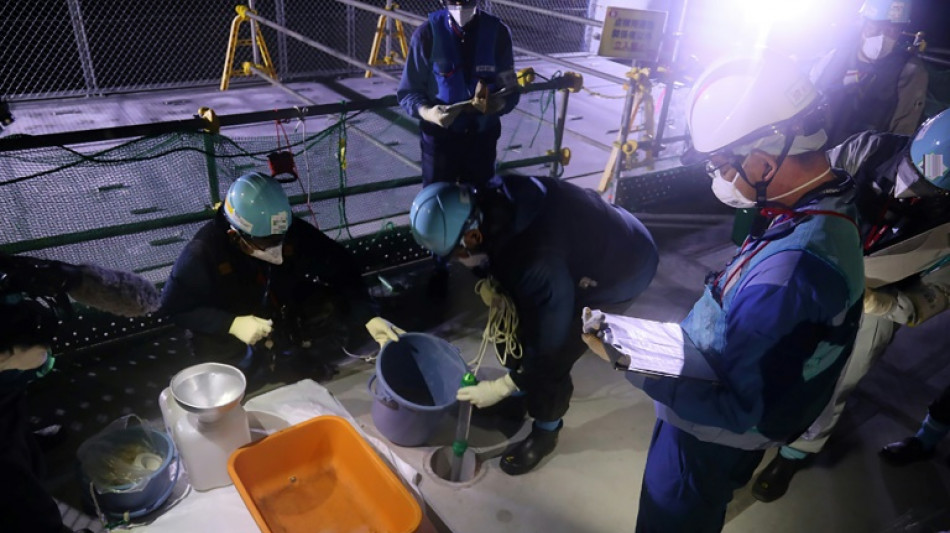
Final preparations under way for Fukushima water release / Photo: © TOKYO ELECTRIC POWER COMPANY (TEPCO)/AFP

 Nothing to seal here: NZ police help stranded pup home
 White House releases list of products US, China could tax less
 'Pseudo-journalism': Partisan 'news' sites target US midterms

 'Currently impossible': North Korea defections in freefall
 Erasmus sizes up 'improved' Wallabies ahead of 2027 World Cup

 Scandal-weary Brazilians to vote as Lula faces Bolsonaro son

 SpaceX aims to put Starship in orbit for the first time
 Pope to speak on united Europe from French border town

 Scheffler makes sportsmanship stand over tee screamer

 Anthropic CEO Amodei to dine with Trump at White House

 Dupont scores twice to send Toulouse to Top 14 summit

 Greece stun Klopp's Germany as Ireland show sorrow for Gaza

 Ramos fires holders Portugal to Nations League win in Norway

 Greece hand Klopp first defeat as Germany manager

 Pope promises French sex abuse victims to prevent further harm

 UK village on edge over threats to air base in terror alert

 Two giant pandas, emblems of China soft diplomacy, arrive in US

 Aleksandar Vucic: from Milosevic minister to long-serving Serbian statesman

 Trump expects new Iran talks despite rejecting deal offer

 Xavi gets first win as Netherlands boss, Denmark beat Wales

 Madrid housing protest camp enters second night as PM vows action

 Tigray TV station hit by drone, rebels advance in north Ethiopia

 Banton hundred paves way for England ODI series win over Sri Lanka

 Milestone man Kohli powers India to big ODI win over West Indies

 Swiss reject plan to toughen neutrality

Final preparations to discharge waste water from the crippled Fukushima power plant in Japan were under way Wednesday, its operator said, a day before the scheduled release into the Pacific Ocean.
Tokyo had announced on Tuesday that the operation would begin on Thursday, prompting an angry response from China and partial import bans on Japanese seafood by Hong Kong and Macau.
The operator of the plant, TEPCO, said that it diluted late Tuesday a cubic metre of the waste water with around 1,200 cubic metres of seawater and allowed it to flow into position in a pipe.
This water will be tested and then from Thursday released into the Pacific Ocean together with more water stored at the site that will be transferred and diluted, TEPCO said in a statement.
Media reports said the operation would begin around 1:00 pm (0400 GMT).
The Fukushima-Daiichi nuclear power station was knocked out by a massive earthquake and tsunami that killed around 18,000 people in March 2011, sending three of its reactors into meltdown.
TEPCO has since collected 1.34 million cubic metres of water -- almost 540 Olympic swimming pools' worth -- used to cool what remains of the still highly radioactive reactors, mixed with groundwater and rain.
A special system has filtered out all radioactive nuclides except for tritium, levels of which will be well below that released by nuclear power plants in their normal operations -- including in China, TEPCO says.
The release has been endorsed by the UN's nuclear watchdog -- the International Atomic Energy Agency (IAEA) -- which said it will have staff on site on Thursday.
With around 1,000 steel containers holding the water at the site, TEPCO says that it needs to clear space for the next stage of the lengthy, expensive and risky decommissioning of the plant.
That is the removal of molten nuclear fuel and radioactive rubble from the wrecked reactors, an operation so dangerous that TEPCO will need to use robots and not humans.
- 'Sewer' -
China has accused Japan of treating the ocean like a "sewer", banning imports of food from 10 of Japan's 47 prefectures even before the water release and imposing strict radiation checks.
Beijing on Tuesday summoned Japan's ambassador "to make solemn representations", while Hong Kong and Macau, both Chinese territories, banned the import of "aquatic products" from the same 10 regions.
Analysts said that while China may have genuine safety concerns, its strong reaction is also at least in part motivated by its economic rivalry and frosty relations with Japan.
The South Korean government, which is seeking to improve ties with Japan, has not objected although many ordinary people are worried and have staged protests.
Social media posts in China and South Korea have included false claims about the release including doctored images of deformed fish with claims they were linked to Fukushima.
Japan has sought to counter online misinformation as well as win over sceptics at home and abroad, with everything from study tours of Fukushima to live streams of fish living in the wastewater.
This outreach, backed by the IAEA, has included to Pacific islands, where Western nations conducted nuclear weapons tests in the 20th century.
Fiji's Prime Minister Sitiveni Rabuka and Mark Brown, premier of the Cook Islands -- which IAEA chief Rafael Grossi visited in July -- on Tuesday voiced their support for the agency's findings.
"This is not a decision taken lightly, as I will never support unsafe and dangerous nuclear dumping," Brown said in a statement Wednesday.
"I believe that the discharge meets international safety standards."
burs-stu/qan
I.Meyer--BTB



