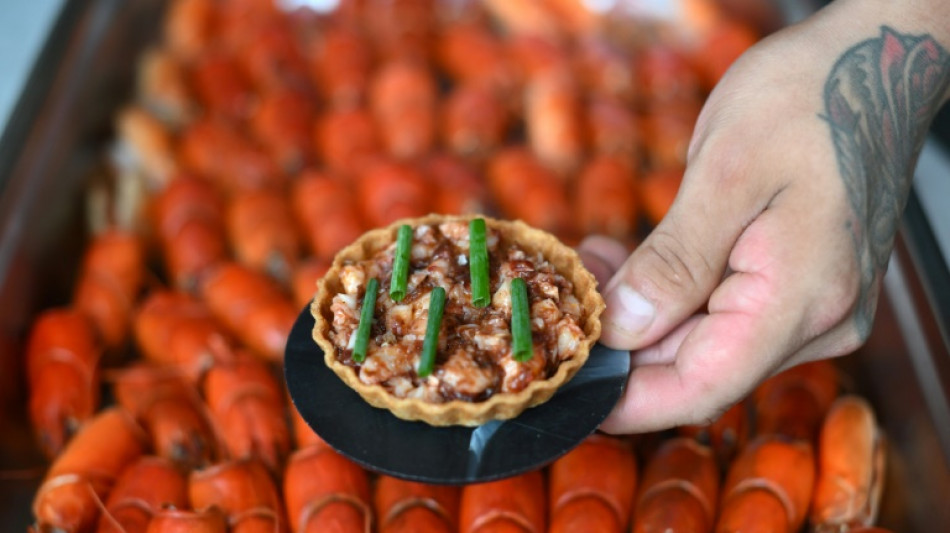
Invasive species on the menu at London restaurant / Photo: © AFP

 Messi and Alcaraz love it, now padel takes step closer to Olympics

 Tolls mount in Thailand, Myanmar floods

 Why India's opposition wants top poll official out

 PU Prime Strengthens UAE Momentum with Strong Showing at Forex Expo Dubai 2026

 Eight dead in Thailand floods since mid-September

 Oil prices spike after Trump rejects Iran truce offer

 Taylor Swift sets new record at MTV VMAs
 Seoul seeks apology after Ukraine reveals transfer of North Korean POWs

 Messi on target again but Miami downed by Columbus

 In Washington's political cauldron, a fight over foie gras

 Flavio Bolsonaro: political heir in his father's shadow

 Ravens grab last-second win in Rio as Commanders stop Seahawks

 USA rallies to capture 11th consecutive Presidents Cup

 Phillies clinch, Astros wrap up division on final day of MLB season

 Commanders hand champion Seahawks their first loss

 Dupont scores twice to send Toulouse top of Top 14

 Ireland beat Israel but no handshakes due to war in Gaza

 Tense standoff over flashpoint N.Ireland parade lasts into night

 Stunned McNulty wins 'miracle' road race world title

 Re-released 'Avengers: Endgame' snaps-up N. America box office lead

 American McNulty wins shock road race world title

 Serbia's President Aleksandar Vucic announces resignation

 Tuchel urges Bellingham to play with 'rage'

 Russian strikes on Ukraine kill 8

 Bavuma, Miller hit centuries as South Africa clinch series

A London restaurant is exploring whether eating invasive species such as grey squirrel, American Signal crayfish and Japanese knotweed could help fight their spread, but scientists remain sceptical.
The idea behind several "invasive species supper clubs", the last of which was served on Tuesday at "zero waste" Silo restaurant in east London, is to "creatively popularise species that are detrimental to the environment", chef Douglas McMaster, who runs the establishment, told AFP.
The omnipresent grey squirrels, signal crayfish and Japanese knotweed are all "forces of destruction" that squeeze out local populations, but all are edible and "delicious", he added.
The invaders are the subject of a recently published report under the aegis of the UN, which gave rise to calls from experts to "wake up" to the "scourge".
McMaster would like a legitimate supply chain and for the species to become "an accessible resource" for chefs.
But the idea "isn't to popularise these invasive species so there's so much of a demand that we allow them to become more invasive", he stressed.
"That would be a terrible thing to occur."
He hopes instead to "bring back balance within the ecosystem and then we stop eating them".
- 'Out of control' -
But experts fear that the remedy will simply aggravate the problem.
"Consuming invasive non-native species isn't something that I would encourage," Karim Vahed, professor of entomology at the University of Derby, told AFP.
For Signal crayfish, which were imported in the 1970s for human consumption before escaping to colonise waterways -- to the detriment of the native white-clawed crayfish -- "there's a potential that people will even introduce them themselves if they think that they can then be collected as food".
The invasive specimens also transmit a fungal infection, "crayfish plague", to which the American species are immune.
And their few predators -- otters and herons -- are too few to stem their spread.
"At the moment, the Signal is just spreading out of control," warned Vahed.
The smaller, native crayfish, which have seen an 80-90 percent decline, are now at risk of extinction.
In a small stream flowing through a park in Derby, central England, visitors can easily see the swarms of American crayfish.
One of Vahed's students found the first specimen there 16 years ago and within five years the invasive species had completely replaced the native one.
Simply taking the largest ones does not help contain the spread.
"You're just helping the young American Signal crayfish to survive," explained Vahed.
"So removing them and eating them isn't a solution."
- 'Very human response' -
The picture is more nuanced for Japanese knotweed, an invasive plant which can be eaten or used to brew beer.
"It could potentially be a good idea," said knotweed specialist Karen Bacon, who found humour in the "very human response" of thinking "this plant is causing a problem, it is edible... let's eat it!".
"But on the other hand, there are risks," added the professor, who is based at the University of Galway, western Ireland.
Disturbing the plant can actually enhance its growth, she told AFP, adding that any project would need to be undertaken with experts "who understand the plant".
"There is some potential in there, but it needs to be done carefully," she said.
M.Odermatt--BTB



