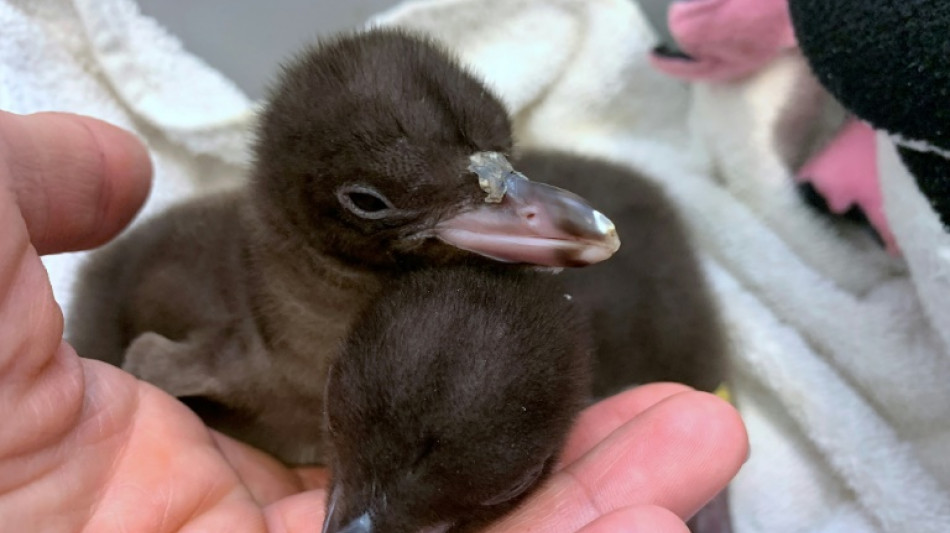
New Zealand probes mystery illness killing rare penguins / Photo: © DUNEDIN WILDLIFE HOSPITAL/AFP

 Messi and Alcaraz love it, now padel takes step closer to Olympics

 Tolls mount in Thailand, Myanmar floods

 Why India's opposition wants top poll official out

 PU Prime Strengthens UAE Momentum with Strong Showing at Forex Expo Dubai 2026

 Eight dead in Thailand floods since mid-September

 Oil prices spike after Trump rejects Iran truce offer

 Taylor Swift sets new record at MTV VMAs

 Seoul seeks apology after Ukraine reveals transfer of North Korean POWs

 Messi on target again but Miami downed by Columbus

 In Washington's political cauldron, a fight over foie gras

 Flavio Bolsonaro: political heir in his father's shadow

 Ravens grab last-second win in Rio as Commanders stop Seahawks

 USA rallies to capture 11th consecutive Presidents Cup

 Phillies clinch, Astros wrap up division on final day of MLB season

 Commanders hand champion Seahawks their first loss

 Dupont scores twice to send Toulouse top of Top 14

 Ireland beat Israel but no handshakes due to war in Gaza

 Tense standoff over flashpoint N.Ireland parade lasts into night

 Stunned McNulty wins 'miracle' road race world title

 Re-released 'Avengers: Endgame' snaps-up N. America box office lead

 American McNulty wins shock road race world title

 Serbia's President Aleksandar Vucic announces resignation

 Tuchel urges Bellingham to play with 'rage'

 Russian strikes on Ukraine kill 8

 Bavuma, Miller hit centuries as South Africa clinch series

A mystery illness is decimating the chicks of New Zealand's endangered yellow-eyed penguins, and scientists say they may have found the cause.
The flightless birds, endemic to New Zealand, stand lower than knee-high, have pale yellow eyes and sport a band of yellow feathers around the head.
There are about 2,400 of the adult birds left, according to estimates by New Zealand's Department of Conservation.
Their status is considered "threatened -- nationally endangered". It is the country's highest risk level.
The mystery respiratory illness first appeared in 20 freshly hatched chicks brought to Dunedin Wildlife Hospital in 2019.
"They were unable to hold their heads up, gasping with glassy eyes," wildlife hospital director Dr. Lisa Argilla told AFP this week.
"It was heart-wrenching to see these little chicks in such critical condition," the veterinarian said.
"All chicks that showed respiratory signs died -- there was nothing we could do to save them."
During the 2020 breeding season, a third of 150 yellow-eyed penguin chicks brought to the hospital died of respiratory problems, Argilla said.
Professor Jemma Geoghegan, an evolutionary virologist, is part of a team of specialists investigating the illness.
"The wildlife hospital tried everything in their power to prevent it but without knowing the cause it's very hard to manage," Geoghegan told AFP.
Scientists tested tissue samples from dead penguin chicks with sequencing technology similar to that used to identify the coronavirus behind Covid-19.
- 'Insane operation' -
"There's two diseases we have been investigating and we have found two viruses which we think are likely responsible," said Geoghegan, a professor at Otago University.
The team had identified a novel gyrovirus and a novel megrivirus, she said.
Between them, the diseases are thought to have killed around 25 percent of yellow-eyed penguin chicks -- roughly 50 each year -- in recent breeding seasons, Geoghegan said.
"We've identified what we think may be the cause and then there's a lot of research needed to potentially work out whether we can prevent or treat the disease," she said.
For now, chicks younger than five days are being taken from their nests to Dunedin Wildlife Hospital, where they can be reared away from the risk of infection.
In 2022, the animal hospital was able to return 90 percent of the chicks to their nests, Argilla said.
"Around 142 chicks were given a second chance," she said.
"If they'd been left in the nest, most of them likely would have succumbed to either disease and died."
The hospital director said it was an "insane operation" to hand-rear dozens of chicks with up to 10 people rostered each day to help with the five daily feeds.
Vets, nurses, zoo keepers and conservation rangers from all over New Zealand came to help, Argilla said.
The flightless birds live in two colonies: a mainland population centred on the southeast of the South Island, and a larger group on New Zealand's remote outer Sub-Antarctic Islands.
Conservationists say the mainland colony's population has declined 75 percent since 2008, leaving only about 200 breeding pairs, which risk disappearing in two decades.
Predators -- such as the long, thin barracouta fish in the ocean, or dogs, cats, ferrets and stoats on land -- along with climate change and infectious diseases have taken a toll.
Argilla said she was hopeful a vaccine would be found to help save the chicks.
"We are only an ambulance at the bottom of the hill doing our bit to save individual birds so that the population decline can hopefully slow down," she said.
I.Meyer--BTB



