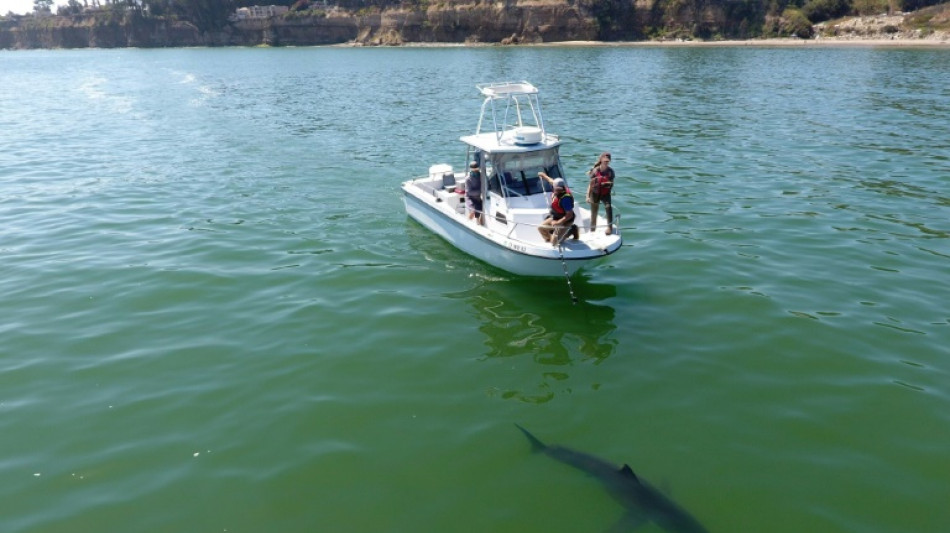
Climate change draws great white sharks north, threatening ecosystem / Photo: © UGC/AFP

 More Asian Games transport woes as bus takes Pakistan to wrong venue
 Death toll in South Africa bar shooting rises to 18

 Aide to Venezuelan opposition leader returns from exile

 Messi and Alcaraz love it, now padel takes step closer to Olympics

 Tolls mount in Thailand, Myanmar floods

 Why India's opposition wants top poll official out

 PU Prime Strengthens UAE Momentum with Strong Showing at Forex Expo Dubai 2026

 Eight dead in Thailand floods since mid-September

 Oil prices spike after Trump rejects Iran truce offer

 Taylor Swift sets new record at MTV VMAs
 Seoul seeks apology after Ukraine reveals transfer of North Korean POWs

 Messi on target again but Miami downed by Columbus

 In Washington's political cauldron, a fight over foie gras

 Flavio Bolsonaro: political heir in his father's shadow

 Ravens grab last-second win in Rio as Commanders stop Seahawks

 USA rallies to capture 11th consecutive Presidents Cup

 Phillies clinch, Astros wrap up division on final day of MLB season

 Commanders hand champion Seahawks their first loss

 Dupont scores twice to send Toulouse top of Top 14

 Ireland beat Israel but no handshakes due to war in Gaza

 Tense standoff over flashpoint N.Ireland parade lasts into night

 Stunned McNulty wins 'miracle' road race world title

 Re-released 'Avengers: Endgame' snaps-up N. America box office lead

 American McNulty wins shock road race world title

 Serbia's President Aleksandar Vucic announces resignation

There never used to be young great white sharks basking off the busy beaches of central California, but as climate change starts to bite, warmer waters are enticing them north -- with possibly catastrophic consequences for a whole ecosystem.
Despite their fearsome reputation, brought about in part by the "Jaws" movie franchise, the main risk from these predators is not to swimmers and surfers -- or even the local police chief -- but to otters.
"What we've been finding is that over time the number of bites on sea otters has increased in this region drastically," says marine ecologist Salvador Jorgensen of California State University Monterey Bay.
"That's having a real impact on the sea otter population."
And -- in an illustation of how interconnected ecosystems are -- that could have far-reaching consequences for all kinds of species in this wildlife-rich area.
- Warm water -
Great white sharks are some of the most majestic, most studied, and most feared of ocean dwellers.
Growing to around 16 feet (4.9 meters), they roam the world's seas thousands of feet deep to satisfy a voracious appetite for seals, sea lions and dolphins.
They live for upwards of 70 years and give birth to litters of live pups, who are left to fend for themselves from an early age.
But because white sharks are endotherms -- warm-bodied, like mammals -- youngsters are vulnerable to the cold of the ocean depths, and spend their time in warmer pockets of water in coastal regions.
Until a decade or so ago, that meant juveniles would only be found as far north as southern California.
But, says Jorgensen, that's changing.
"We documented the sudden occurrence of much smaller sharks than had ever been seen here before," he told AFP in Monterey Bay, hundreds of miles (kilometers) north, where he attaches acoustic transmitters to individuals that allow him to track their travels.
"As ocean temperatures have been warming through a series of El Ninos, and heat waves, many species have been shifting their range further north further towards what were historically cooler areas."
That's what brings them into contact with sea otters, who hang around in the rich kelp forests offshore.
- Sea urchins -
"Smaller sharks are transitioning from eating fish and squid to a point where they're going to start eating marine mammals," says Jorgensen
"To an inexperienced shark, an otter may seem like the right target, but it turns out that otters don't have a rich blubber layer, (so) once they're bitten, they're actually not consumed. But often those interactions are fatal for the otter."
Aside from this being bad news for the individual, it's terrible news for the otter population -- setting off a cascade effect.
Otters forage for sea urchins, a species that left unchecked will graze a kelp forest into a barren desert, killing a vital marine habitat that provides food and shelter for a suite of invertebrates, fish, mammals and birds.
Without the otters, the kelp dies; without the kelp, scores of ocean species struggle.
- Climate change -
For Eric Mailander, an amateur scientist and boat skipper who helps Jorgensen tag great whites, the presence of young sharks in Monterey Bay offers a chance to see a truly impressive creature up close.
"The excitement is always there," he said.
"It's like the first time I saw a shark, it never goes away. If I go out and see a shark, I'm excited."
While the very visible presence of these enormous creatures so close to the shore can raise concerns among humans, Mailander says people don't need to be too worried -- despite the creature's reputation.
"'Jaws' scared the bejesus out of me. But I want people to know not to fear them. Just go look at them."
For Jorgensen it's a vivid illustration of just how rapidly we are altering our planet, with the unchecked burning of fossil fuels.
"I've always thought that this is a very tangible way that people can understand climate change," says Jorgensen.
"People who live on that beach, bring their children there, never had a bunch of sharks swimming 20 feet away, and now it's a regular sight.
"You can't look out at the ocean and think that climate change is not happening."
N.Fournier--BTB



