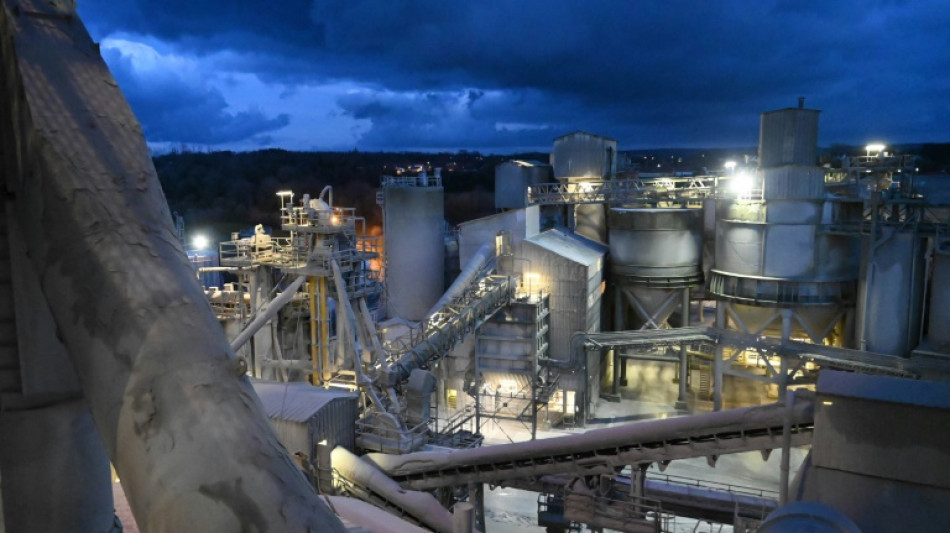
Heavy industry turns to carbon capture to clean up its act / Photo: © AFP

 More Asian Games transport woes as bus takes Pakistan to wrong venue
 Death toll in South Africa bar shooting rises to 18
 Aide to Venezuelan opposition leader returns from exile

 Messi and Alcaraz love it, now padel takes step closer to Olympics
 Tolls mount in Thailand, Myanmar floods

 Why India's opposition wants top poll official out

 PU Prime Strengthens UAE Momentum with Strong Showing at Forex Expo Dubai 2026
 Eight dead in Thailand floods since mid-September

 Oil prices spike after Trump rejects Iran truce offer

 Taylor Swift sets new record at MTV VMAs
 Seoul seeks apology after Ukraine reveals transfer of North Korean POWs
 Messi on target again but Miami downed by Columbus

 In Washington's political cauldron, a fight over foie gras

 Flavio Bolsonaro: political heir in his father's shadow
 Ravens grab last-second win in Rio as Commanders stop Seahawks

 USA rallies to capture 11th consecutive Presidents Cup
 Phillies clinch, Astros wrap up division on final day of MLB season

 Commanders hand champion Seahawks their first loss

 Dupont scores twice to send Toulouse top of Top 14

 Ireland beat Israel but no handshakes due to war in Gaza

 Tense standoff over flashpoint N.Ireland parade lasts into night

 Stunned McNulty wins 'miracle' road race world title

 Re-released 'Avengers: Endgame' snaps-up N. America box office lead

 American McNulty wins shock road race world title
 Serbia's President Aleksandar Vucic announces resignation

For decades heavy industry around Dunkirk in northern France has belched out millions of tonnes of climate-heating gases.
Now the area close to the Belgium border -- one of Europe's industrial powerhouses -- wants to catch its pollution before it escapes.
With factories turning out steel, cement and fertilisers, the Dunkirk area produces more carbon dioxide (CO2) than any other industrial region in France.
In Rety, about an hour's drive from the port city, a never-ending stream of lorries brings limestone to a plant run by Belgian giant Lhoist, the world leader in quicklime production.
The limestone is heated to more than 1,000 degrees Celsius (1,830 degrees Fahrenheit) for 24 hours in kilns 50 metres (165 feet) tall to produce the calcium oxide needed by the steel and paper pulp industries.
"We have the capacity to produce 700,000 tonnes of quicklime a year, so we emit about an equivalent amount of CO2," said Yves Boraccino, the manager of the plant in Rety, where nearly every surface is coated in white dust from a nearby quarry.
- Freezing the CO2 -
Two-thirds of that CO2 is belched out of the plant's chimneys during the limestone calcination process.
The remainder comes from the fossil fuels used to fire up the kilns.
In 2025, the site hopes to start equipping itself with a new mini-factory to capture the CO2.
Carbon capture and storage will be pushed hard by industry at the UN COP28 climate talks in November as a way to slow the rise in the planet's average temperature to around 1.5 degrees Celsius.
But there are still big questions over technologies that are in their infancy, and the world does not have much time.
The International Energy Agency (IEA) says that even if it works, carbon capture would have to be scaled up 100,000-fold by 2050 to hit net-zero targets.
Lhoist has turned to industrial gas giant Air Liquide for help to capture carbon emissions from its Rety plant.
They have developed a technology called CryoCap which will capture the gases and cool them down to -50C (-58F) when CO2 turns to liquid, said Nicolas Droin of Air Liquide.
The CO2 will then be separated off and piped to a terminal in Dunkirk that will hold 1.5 million tonnes of the gas when it opens in 2028.
- 'Industrial revolution' -
The Lhoist site in Rety is not the only one in the area aiming to clean up its act.
A few kilometres away, a cement plant owned by Eqiom is also planning to sequester its carbon pollution and send it to Dunkirk.
"From there, it could be taken by ship to deep geological storage sites in the North Sea," Boraccino said.
The whole project -- estimated to cost 530 million euros ($560 million), much of it with European Union funds -- could, in the medium term, store up to four million tonnes of CO2 per year, according to Air Liquide and its partner, Dunkerque LNG.
That would enable steel giant ArcelorMittal, which is testing a different carbon capture procedure, to connect up to the terminal at some point in the future.
Patrice Vergriete, head of the urban Dunkirk authority, said the region is transforming itself through this low-carbon "industrial revolution".
Carbon capture projects almost tripled globally in 2021 and have almost doubled again since then, according to the IEA.
But in a report in July it also warned against relying on technologies that are "expensive and unproven at scale". So far, it said, only five percent of capture projects have got the green light from investors.
Instead the IEA insisted that the best solution is to reduce the amount of CO2 being generated in the first place.
L.Janezki--BTB