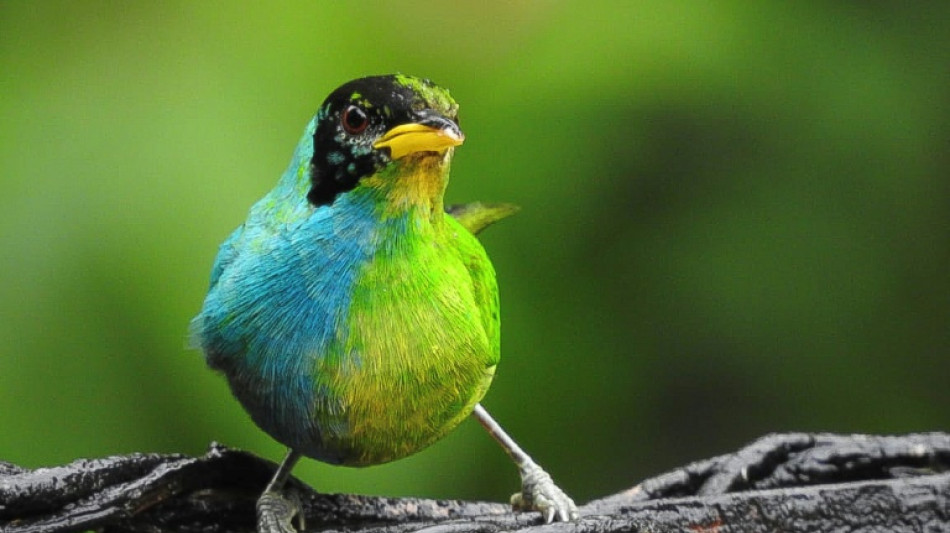
In Colombia, rare bird flaunts male and female feathers / Photo: © John MURILLO/AFP

 Trump admin finalizes reversal of US fuel economy standards

 US says no China arms sale plans after envoy cites Trump offer

 Dozens kidnapped in two weekend attacks in northern Nigeria

 Next stop the world: Pathirage wins Asian Games javelin gold

 Aster Launches Perpetual Grid Trading 2.0 with Up to 140,000 $ASTER Liquidity Mining Campaign

 Seoul says North Korean mines 'highly suspected' as cause of DMZ blast

 Russia pummels Kyiv in latest deadly daytime attack

 Wartime Ukraine works to keep its railways on track

 Boy among 3 dead in migrant Channel crossing accident: French authorities

 SGFX Creates a Standout Brand Experience at Forex Expo Dubai 2026

 Pope urges Europe to help combat 'deceit and lies' in international ties

 Injured Buttler to miss England ODI series in Pakistan

 Madrid housing protesters vow to maintain pressure on government

 In kayaks or waist-deep in floodwater, shoppers return to Bangkok markets

 UK police probes Iran link to air base bomb scare: media

 Eala blasts into Asian Games quarters in just 55 minutes

 Taiwan gender-row boxer Lin Yu-ting guarantees Asian Games medal

 Comedian on trial for allegedly insulting Erdogan in standup show

 More Asian Games transport woes as bus takes Pakistan to wrong venue

 Death toll in South Africa bar shooting rises to 18

 Aide to Venezuelan opposition leader returns from exile

 Messi and Alcaraz love it, now padel takes step closer to Olympics

 Tolls mount in Thailand, Myanmar floods

 Why India's opposition wants top poll official out

 PU Prime Strengthens UAE Momentum with Strong Showing at Forex Expo Dubai 2026

On the right side of its body, the bird flaunted the typical blue plumage and black head of the male Green Honeycreeper. On the left, it was a beautiful grass green.
According to experts, the specimen spotted in Colombia was a rare example of "bilateral gynandromorphy" -- a condition in which one side of an animal exhibits male characteristics and the other female.
Amateur photographer John Murillo said he first spotted the unique bird through his camera lens when it landed on a feeder to enjoy a meal of bananas and grapes at a nature reserve in Villamaria in Colombia's west in late 2019.
It was then observed by Murillo and experts for more than a year, but never captured.
In an article published last month in the Journal of Field Ornithology, Murillo and a group of bird scientists report the first recorded observation of gynandromorphy in a living Green Honeycreeper (Chlorophanes spiza.)
"In birds, the phenomenon is thought to arise as a result of an error during egg meiosis (a type of cell division), with subsequent double fertilization by separate sperm," they wrote.
Whether the internal organs of the bird were also gynandromporphic and whether it was fertile, was "impossible to tell," the team added.
Green Honeycreepers are small birds found in the tropics from southern Mexico to Brazil.
Murillo, 56, told AFP he felt very fortunate to have observed something "very different from anything we have seen."
He also recounted the bird's "strange" behavior: "it was always alone" at the feeder.
Murillo said the bird seemed more comfortable with humans than with individuals of its kind.
"It is unique in the world, and so it will die," he said.
F.Pavlenko--BTB


