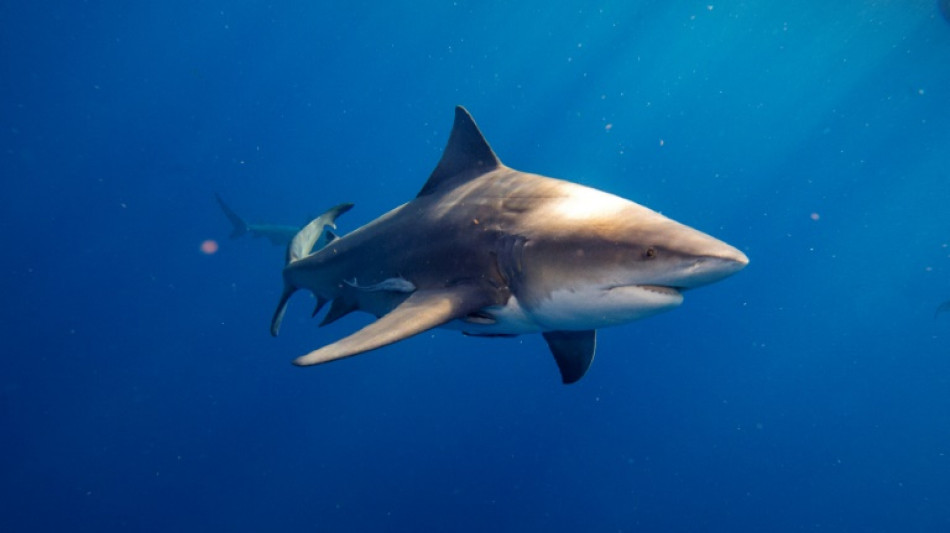
Sharks killed at alarming rates despite regulations: study / Photo: © AFP/File

 Trump admin finalizes reversal of US fuel economy standards

 US says no China arms sale plans after envoy cites Trump offer

 Dozens kidnapped in two weekend attacks in northern Nigeria

 Next stop the world: Pathirage wins Asian Games javelin gold

 Aster Launches Perpetual Grid Trading 2.0 with Up to 140,000 $ASTER Liquidity Mining Campaign

 Seoul says North Korean mines 'highly suspected' as cause of DMZ blast

 Russia pummels Kyiv in latest deadly daytime attack

 Wartime Ukraine works to keep its railways on track

 Boy among 3 dead in migrant Channel crossing accident: French authorities

 SGFX Creates a Standout Brand Experience at Forex Expo Dubai 2026

 Pope urges Europe to help combat 'deceit and lies' in international ties

 Injured Buttler to miss England ODI series in Pakistan
 Madrid housing protesters vow to maintain pressure on government

 In kayaks or waist-deep in floodwater, shoppers return to Bangkok markets

 UK police probes Iran link to air base bomb scare: media

 Eala blasts into Asian Games quarters in just 55 minutes

 Taiwan gender-row boxer Lin Yu-ting guarantees Asian Games medal

 Comedian on trial for allegedly insulting Erdogan in standup show

 More Asian Games transport woes as bus takes Pakistan to wrong venue

 Death toll in South Africa bar shooting rises to 18

 Aide to Venezuelan opposition leader returns from exile

 Messi and Alcaraz love it, now padel takes step closer to Olympics

 Tolls mount in Thailand, Myanmar floods

 Why India's opposition wants top poll official out

 PU Prime Strengthens UAE Momentum with Strong Showing at Forex Expo Dubai 2026

Global shark populations are plummeting despite worldwide efforts to curb mass killings for their fins, researchers said in a new report showing that more needs to be done to protect one of the ocean's apex species.
Between 2012 and 2019, the number of sharks killed from fishing increased from some 76 million a year to more than 80 million, they reported in the journal Science.
At least 25 million were threatened species.
Sharks have prowled Earth's waters for 400 million years, but a growing appetite for their fins -- a valuable commodity in Asian markets -- has driven several species to the brink of extinction.
Today, 70 percent of countries and jurisdictions have implemented protective regulations to eliminate shark finning, where the top predators are tossed back into the ocean and left to die once fins are removed.
But some of these rules -- which first emerged in the 1990s -- have had unintended consequences that are costing even more sharks their lives, new data revealed.
Finning has marginally declined over the past two decades, but policies requiring fishers to land whole sharks inadvertently incentivised a market for shark meat.
"Anti-finning measures were not the silver bullet we hoped for," study author Laurenne Schiller told AFP.
Researchers spent three years collecting data on fishery regulations and shark mortality.
They were surprised to learn "how widespread the trade with shark meat, oil and cartilage is, and how sharks are showing up in a lot of products without consumers being aware," said lead author Boris Worm.
- Blood in the water -
Fisheries are now catching smaller sharks, including juveniles, more often, because of the decline in the fin trade and regional declines in the abundance of large sharks.
In hotspots where shark mortality is greatest, researchers found a higher use of gillnets -- walls of netting that hang in the water -- and trawls, which is heavy netting dragged along the ocean floor.
Despite being highly evolved ocean predators, sharks are incredibly vulnerable, Schiller said.
"Sharks have spent over 99% of their time on Earth in an ocean without humans, so in many ways, they were not prepared for us and the impacts of fishing."
As a keystone species, sharks are crucial for keeping oceans healthy.
"When we lose these species, it can throw off the balance of the marine ecosystem", she said.
Today, one in three shark species around the world is threatened with extinction.
On a more positive note, Worm emphasised that many nations and territories have already implemented shark fishing prohibitions and sanctuaries to safeguard one of the world's oldest species.
Implementing shark sanctuaries and no-take protected areas seem to keep shark mortality levels low, according to the study.
Still, the current risks for coastal sharks appear to be escalating globally, a conclusion supported by the International Union for the Conservation of Nature (IUCN).
"We need to take a more targeted approach to reducing shark mortality," Schiller said.
J.Horn--BTB


