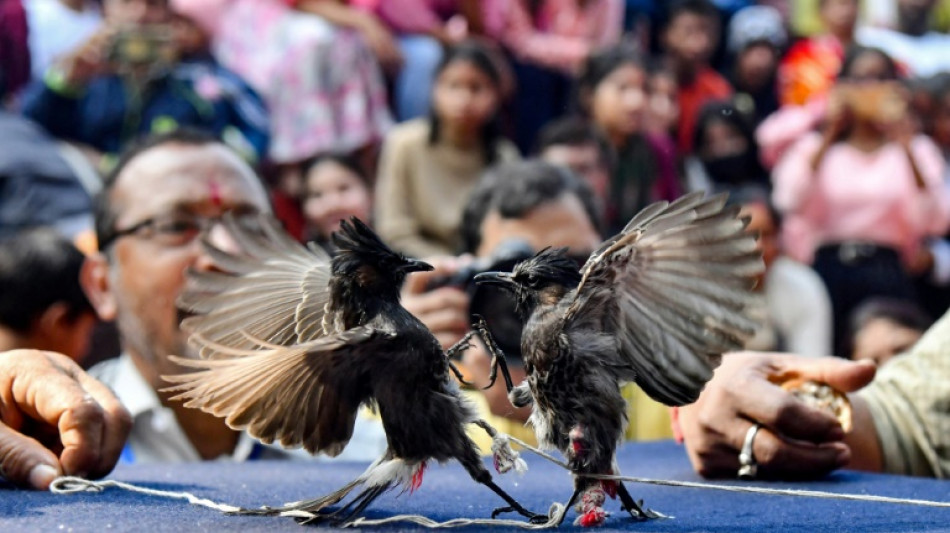
Indian songbird fights return after cruelty ban overturned / Photo: © AFP

 Trump admin finalizes reversal of US fuel economy standards

 US says no China arms sale plans after envoy cites Trump offer

 Dozens kidnapped in two weekend attacks in northern Nigeria

 Next stop the world: Pathirage wins Asian Games javelin gold

 Aster Launches Perpetual Grid Trading 2.0 with Up to 140,000 $ASTER Liquidity Mining Campaign

 Seoul says North Korean mines 'highly suspected' as cause of DMZ blast

 Russia pummels Kyiv in latest deadly daytime attack

 Wartime Ukraine works to keep its railways on track

 Boy among 3 dead in migrant Channel crossing accident: French authorities

 SGFX Creates a Standout Brand Experience at Forex Expo Dubai 2026

 Pope urges Europe to help combat 'deceit and lies' in international ties

 Injured Buttler to miss England ODI series in Pakistan

 Madrid housing protesters vow to maintain pressure on government

 In kayaks or waist-deep in floodwater, shoppers return to Bangkok markets

 UK police probes Iran link to air base bomb scare: media

 Eala blasts into Asian Games quarters in just 55 minutes

 Taiwan gender-row boxer Lin Yu-ting guarantees Asian Games medal

 Comedian on trial for allegedly insulting Erdogan in standup show

 More Asian Games transport woes as bus takes Pakistan to wrong venue

 Death toll in South Africa bar shooting rises to 18

 Aide to Venezuelan opposition leader returns from exile

 Messi and Alcaraz love it, now padel takes step closer to Olympics

 Tolls mount in Thailand, Myanmar floods

 Why India's opposition wants top poll official out

 PU Prime Strengthens UAE Momentum with Strong Showing at Forex Expo Dubai 2026

Squawking and screeching, tiny songbirds flutter around a fighting ring in a centuries-old Indian tradition decried by some as cruel but returning after an eight-year ban was overturned.
The red-vented bulbuls are cheered on by a packed crowd, with chanting spectators encouraging them to peck each other with their hooked beaks to win their freedom.
Bird fights at the Haigriva Madhav temple in Hajo in northeast India's Assam state returned on Monday, after a ban was scrapped because Hindu priests argued it was part of their tradition.
"We have seen the birds fight since our childhood... the ritual of bird fight is very close to the people," said Kichin Das, one of three judges who decides the winner based on the moves of the birds.
Supporters say the battles began after an 18th-century king saw two birds fighting, and it became a popular pastime to mark the harvest festival in January.
"This is a game from the era of kings," said bird fighter Biswajit Biswasi, 49. "Since childhood, I have learned how to catch these birds and how to train them."
- 'Faith and tradition' -
Traditionally, captured wild birds were goaded to fight through hunger before being fed an intoxicating spice mix -- reportedly including cannabis, pepper, cinnamon and cloves.
"It's a short game," said Babul Mazumdar, who has captured birds to fight for 30 years.
"Whichever bird overpowers the other in, say three to four moves, is declared the winner."
In the past, losing birds had their fine head crest clipped to stop them from being entered into another fight. New rules mean the birds are now just inked on their tail feathers.
"This game is related to our faith and tradition," said Satya Nath Bharali, 85, one of the thousands of spectators who came to watch around 100 birds fight on Monday. "This has been happening for hundreds of years."
The fights have a loyal local following, but activists condemn the practice -- which is like cockfighting but with songbirds netted from the wild -- as cruel.
After a 2014 Supreme Court order banned popular bull-taming festivals long blighted by allegations of animal cruelty, activists sought to also restrict bird fights.
A year later, Assam's High Court ordered the bulbul fights to stop, sparking protests.
- 'Inhumane and barbaric' -
In India's Tamil Nadu state, the ban on bull-wrestling was lifted in 2017 after massive protests.
Last year, the Assam state government said the songbird fights could resume -- as long as organisers observe strict guidelines.
Fights must be "conducted in a disciplined manner", with the birds well fed and watered.
Once the fight is over, organisers must ensure the birds are "released in the open air in perfect condition", the government ordered.
"We are happy that the government allowed the bird fight to take place this year," said Pradyumna Bhagawati, one of the thousands of spectators who came to watch.
But Tushar Kol, from the People for the Ethical Treatment of Animals (PETA), condemned the return of the fights.
"Inciting an animal to fight another animal is outdated, inhumane and barbaric and such events have no place in a modern civilized society," Kol wrote in a letter to the Assam authorities, pleading for the fights to be stopped.
"Confining them and forcing them to fight denies them their natural behaviour, causing immense stress and suffering," Kol added.
India has about two dozen bulbul species, some with eye-catching yellow and red colours.
While many species are common, some are listed as "vulnerable" and "near threatened" by the International Union for the Conservation of Nature.
O.Lorenz--BTB


