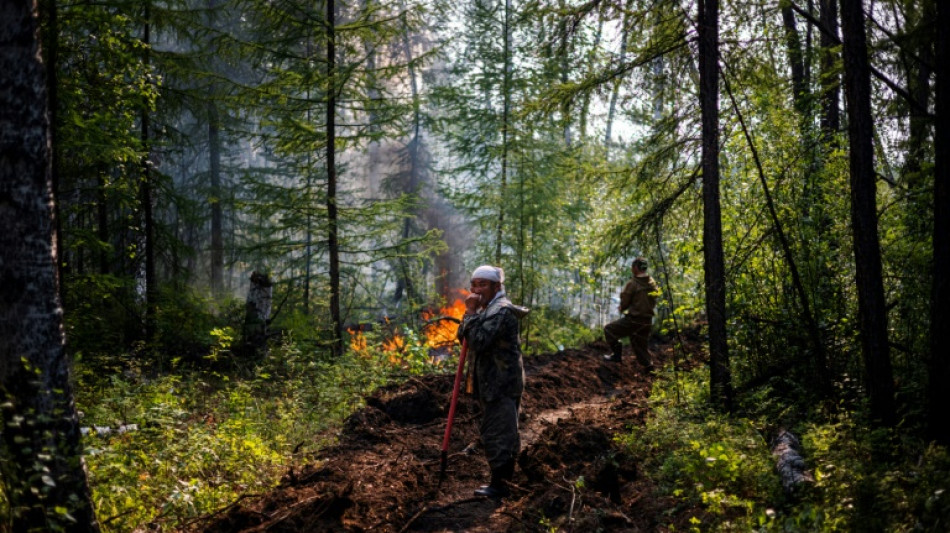
Scientists warn missing Russian data causing Arctic climate blind spots / Photo: © AFP/File

 Trump admin finalizes reversal of US fuel economy standards
 US says no China arms sale plans after envoy cites Trump offer
 Dozens kidnapped in two weekend attacks in northern Nigeria
 Next stop the world: Pathirage wins Asian Games javelin gold

 Aster Launches Perpetual Grid Trading 2.0 with Up to 140,000 $ASTER Liquidity Mining Campaign
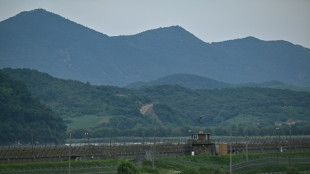 Seoul says North Korean mines 'highly suspected' as cause of DMZ blast
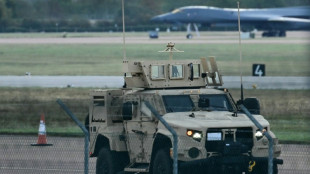
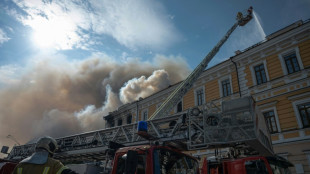 Russia pummels Kyiv in latest deadly daytime attack

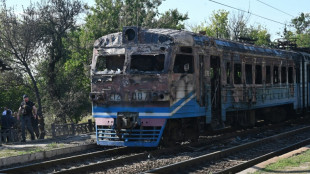 Wartime Ukraine works to keep its railways on track

 Boy among 3 dead in migrant Channel crossing accident: French authorities
 SGFX Creates a Standout Brand Experience at Forex Expo Dubai 2026
 Pope urges Europe to help combat 'deceit and lies' in international ties

 Injured Buttler to miss England ODI series in Pakistan
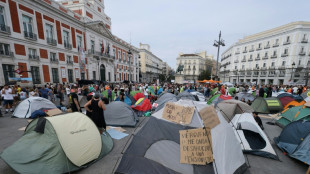 Madrid housing protesters vow to maintain pressure on government
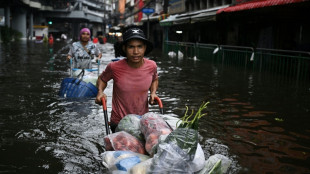 In kayaks or waist-deep in floodwater, shoppers return to Bangkok markets

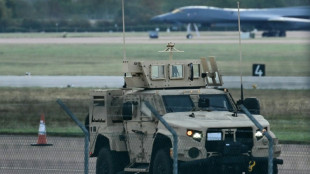 UK police probes Iran link to air base bomb scare: media
 Eala blasts into Asian Games quarters in just 55 minutes
 Taiwan gender-row boxer Lin Yu-ting guarantees Asian Games medal
 Comedian on trial for allegedly insulting Erdogan in standup show

 More Asian Games transport woes as bus takes Pakistan to wrong venue
 Death toll in South Africa bar shooting rises to 18
 Aide to Venezuelan opposition leader returns from exile

 Messi and Alcaraz love it, now padel takes step closer to Olympics

 Tolls mount in Thailand, Myanmar floods

 Why India's opposition wants top poll official out

 PU Prime Strengthens UAE Momentum with Strong Showing at Forex Expo Dubai 2026

Loss of scientific data from Russia's Arctic monitoring stations following the invasion of Ukraine has worsened information gaps that could have serious implications for tracking and predicting climate change globally, researchers warned Monday.
The Arctic is warming between two and four times faster than the rest of the planet and holds glaciers, forests and carbon-rich frozen soils at risk of irreversible change that could reverberate across the planet.
Monitoring relies heavily on data from stations spread across the vast and diverse region, but Moscow's assault on Ukraine in February 2022 triggered a freeze in scientific cooperation in the Arctic -- and elsewhere.
Russia represents almost half the landmass of the entire Arctic region, creating a massive information gap, said lead author Efren Lopez-Blanco, of Aarhus University, who led the study published in Nature Climate Change.
Researchers sought to quantify just how much of an impact this has had on scientific understanding of the changes taking place in the Arctic.
"One of the immediate issues that arises if we neglect the Russian boreal forest is that we have an underestimation of biomass, soil organic carbon," Lopez-Blanco told AFP.
"This has potentially global consequences for important processes such as permafrost thawing, shifts in biodiversity, or even greenhouse gas emissions."
- Sharing problems -
The researchers focused on around 60 research stations making up part of a large territorial network called INTERACT.
Using computer models, they looked at eight factors -- including air temperature, rainfall, snow depth, vegetation biomass and soil carbon -- and found that even before the conflict in Ukraine the network had gaps, with stations concentrated in warmer, wetter areas, leaving other areas under-represented.
Without Russia, which accounts for 17 of the 60 stations, this bias increased, with the loss of areas such as Siberia's huge taiga forest.
The research highlights the logistical challenges of monitoring such a vast and often inhospitable region, as well as inherent problems with voluntary data sharing.
As a result, projects have been delayed or cancelled, while the regional Arctic Council forum -- long held up as a model of cooperation -- is now divided between the West (Canada, Denmark, Finland, Iceland, Norway, Sweden and the United States) and Russia.
Dmitry Streletskiy, a researcher at George Washington University, who was not involved in the paper and whose work on permafrost uses another monitoring group, CALM, said of nearly 80 Russian sites registered in their network, around 55 normally share data every year.
But so far, only 37 have provided 2023 data, he said, although some may send information later.
One solution, he said, would be to treat key climate metrics the same way weather data is, and have a United Nations system to ensure continuous monitoring.
Streletskiy said data is being collected but not shared, potentially leading to gaps in global understanding.
"It's like these big communal apartments. You have a lot of rooms, and some neighbours are nice, some are not," he said.
"But if you aren't aware that your neighbour has a room with a leaking roof, you will only find out when the entire house is flooded. That's pretty much what's happening."
A.Gasser--BTB


