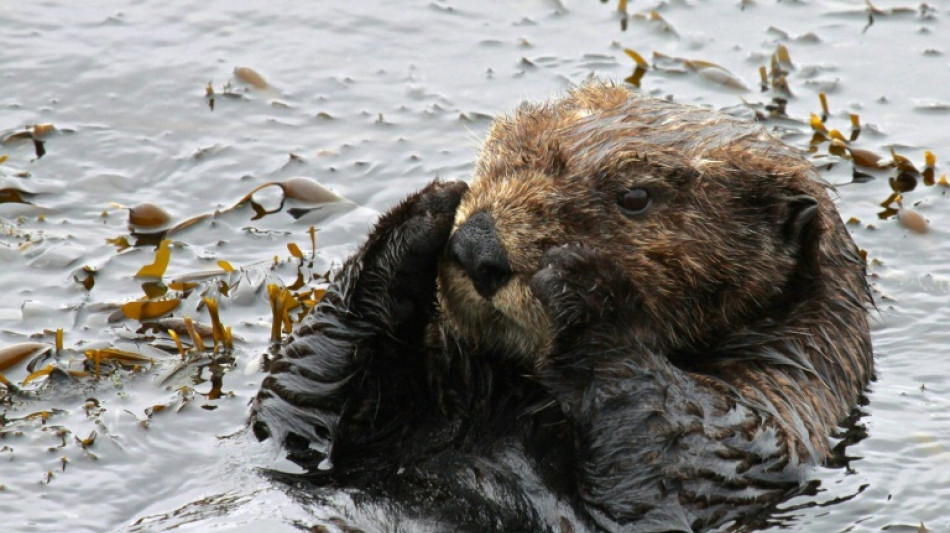
Return of hungry sea otters protects key coastal ecosystem: study / Photo: © US Fish and Wildlife Services/AFP/File

 Rose, Scott among 2027 World Golf Hall of Fame finalists

 Brunson says NBA champion Knicks can't get satisfaction

 France puts out largest wildfire since 1949

 Real Madrid's Perez summoned over Barcelona referee payments comments

 Oil takes off again, Wall Street dips after Trump rejects Iran truce offer

 AlgoQuant Asset Management Selects Liquid Mercury to Enhance Digital Asset Trading Infrastructure

 UK to reopen refugee resettlement scheme to push 'safe' migration

 Pope urges Europe to help combat 'lies and deceit' in world affairs

 Iranian lawyer Nasrin Sotoudeh wins Council of Europe's rights prize

 French far-right's Bardella denies alleged 2013 antisemitic comments

 Oil up, Wall Street dips after Trump rejects Iran truce offer

 Gakpo withdraws from Netherlands squad

 SpaceX puts Starship megarocket in orbit for first time

 Iran denies link to suspected bomb plot at UK airbase used by US

 Ex-boss Mancini says City charges 'not my concern'

 Berlin Marathon winner Assefa finished race with torn Achilles

 Comedian convicted for Erdogan 'insult' but freed pending appeal

 French prosecutors seek two-year sentence for ex-minister Dati in graft case

 Eala makes fast start as weather and transport woes hit Asian Games

 Hurricane Polo approaches Mexico, threatens severe damage

 Energy markets rally after Trump rejects Iran truce offer

 Japanese convenience store enlists Lady Gaga to bolster recruitment

 Seoul summons Ukraine envoy in row over North Korean POWs

 Ireland 'raised awareness worldwide' in Israel game: Hallgrimsson

 Colombian police capture wife, daughter of Ecuador drug lord

Back from the brink of extinction, sea otters in central California have started restoring the degraded landscape of a key estuary -- thanks to their insatiable appetite for crabs, according to a study published on Wednesday.
The research depicts the ripple effects of the sea otters' return to Monterey Bay, California, highlighting how successful conservation efforts can improve the health and resilience of whole ecosystems.
Once hunted for their fur to the verge of local extinction, sea otters have made a dramatic recovery in central California after more than four decades of extensive conservation efforts in the region.
The otters have returned to coastal kelp forests and the the salt marsh-dominated coastal estuary, Elkhorn Slough.
And their return has heralded wide-ranging improvements around the estuary, a critical habitat that protects the shoreline.
In a new paper published in Nature, scientists in the United States and Canada found that the marine mammal slowed the erosion of parts of the estuary by up to 90 percent between the time they recolonised the area in the mid 1980s and 2018.
"One of the most remarkable things about this is that it's truly a conservation success story," study author Christine Angelini, director of the Center for Coastal Solutions at the University of Florida, told AFP.
Previous studies on salt marshes have shown the physical and chemical explanations for erosion.
But this study points a pincer at another culprit -- the shore crab.
These abundant crabs eat plant roots, burrow into the salt marsh soils and eventually can cause erosion and even collapse.
Sea otters eat around 25 percent of their body weight every day and researchers said they have an especially large appetite for these crabs.
"After a few decades, in areas the sea otters had recolonised, salt marshes and creekbanks were becoming more stable again, said lead author Brent Hughes, associate professor of biology at Sonoma State University, in a statement.
This was "despite rising sea levels, increased water flow from inland sources, and greater pollution".
- 'Crab feast' -
Researchers combined decades of data, over 35,000 observations of sea otters and three years of experiments manipulating the presence of top predators in a salt marsh ecosystem.
Top predators have declined in nearly every ecosystem on Earth, but conservation efforts over the past decades have helped recover species like wolves, brown bears, and eagles.
And growing research shows that reintroduction can have a wide-ranging impact on restoring ecosystems.
In this case researchers said sea otter conservation has unlocked several decades worth of benefits.
"It would cost tens of millions of dollars for humans to rebuild these creek banks and restore these marshes," said study author Brian Silliman, professor of Marine Conservation Biology at Duke University.
"The sea otters are stabilising them for free in exchange for an all-you-can-eat crab feast."
G.Schulte--BTB


