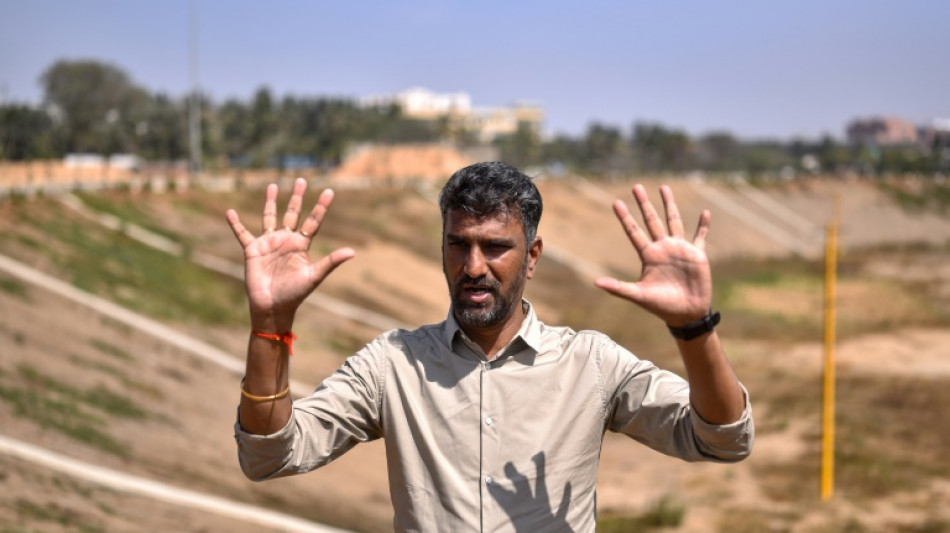
India's 'lake man' cleans up critical water supplies / Photo: © AFP

 Rose, Scott among 2027 World Golf Hall of Fame finalists

 Brunson says NBA champion Knicks can't get satisfaction

 France puts out largest wildfire since 1949

 Real Madrid's Perez summoned over Barcelona referee payments comments

 Oil takes off again, Wall Street dips after Trump rejects Iran truce offer

 AlgoQuant Asset Management Selects Liquid Mercury to Enhance Digital Asset Trading Infrastructure

 UK to reopen refugee resettlement scheme to push 'safe' migration

 Pope urges Europe to help combat 'lies and deceit' in world affairs

 Iranian lawyer Nasrin Sotoudeh wins Council of Europe's rights prize

 French far-right's Bardella denies alleged 2013 antisemitic comments

 Oil up, Wall Street dips after Trump rejects Iran truce offer

 Gakpo withdraws from Netherlands squad

 SpaceX puts Starship megarocket in orbit for first time
 Iran denies link to suspected bomb plot at UK airbase used by US

 Ex-boss Mancini says City charges 'not my concern'

 Berlin Marathon winner Assefa finished race with torn Achilles

 Comedian convicted for Erdogan 'insult' but freed pending appeal

 French prosecutors seek two-year sentence for ex-minister Dati in graft case

 Eala makes fast start as weather and transport woes hit Asian Games

 Hurricane Polo approaches Mexico, threatens severe damage

 Energy markets rally after Trump rejects Iran truce offer
 Japanese convenience store enlists Lady Gaga to bolster recruitment

 Seoul summons Ukraine envoy in row over North Korean POWs

 Ireland 'raised awareness worldwide' in Israel game: Hallgrimsson

 Colombian police capture wife, daughter of Ecuador drug lord

Ancient lake systems once provided Bengaluru with critical water supplies, but the Indian tech hub's breakneck expansion left many waterways covered over or used as dumps.
In the rush to modernise, the city once known for its abundance of water largely forgot the centuries-old reservoirs it depended upon to survive, with the number of lakes shrinking by more than three-quarters.
But after experts warned the city of nearly 12 million -- today dubbed "India's Silicon Valley" -- would not be able to meet its water needs with existing resources, mechanical engineer Anand Malligavad decided to take action.
"Lakes are lungs of the earth," said the 43-year-old, known to some as the "lake man" for his campaign to bring scores of them back to life.
"I tell people if you have money, better to spend it on lakes. Decades later, it will serve you."
Water shortages are a chronic problem in India, which has nearly a fifth of the world's population but only four percent of its water resources, according to government think tank NITI Aayog.
Malligavad's first target was a trash-filled and dried-out site he passed on his way to work at an automotive components maker.
"I thought instead of inspiring people... let me start doing it," Malligavad said. "Let it start with me."
- 'Simple cost' -
He began by studying the skills used during the centuries-long rule of the medieval Chola dynasty, who turned low-lying areas into shallow reservoirs that provided water for drinking and irrigation.
The lakes stored the heavy monsoon rains and helped to replenish groundwater.
But of the 1,850 that once dotted the city, fewer than 450 remain today.
Many were destroyed to make room for high-rise towers, while canals were filled in with concrete -- meaning heavy rainfall now sparks flooding and is not stored for the future.
Nearly half of Bengaluru depends on water sucked from intensive groundwater boreholes that often run dry in the summer heat, according to the city's Water, Environment, Land and Livelihoods (WELL) Labs research centre.
Many residents already rely on expensive water trucked in from afar, and the problem is likely to get worse as climate change pushes global temperatures higher and alters weather patterns.
"We're dependent on a precarious groundwater table, and that is going to get even more precarious as you have a more unreliable rainfall," said WELL Labs chief Veena Srinivasan.
"We already don't have enough water to drink," she added, noting that "the water sources that we do have, we are polluting".
Fixing lakes can ease the problem, though the city still needs a large-scale urban water management plan, she said.
Malligavad, trekking out to visit more than 180 ancient lakes, said he saw the "simple cost" they had taken to construct.
They did not use expensive materials but only "soil, water, botanicals (plants) and canals", he said.
He persuaded his company to stump up around $120,000 to fund his first project, the restoration of the 14-hectare (36-acre) Kyalasanahalli lake.
Using excavators, Malligavad and his workers took around 45 days to clear the site back in 2017.
When the monsoon rains came months later, he went boating in the cool and clean waters.
- Natural process -
The restoration process is simple, Malligavad said.
He first drains the remaining lake water and removes the silt and weeds.
Then he strengthens the dams, restores the surrounding canals and creates lagoons, before replanting the site with native trees and aquatic plants.
After that, he says: "Don't put anything into it. Naturally, rain will come and naturally, an ecosystem will be built."
His initial success eventually led him to work full-time in cleaning lakes, raising cash from company corporate social responsibility funds.
So far, he has restored more than 80 lakes covering over 360 hectares in total, and expanded into nine other Indian states.
The renewed reservoirs help supply water to hundreds of thousands of people, according to Malligavad.
Bengaluru resident Mohammed Masood, 34, often fills giant drums of water from one such lake.
He said he typically uses a water tanker, but supplies can be uncertain and expensive.
"If the lake was not built, the hardship would not go away," Masood said. "We would have to go further away for water."
Malligavad said his work has carried some risk -- he has been threatened by land grabbers and real estate moguls, and was beaten by a gang wanting him to stop.
But the sight of people enjoying a restored lake gave him his "biggest happiness", he told AFP.
"Kids are swimming and enjoying it", he said, beside a restored lake.
"More than this, what do you want?"
J.Fankhauser--BTB


