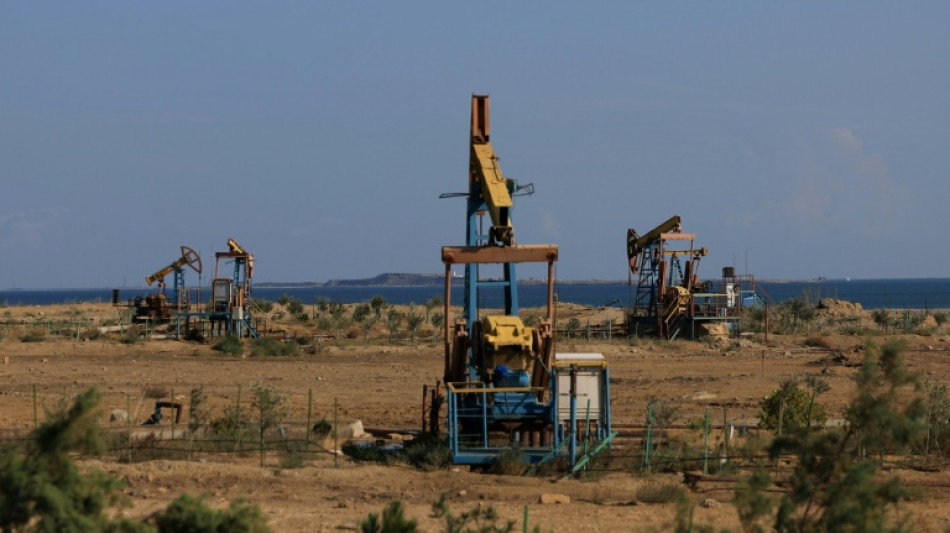
Gas booming for UN COP29 host Azerbaijan / Photo: © AFP

 Rose, Scott among 2027 World Golf Hall of Fame finalists

 Brunson says NBA champion Knicks can't get satisfaction

 France puts out largest wildfire since 1949
 Real Madrid's Perez summoned over Barcelona referee payments comments
 Oil takes off again, Wall Street dips after Trump rejects Iran truce offer
 AlgoQuant Asset Management Selects Liquid Mercury to Enhance Digital Asset Trading Infrastructure
 UK to reopen refugee resettlement scheme to push 'safe' migration

 Pope urges Europe to help combat 'lies and deceit' in world affairs
 Iranian lawyer Nasrin Sotoudeh wins Council of Europe's rights prize
 French far-right's Bardella denies alleged 2013 antisemitic comments
 Oil up, Wall Street dips after Trump rejects Iran truce offer

 Gakpo withdraws from Netherlands squad

 SpaceX puts Starship megarocket in orbit for first time
 Iran denies link to suspected bomb plot at UK airbase used by US
 Ex-boss Mancini says City charges 'not my concern'
 Berlin Marathon winner Assefa finished race with torn Achilles

 Comedian convicted for Erdogan 'insult' but freed pending appeal

 French prosecutors seek two-year sentence for ex-minister Dati in graft case

 Eala makes fast start as weather and transport woes hit Asian Games

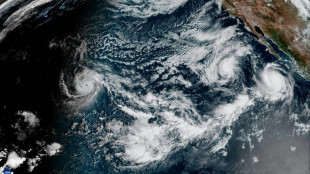 Hurricane Polo approaches Mexico, threatens severe damage

 Energy markets rally after Trump rejects Iran truce offer
 Japanese convenience store enlists Lady Gaga to bolster recruitment

 Seoul summons Ukraine envoy in row over North Korean POWs

 Ireland 'raised awareness worldwide' in Israel game: Hallgrimsson

 Colombian police capture wife, daughter of Ecuador drug lord
Following the UN's COP28 climate talks in oil-fuelled Dubai, the COP29 conference is headed for the historic cradle of oil, Azerbaijan, which is in the midst of a gas boom.
The former Soviet republic of 10 million people brimming with hydrocarbons is on track to increase its gas production by 35 percent in the next 10 years, contrary to efforts to contain global warming.
Despite the last COP in the United Arab Emirates ending with an unprecedented call to "transition" away from fossil fuels, an analysis by the NGO Global Witness based on data from Rystad Energy shows that the upcoming COP29 host aims to hike its gas production from 35 billion cubic metres (bcm) in 2024 to 47 bcm in 2034.
The forecast covers actual production figures, estimates from approved developments, as well as confirmed reserves not yet being exploited. They exclude condensate, a liquid form of gas.
"Azerbaijan is ramping up its gas production when the world urgently needs to kick its fossil fuel habit," Patrick Galey, senior investigator at Global Witness, told AFP.
The country, a member of OPEC+, has a long history with hydrocarbons, which make up half of its economy.
In the 13th century, the explorer Marco Polo wrote of black gold gushing from the ground. But today, it is gas that is surpassing its declining oil fields.
In the 2030s, gas is expected to represent more than half of fossil fuel production in the country, according to Rystad Energy data reported to AFP.
Its exports to Turkey, Europe, Georgia and Iran have already multiplied threefold since 2015.
Baku's expanding gas production is fuelled mainly by the Shah Deniz project, one of the biggest gas fields in the world, discovered in 1999 along the Caspian Sea and operated by BP, while other projects like Umid-Babek and Absheron will increase their output.
The Absheron field, which began production in July, is operated by Jocap, which includes national oil and gas firm Socar, as well as France's TotalEnergies and Adnoc, the national Emirati firm that was cause for controversy at the last COP.
- Replacing Russia -
The UAE, host of COP28, had designated Sultan Al Jaber, the head of Adnoc, to preside over the UN conference, a choice which angered NGOs and certain countries.
The scene is set to be similar in 2024 with COP being presided over by the former Socar executive, Mukhtar Babayev, minister of ecology and natural resources.
The country is a "small player" compared to major oil giants like the United States, Russia and Saudi Arabia, but it plays an important role "for Southern Europeans at least", said Swapnil Babele, an analyst at Rystad Energy.
To replace Russian gas, Europe turned to Azerbaijan, whose share of imports grew from 2 percent in 2021 to 4 percent in 2023, according to Eurostat.
After Azerbaijan's seizure of the Armenian Nagorno-Karabakh enclave, these supplies were criticised by MEPs, who lamented the EU's timid reaction to Azerbaijan's offensive and called for the suspension of negotiations on the gas agreement signed in 2022.
The objective of that agreement was ambitious: double gas exports to 20 bcm by 2027.
The main obstacle to meeting that potential "is their pipelines capacity", according to Babele.
Baku exports its gas through a southern European gas corridor, a network of pipelines that reaches Europe via Georgia and Turkey, including the Trans Adriatic Pipeline (TAP).
Its capacity could be doubled but only with hefty investments that would require "long-term commitments" from European gas operators, according to Rystad.
K.Brown--BTB


